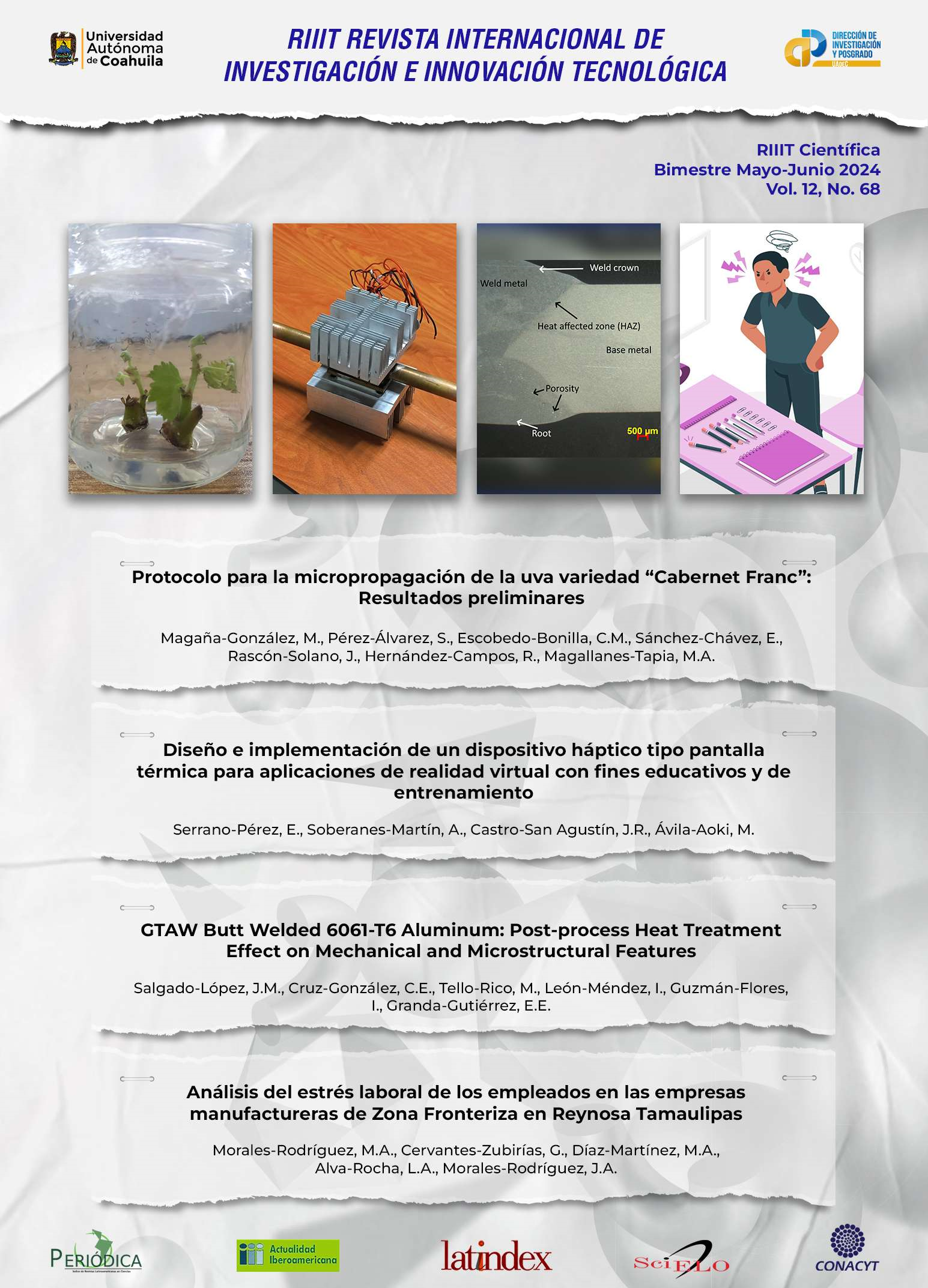
Protocol for the micropropagation of grape variety “Cabernet Franc”: Preliminary results
Keywords:
Disinfection, In vitro multiplication, Plant growth regulators, Vitis vinifera L.Abstract
Micropropagation is a technique that allows producing disease-free plants, in large quantities and in a short time. The aim of this study was to establish the protocol for disinfection and in vitro multiplication of the grape (Vitis vinifera L.) of the Cabernet Franc variety using axillary buds as a source of explant. The buds received the following three disinfection treatments: (T1) Captan and Triadimefon for 10 min and 9% sodium hypochlorite (NaClO) for 10 min, (T2) 75% ethyl alcohol for 5 min and 2% NaClO for 20 min and (T3) 75% ethyl alcohol for 10 min and 2% NaClO for 20 min. Then they were established in Murashige and Skoog (MS) culture medium with four treatments for multiplication: (T1) 6-benzylaminopurine (6BAP) 1.0 mg L-1 + Kinetin 0.5 mg L-1; (T2) Kinetin 3.0 mg L-1 + gibberellic acid (AG3) 1.0 mg L-1; (T3) 6BAP 1.0 mg L-1 + Kinetin 0.5 mg L-1 + indole acetic acid (IAA) 0.2 mg L-1; and (T4) Kinetin 1.5 mg L-1 + naphthalene acetic acid (ANA) 0.5 mg L-1. The disinfection percentage, bud development (multiplication) and multiplication coefficient were evaluated in five subcultures. The best response obtained in the disinfection treatments was with T2 and T3, obtaining 100% of the buds free of pathogens. In the multiplication phase, T4, obtained a vine bud multiplication frequency of 8.57 was obtained and T1 a multiplication coefficient of 3.8. Finally, with this research, a protocol for the disinfection and in vitro multiplication of vine buds of the “Cabernet Franc” variety was established.
References
1. Borja-Bravo, M., García-Salazar, J. A., Reyes-Muro, L. and Arellano-Arciniega, S. (2016). Rentabilidad de los sistemas de producción de uva (Vitis vinífera) para mesa e industria en Aguascalientes, México. Agricultura, Sociedad y Desarrollo, 13(1): 151-168. https://doi.org/10.22231/asyd.v13i1.285
2. SIAP (Servicio de Información Agroalimentaria y Pesquera). (2022). Panorama agroalimentario. https://drive.google.com/file/d/1jVWS4EFKK7HGwQOBpGeljUyaDT8X8Iyz/view (Consultado el 19 de Junio de 2023).
3. SIAP (Servicio de Información Agroalimentaria y Pesquera). (2021). Anuario Estadístico de la Producción Agrícola. https://nube.siap.gob.mx/cierreagricola/ (Consultado el 03 de Mayo de 2023).
4. CMV (Consejo Mexicano Vitivinícola). (2018). Producción del vino en México. https://uvayvino.org.mx/html/docs/produccion_consumo_vino.pdf (Consultado el 15 de Octubre de 2023).
5. CEDRSSA (Centro de Estudios para el Desarrollo Rural Sustentable y la Soberanía Alimentaria). (2017). Investigación interna: La vid en México. Cámara de Diputados, LXIII Legislatura, Ciudad de México, 19p.
6. Gallino, J.P. (2023). Cultivo de tejidos vegetales y sus aplicaciones en el mejoramiento de cultivos. Revista INIA, 75: 89-92.
7. Ramírez‑Mosqueda, M. A., Sánchez‑Segura, L., Hernández‑Valladolid, S. L., Bello-Bello, E. and Bello-Bello, J. J. (2020). Influence of silver nanoparticles on a common contaminant isolated during the establishment of Stevia rebaudiana Bertoni culture. Plant Cell Tissue and Organ Culture, 143: 609‑618. https://doi.org/10.1007/s11240‑020‑01945‑9
8. García, Y.S., González, E. A., Ruíz, O. M., Insausti, M.C.P., Gutiérrez, M.H., Fernandez, E.S. and Pedranzani, H.E. (2023). In vitro micropropagation of Vitis vinifera L. var. Cabernet Franc and callus production. Asian Journal of Agriculture and Allied Sciences, 6(1): 30-38.
9. Osama, S. S. (2022). Micropropagation of grapevine (Vitis vinifera L.) cvs. Red globe and superior. Iraqi Journal of Agricultural Sciences, 53(4):833-849. https://doi.org/10.36103/ijas.v53i4.1596
10. Murashige, T. and Skoog, F. (1962). A revised medium for rapid growth and bio assays with tobacco tissue cultures. Plant Physiology, 15(3): 473-497. https://doi.org/10.1111/j.1399-3054.1962.tb08052.x
11. Bello‑Bello, J. J., Schettino‑Salomón, S., Ortega‑Espinoza, J. and Spinoso‑Castillo, J. L. (2021). A temporary immersion system for mass micropropagation of pitahaya (Hylocereus undatus). 3 Biotech, 11: 437. https://doi.org/10.1007/s13205‑021‑02984‑5
12. Mahmoud, S.N. and Al-Ani, N.K. (2016). Effect of different sterilization methods on contamination and viability of nodal segments of Cestrum nocturnum L. International Journal of Research Studies in Biosciences, 4(1): 4-9. http://dx.doi.org/10.20431/2349-0365.0401002
13. Echenique-Quezada, M. A. y Condori Almanza, L. L. (2023). Efecto de diferentes concentraciones y tiempos de inmersión de hipoclorito de sodio en el establecimiento in vitro de Asaí (Euterpe precatoria Mart). Apthapi, 9(3): 2572-2582
14. Cavazos-Galindo, J.M., Alvarado-Gómez, O.G., Santos-Haliscak, J.A., Moreno-Degollado, G., Rodríguez Fuentes, H. y Ojeda-Zacarías, M. del C. (2018). Propagación clonal de dos cultivares adultos de vid (Vitis vinifera L.) para su conservación in vitro. Polibotánica, 45: 181-190. http://dx.doi.org/10.18387/polibotanica.45.13
15. Tarinejad, A. and Amiri, S. (2019). Influence of plant growth regulators, carbohydrate source and concentration on micropropagation and other physiological traits of grape (Vitis vinifera L. cv. Shahroudi) under in vitro conditions. Journal of Plant Physiology and Breeding, 9(1):75-82.
16. Kinfe, B., Feyssa, T., and Bedada, G. (2017). In vitro micropropagation of grape vine (Vitis vinifera L.) from nodal culture. African Journal of Biotechnology, 16(43): 2083-2091.
17. Asim-Hashemi, S.A., Sathyanarayana, B. N. y Sharaf, Z. (2020). n Vitro Propagation of Grape (Vitis vinifera L.) cv. Thompson Seedless. Indian Journal of Pure Applied Bioscience, 8(5):421-428.
18. Poniewozik, M., Parzymies, M., Szot, P. (2022). Effect of activated charcoal and ascorbic acid on in vitro morphogenesis and o-dihydroxyphenols content in Paphiopedilum insigne. Horticultural Science (Prague), 49(1): 48-51. https://doi.org/10.17221/68/2020-HORTSCI
19. Kim, S.-H., Zebro, M., Jang, D.-C., Sim, J.-E., Park, H.-K., Kim, K.-Y., Bae, H.-M., Tilahun, S., Park, S.-M. (2023). Optimization of plant growth regulators for in vitro mass propagation of a disease-free ‘Shine Muscat’ grapevine cultivar. Current Issues in Molecular Biology, 45, 7721–7733. https://doi.org/10.3390/cimb45100487
20. Jing, H. and Strader, L.C. (2019). Interplay of auxin and cytokinin in lateral root development. International Journal of Molecular Sciences, 20, 486. https://doi.org/10.3390/ijms20030486
21. Ribeiro, Y.R. de S., Aragão, V.P.M., Sousa, K.R. de, Macedo, A.F., Floh, E.I.S., Silveira, V., Santa-Catarina, C. (2022). Involvement of differentially accumulated proteins and endogenous auxin in adventitious root formation in micropropagated shoot cuttings of cedrela fissilis vellozo (Meliaceae). Plant Cell Tissue Organ Culture, 148:119-135.
22. Qiu, Y., Guan, S.C., Wen, C., Li, P., Gao, Z. and Chen, X. (2019). Auxin and cytokinin coordinate the dormancy and outgrowth of axillary bud in strawberry runner. BMC Plant Biology, 19:528. https://doi.org/10.1186/s12870-019-2151-x
23. Nowakowska, K., Pi ´nkowska, A., Siedlecka, E. and Pacholczak, A. (2022). The Effect of Cytokinins on Shoot Proliferation, Biochemical Changes and Genetic Stability of Rhododendron ‘Kazimierz Odnowiciel’ in the in Vitro Cultures. Plant Cell Tissue Organ Culture, 149:675-684. https://doi.org/10.1007/s11240-021-02206-z
24. Zhang, Y., Lin, Z., Wang, L., Guo, X., Hao, Z., Li, Z., Johnston, L.J., Dong, B. (2022). Cooperative interaction of phenolic acids and flavonoids contained in activated charcoal with herb extracts, involving cholesterol, bile acid, and FXR/PXR activation in broilers fed with mycotoxin-containing diets. Antioxidants (Basel), 11(11):2200. https://doi.org/10.3390/antiox11112200
25. Díaz Lezcano, M. I., Flor Benítez, B.A., Enciso Garay, C.R. y González Segnana, L. R. (2016). El carbón activado y las condiciones de oscuridad en la micropropagación de banana variedad Nanicão. Revista Colombiana de Biotecnología, XVIII (2):140-146. https://doi.org/10.15446/rev.colomb.biote.v18n2.55618