Walnut shell for removal by adsorption of methylene blue from aqueous solution
Keywords:
Adsorption isotherm, Equilibrium, Kinetics, Methylene blue, Walnut shell.Abstract
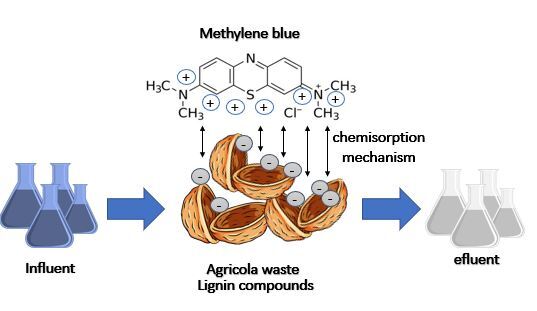
Walnut shells (WS) were used as an agricultural adsorbent material to remove methylene blue (MB) from aqueous solutions and evaluated in a batch process. WS was analyzed by Scanning Electron Microscopy (SEM) and Fourier transform infrared (FTIR). The experiments were carried out depending on the contact time, the dose of adsorbent (0.5 and 0.1 g), the agitation (50 and 100 rpm) and the temperature (293 and 313 K), initial concentration of the adsorbate (50 mg/L). The kinetic data were analyzed using pseudo-first order and pseudo-second order equations. Isotherm data were modeled with the Langmuir and Freundlich equations. The adsorption isotherm data fit well with the Langmuir isotherm and the adsorption capacity of the monolayer was found to be 80.65 mg/g for MB. MB adsorption on WS is confirmed by FTIR and SEM. The thermodynamic study reveals that MB adsorption in WS is carried out by an endothermic reaction (ΔH = 1,097 kJ/mol), feasible and spontaneous (ΔG0 = -21,157.32 kJ/mol a 293 K; -23,363.13 kJ/mol a 303 K; y -17,333.87 kJ/mol a 313 K) and decreases the disorder of the molecules in the adsorption process (ΔS0 = -2.63 kJ/mol K). The efficiency of the WS on MB was related to the arrangement of adsorption sites, as well as the microporous structure of the adsorbent material. The results indicated that walnut shells could be an alternative to the more expensive adsorbents used to remove the dye.
References
1. Jacob, J. M., Karthik, C., Saratale, R. G., Kumar, S. S., Prabakar, D., Kadirvelu, K., & Pugazhendhi, A. (2018). Biological approaches to tackle heavy metal pollution: a survey of literature. Journal of environmental management, 217, 56-70. http://doi.org/10.1016/j.jenvman.2018.03.077
2. Zainith, S. U. R. A. B. H. I., Sandhya, S., Saxena, G. A. U. R. A. V., & Bharagava, R. N. (2016). Microbes: Ecofriendly tools for the treatment of industrial wastewater. Microbes and Environmental Management, 2016, 75-100.
3. Mani, S., Chowdhary, P., & Bharagava, R. N. (2019). Textile wastewater dyes: Toxicity profile and treatment approaches. Emerging and Eco-friendly Approaches for Waste Management, 219-244. http://doi.org/10.1007/978-981-10-8669-4_11
4. Aksu, Z. (2005). Application of biosorption for the removal of organic pollutants: A review. Process Biochemistry, 40(3-4), 997-1026. http://doi.org/10.1016/j.procbio.2004.04.008
5. Yang, X. Q., Zhao, X. X., Liu, C. Y., Zheng, Y., & Qian, S. J. (2009). Decolorization of azo, triphenylmethane and anthraquinone dyes by a newly isolated Trametes sp. SQ01 and its laccase. Process Biochemistry, 44(10), 1185-1189. http://doi.org/10.1016/j.procbio.2009.06.015
6. Forgacs, E., Cserháti, T., & Oros, G. (2004). Removal of synthetic dyes from wastewaters: A review. Environment International, 30(7), 953-971. http://doi.org/10.1016/j.envint.2004.02.001
7. Al-Ghouti, M. A., & Sweleh, A. O. (2019). Optimizing textile dye removal by activated carbon prepared from olive stones. Environmental Technology & Innovation, 16, 100488.
http://doi.org/10.1016/j.eti.2019.100488
8. Oz, M., Lorke, D. E., Hasan, M., & Petroianu, G. A. (2011). Cellular and molecular actions of methylene blue in the nervous system. Medicinal Research Reviews, 31(1), 93-117. http://doi.org/10.1002/med.20177
9. Lu, G., Nagbanshi, M., Goldau, N., Mendes Jorge, M., Meissner, P., Jahn, A., ... & Mueller, O. (2018). Efficacy and safety of methylene blue in the treatment of malaria: A systematic review. BMC Medicine, 16, 1-16. http://doi.org/10.1186/s12916-018-1045-3
10. Bosoy, D., Axelband, J., Pursell, R. N., Lukaszczyk, J. J., & Stawicki, S. P. (2017). Utilization of methylene blue in the setting of hypotension associated with concurrent renal and hepatic failure: A concise review. International Journal of Academic Medicine, 3(Suppl 1), S101-S111. http://doi.org/10.4103/IJAM.IJAM_88_16
11. Kumar, K. V., Ramamurthi, V., & Sivanesan, S. (2005). Modeling the mechanism involved during the sorption of methylene blue onto fly ash. Journal of Colloid and Interface Science, 284(1), 14-21. http://doi.org/10.1016/j.jcis.2004.09.063
12. Vadivelan, V., & Kumar, K. V. (2005). Equilibrium, kinetics, mechanism, and process design for the sorption of methylene blue onto rice husk. Journal of Colloid and Interface Science, 286(1), 90-100. http://doi.org/10.1016/j.jcis.2005.01.007
13. Seif, C., Portillo, F. J. M., Osmonov, D. K., Böhler, G., van der Horst, C., Leissner, J., ... & Braun, P. M. (2004). Methylene blue staining for nerve-sparing operative procedures: An animal model. Urology, 63(6), 1205-1208. http://doi.org/10.1016/j.urology.2003.12.020
14. Zhang, H., Rogiers, P., Preiser, J. C., Spapen, H., Manikis, P., Metz, G., & Vincent, J. L. (1995). Effects of methylene blue on oxygen availability and regional blood flow during endotoxic shock. Critical Care Medicine, 23(10), 1711-1721. http://doi.org/10.1097/00003246-199510000-00016
15. Lian, L., Guo, L., & Guo, C. (2009). Adsorption of Congo red from aqueous solutions onto Ca-bentonite. Journal of Hazardous Materials, 161(1), 126-131.
http://doi.org/10.1016/j.jhazmat.2008.03.063
16. Malik, R., Ramteke, D. S., & Wate, S. R. (2007). Adsorption of malachite green on groundnut shell waste-based powdered activated carbon. Waste Management, 27(9), 1129-1138. http://doi.org/10.1016/j.wasman.2006.06.009
17. Sulak, M. T., Demirbas, E., & Kobya, M. (2007). Removal of Astrazon Yellow 7GL from aqueous solutions by adsorption onto wheat bran. Bioresource Technology, 98(13), 2590-2598. http://doi.org/10.1016/j.biortech.2006.09.010
18. Daneshvar, N., Ayazloo, M., Khataee, A. R., & Pourhassan, M. J. B. T. (2007). Biological decolorization of dye solution containing Malachite Green by microalgae Cosmarium sp. Bioresource Technology, 98(6), 1176-1182. http://doi.org/10.1016/j.biortech.2006.05.025
19. Kumar, C. G., Mongolla, P., Joseph, J., & Sarma, V. U. M. (2012). Decolorization and biodegradation of triphenylmethane dye, brilliant green, by Aspergillus sp. isolated from Ladakh, India. Process Biochemistry, 47(9), 1388-1394. http://doi.org/10.1016/j.procbio.2012.05.015
20. Ahmad, A. A., Hameed, B. H., & Aziz, N. (2007). Adsorption of direct dye on palm ash: Kinetic and equilibrium modeling. Journal of Hazardous Materials, 141(1), 70-76. http://doi.org/10.1016/j.jhazmat.2006.06.094
21. Hasan, M., Ahmad, A. L., & Hameed, B. H. (2008). Adsorption of reactive dye onto cross-linked chitosan/oil palm ash composite beads. Chemical Engineering Journal, 136(2-3), 164-172. http://doi.org/10.1016/j.cej.2007.03.038
22. Hameed, B. H., Mahmoud, D. K., & Ahmad, A. L. (2008). Sorption of basic dye from aqueous solution by pomelo (Citrus grandis) peel in a batch system. Colloids and Surfaces A: Physicochemical and Engineering Aspects, 316(1-3), 78-84. http://doi.org/10.1016/j.colsurfa.2007.08.033
23. Gupta, V. K., Jain, R., Varshney, S., & Saini, V. K. (2007). Removal of Reactofix Navy Blue 2 GFN from aqueous solutions using adsorption techniques. Journal of Colloid and Interface Science, 307(2), 326-332. http://doi.org/10.1016/j.jcis.2006.12.003
24. Gupta, V. K., Jain, R., & Varshney, S. (2007). Removal of Reactofix golden yellow 3 RFN from aqueous solution using wheat husk—an agricultural waste. Journal of Hazardous Materials, 142(1-2), 443-448. http://doi.org/10.1016/j.jhazmat.2006.08.048
25. Coşkun, R., Yıldız, A., & Delibaş, A. (2017). Removal of methylene blue using fast sucking adsorbent. Journal of Materials and Environmental Science, 8, 398-409.
26. Poghossian, A. A. (1997). Determination of the pHpzc of insulators surface from capacitance–voltage characteristics of MIS and EIS structures. Sensors and Actuators B: Chemical, 44(1-3), 551-553. http://doi.org/10.1016/S0925-4005(97)00156-1
27. Karagöz, S., Tay, T., Ucar, S., & Erdem, M. (2008). Activated carbons from waste biomass by sulfuric acid activation and their use on methylene blue adsorption. Bioresource technology, 99(14), 6214-6222. http://doi.org/10.1016/j.biortech.2007.12.019
28. Vieira, A. P., Santana, S. A., Bezerra, C. W., Silva, H. A., Chaves, J. A., de Melo, J. C., ... & Airoldi, C. (2009). Kinetics and thermodynamics of textile dye adsorption from aqueous solutions using babassu coconut mesocarp. Journal of Hazardous Materials, 166(2-3), 1272-1278. http://doi.org/10.1016/j.jhazmat.2008.12.043
29. Radovic, L. R., Silva, I. F., Ume, J. I., Menéndez, J. A., Leon, C. L. Y., & Scaroni, A. W. (1997). An experimental and theoretical study of the adsorption of aromatics possessing electron-withdrawing and electron-donating functional groups by chemically modified activated carbons. Carbon, 35(9), 1339-1348. http://doi.org/10.1016/S0008-6223(97)00072-9
30. Savova, D., Petrov, N., Yardim, M. F., Ekinci, E., Budinova, T., Razvigorova, M., & Minkova, V. (2003). The influence of the texture and surface properties of carbon adsorbents obtained from biomass products on the adsorption of manganese ions from aqueous solution. Carbon, 41(10), 1897-1903. http://doi.org/10.1016/S0008-6223(03)00179-9
31. Dahri, M. K., Kooh, M. R. R., & Lim, L. B. (2014). Water remediation using low cost adsorbent walnut shell for removal of malachite green: equilibrium, kinetics, thermodynamic and regeneration studies. Journal of Environmental Chemical Engineering, 2(3), 1434-1444. http://doi.org/10/1016/j.jece.2014.07.008
32. Miyah, Y., Lahrichi, A., Idrissi, M., Khalil, A., & Zerrouq, F. (2018). Adsorption of methylene blue dye from aqueous solutions onto walnut shells powder: equilibrium and kinetic studies. Surfaces and Interfaces, 11, 74-81. http://doi.org/10.1016/j.surfin.2018.03.006
33. Song, J., Zou, W., Bian, Y., Su, F., & Han, R. (2011). Adsorption characteristics of methylene blue by peanut husk in batch and column modes. Desalination, 265(1-3), 119-125. http://doi.org/10.1016/j.desal.2010.07.041
34. Eren, Z., & Acar, F. N. (2006). Adsorption of Reactive Black 5 from an aqueous solution: equilibrium and kinetic studies. Desalination, 194(1-3), 1-10. http://doi.org/10.1016/j.desal.2005.10.22
35. Jawad, A. H., Kadhum, A. M., & Ngoh, Y. S. (2018). Applicability of dragon fruit (Hylocereus polyrhizus) peels as low-cost biosorbent for adsorption of methylene blue from aqueous solution: kinetics, equilibrium and thermodynamics studies. Desalin Water Treatment, 109(2018), 231-240. http://doi.org/10.5004/dwt.2018.21976
36. Shen, K., & Gondal, M. A. (2017). Removal of hazardous Rhodamine dye from water by adsorption onto exhausted coffee ground. Journal of Saudi Chemical Society, 21, S120-S127. http://doi.org/10.1016/j.jscs.20.13.11.005
37. Mittal, A., Mittal, J., Malviya, A., & Gupta, V. K. (2010). Removal and recovery of Chrysoidine Y from aqueous solutions by waste materials. Journal of Colloid and Interface Science, 344(2), 497-507. http://doi.org/10.1016/j.jcis.2010.01.007
38. Ofomaja, A. E. (2008). Sorptive removal of Methylene blue from aqueous solution using palm kernel fibre: Effect of fibre dose. Biochemical Engineering Journal, 40(1), 8-18. http://doi.org/10.1016/j.bej.2007.11.028
39. Lakshmi, U. R., Srivastava, V. C., Mall, I. D., & Lataye, D. H. (2009). Rice husk ash as an effective adsorbent: Evaluation of adsorptive characteristics for Indigo Carmine dye. Journal of Environmental Management, 90(2), 710-720. http://doi.org/10.1016/j.jenvman.2008.01.002
40. Bouaziz, F., Koubaa, M., Kallel, F., Ghorbel, R. E., & Chaabouni, S. E. (2017). Adsorptive removal of malachite green from aqueous solutions by almond gum: kinetic study and equilibrium isotherms. International Journal of Biological Macromolecules, 105, 56-65.
http://doi.org/10.1016/j.ijbiomac.2017.06.106
41. Uddin, M. K., & Nasar, A. (2020). Walnut shell powder as a low-cost adsorbent for methylene blue dye: isotherm, kinetics, thermodynamic, desorption and response surface methodology examinations. Scientific Reports, 10(1), 7983. http://doi.org/10.1038/s41598-020-64745-3
42. Uddin, M. K., & Nasar, A. (2020). Walnut shell powder as a low-cost adsorbent for methylene blue dye: isotherm, kinetics, thermodynamic, desorption and response surface methodology examinations. Scientific Reports, 10(1), 7983. http://doi.org/10.1038/s41598-020-64745-3
43. Nandi, B. K., Goswami, A., & Purkait, M. K. (2009). Removal of cationic dyes from aqueous solutions by kaolin: kinetic and equilibrium studies. Applied Clay Science, 42(3-4), 583-590. http://doi.org/10.1016/j.clay.2008.03.015
44. Gündüz, F., & Bayrak, B. (2017). Biosorption of malachite green from an aqueous solution using pomegranate peel: equilibrium modelling, kinetic and thermodynamic studies. Journal of Molecular Liquids, 243, 790-798. http://doi.org/10.1016/j.molliq.2017.08.095
45. Saeed, K., Ishaq, M., Sultan, S., & Ahmad, I. (2016). Removal of methyl violet 2-B from aqueous solutions using untreated and magnetite-impregnated almond shell as adsorbents. Desalination and Water Treatment, 57(29), 13484-13493. http://doi.org/10.1080/19443994.2015.1058191
46. İmamoğlu, M. (2014). Adsorption of methylene blue from aqueous solutions by activated carbon prepared from hazelnut husk using zinc chloride. Journal of Applied Analytical and Environmental Chemistry. http://doi.org/10.1016/j.jaap.2014.09.006
47. Ofomaja, A. E. (2008). Sorptive removal of Methylene blue from aqueous solution using palm kernel fibre: Effect of fibre dose. Biochemical Engineering Journal, 40(1), 8-18. http://doi.org/10.1016/j.bej.2007.11.028
48. Önal, Y. (2006). Kinetics of adsorption of dyes from aqueous solution using activated carbon prepared from waste apricot. Journal of Hazardous Materials, 137(3), 1719-1728. https://doi.org/10.1016/j.jhazmat.2006.05.036
49. Gomez, V., Larrechi, M. S., & Callao, M. P. (2007). Kinetic and adsorption study of acid dye removal using activated carbon. Chemosphere, 69(7), 1151-1158. https://doi.org/10.1016/j.chemosphere.2007.03.076
50. Lagergren, S. (1898). Zur theorie der sogenannten Adsorption geloster Stoffe. Kungliga Svenska Vetenskapsakademiens Handlingar, 24(4), 1-39.
51. Ho, Y. S., & McKay, G. (1999). Pseudo-second order model for sorption processes. Process biochemistry, 34(5), 451-465. https://doi.org/10.1016/S0032-9592(98)00112-5
52. Crini, G., & Badot, P. M. (2008). Application of chitosan, a natural aminopolysaccharide, for dye removal from aqueous solutions by adsorption processes using batch studies: A review of recent literature. Progress in Polymer Science, 33(4), 399-447. https://doi.org/10.1016/j.progpolymsci.2007.11.001
53. Aksu, Z. (2005). Application of biosorption for the removal of organic pollutants: A review. Process biochemistry, 40(3-4), 997-1026. https://doi.org/10.1016/j.procbio.2004.04.008
54. Gong, R., Li, M., Yang, C., Sun, Y., & Chen, J. (2005). Removal of cationic dyes from aqueous solution by adsorption on peanut hull. Journal of Hazardous Materials, 121(1-3), 247-250. https://doi.org/10.1016/j.jhazmat.2005.01.029
55. Ponnusami, V., Gunasekar, V., & Srivastava, S. N. (2009). Kinetics of methylene blue removal from aqueous solution using gulmohar (Delonix regia) plant leaf powder: Multivariate regression analysis. Journal of Hazardous Materials, 169(1-3), 119-127. https://doi.org/10.1016/j.jhazmat.2009.03.066
56. Ponnusami, V., Vikram, S., & Srivastava, S. N. (2008). Guava (Psidium guajava) leaf powder: novel adsorbent for removal of methylene blue from aqueous solutions. Journal of Hazardous Materials, 152(1), 276-286. https://doi.org/10.1016/j.jhazmat.2007.06.107
57. Cheung, C. W., Porter, J. F., & Mckay, G. (2001). Sorption kinetic analysis for the removal of cadmium ions from effluents using bone char. Water Research, 35(3), 605-612. https://doi.org/10.1016/S0043-1354(00)00306-7
58. Ayawei, N., Jnr, M. H., & Spiff, I. (2005). Rhizophora mangle waste as adsorbent for metal ions removal from aqueous solution. European Journal of Scientific Research, 9(1), 21.
59. Shooto, N. D., Ayawei, N., Wankasi, D., Sikhwivhilu, L., & Dikio, E. D. (2016). Study on cobalt metal organic framework material as adsorbent for lead ions removal in aqueous solution. Asian Journal of Chemistry, 28(2), 277-281. https://doi.org/10.14233/ajchem.2016.19202
60. Narin, I., Surme, Y., Soylak, M., & Dogan, M. (2006). Speciation of Cr (III) and Cr (VI) in environmental samples by solid phase extraction on Ambersorb 563 resin. Journal of Hazardous Materials, 136(3), 579-584. https://doi.org/10.1016/j.jhazmat.2006.12.034
61. Fost, S. and Aly, M. (1981). Adsorption Processes for Water Treatment, Betterworth Publications.
62. Dąbrowski, A. (2001). Adsorption—from theory to practice. Advances in Colloid and Interface Science, 93(1-3), 135-224. https://doi.org/10.1016/S0001-8686(00)00082-8
63. Ayawei, N., Angaye, S. S., Wankasi, D., & Dikio, E. D. (2015). Synthesis, characterization and application of Mg/Al layered double hydroxide for the degradation of congo red in aqueous solution. Open Journal of Physical Chemistry, 5(3), 56-70. https://doi.org/10.4236/ojpc.2015.53007
64. Ayawei, N., Ekubo, A. T., Wankasi, D., & Dikio, E. D. (2015). Adsorption of congo red by Ni/Al-CO3: equilibrium, thermodynamic and kinetic studies. Oriental Journal of Chemistry, 31(3), 1307. https://doi.org/10.13005/ojc/310307
65. Boparai, H. K., Joseph, M., & O’Carroll, D. M. (2011). Kinetics and thermodynamics of cadmium ion removal by adsorption onto nano zerovalent iron particles. Journal of Hazardous Materials, 186(1), 458-465. https://doi.org/10.1016/j.jhazmat.2010.11.029
66. Noroozi, 5. 6. B., Sorial, G. A., Bahrami, H., & Arami, M. (2007). Equilibrium and kinetic adsorption study of a cationic dye by a natural adsorbent—Silkworm pupa. Journal of Hazardous Materials, 139(1), 167-174. https://doi.org/10.1016/j.jhazmat.2006.06.021
67. Hamdaoui, O. (2006). Batch study of liquid-phase adsorption of methylene blue using cedar sawdust and crushed brick. Journal of Hazardous Materials, 135(1-3), 264-273. https://doi.org/10.1016/j.jhazmat.2005.11.062
68. Batzias, F. A., & Sidiras, D. K. (2004). Dye adsorption by calcium chloride treated beech sawdust in batch and fixed-bed systems. Journal of Hazardous Materials, 114(1-3), 167-174. https://doi.org/10.1016/j.jhazmat.2004.08.014
69. Hameed, B. H., & El-Khaiary, M. I. (2008). Batch removal of malachite green from aqueous solutions by adsorption on oil palm trunk fibre: equilibrium isotherms and kinetic studies. Journal of Hazardous Materials, 154(1-3), 237-244. https://doi.org/10.1016/j.jhazmat.2007.10.017
70. Hameed, B. H., & El-Khaiary, M. I. (2008). Sorption kinetics and isotherm studies of a cationic dye using agricultural waste: Broad bean peels. Journal of Hazardous Materials, 154(1-3), 639-648. https://doi.org/10.1016/j.jhazmat.2007.10.081
71. Banerjee, S., & Dastidar, M. G. (2005). Use of jute processing wastes for treatment of wastewater contaminated with dye and other organics. Bioresource technology, 96(17), 1919-1928. https://doi.org/10.1016/j.biortech.2005.01.039
72. Tran, H. N., You, S. J., Hosseini-Bandegharaei, A., & Chao, H. P. (2017). Mistakes and inconsistencies regarding adsorption of contaminants from aqueous solutions: A critical review. Water Research, 120, 88-116. https://doi.org/10.1016/j.watres.2017.04.014
73. Saha, P., & Chowdhury, S. (2011). Insight into adsorption thermodynamics. Thermodynamics, 16, 349-364. https://doi.org/10.5772/13474.