Johnson-Su composting system as a sustainable organic waste management strategy in forested ecosystems
DOI:
https://doi.org/10.68038/pzhfp219Keywords:
Agroforestry residue valorization, passive aeration, nutrient recovery, salinity, sodicityAbstract
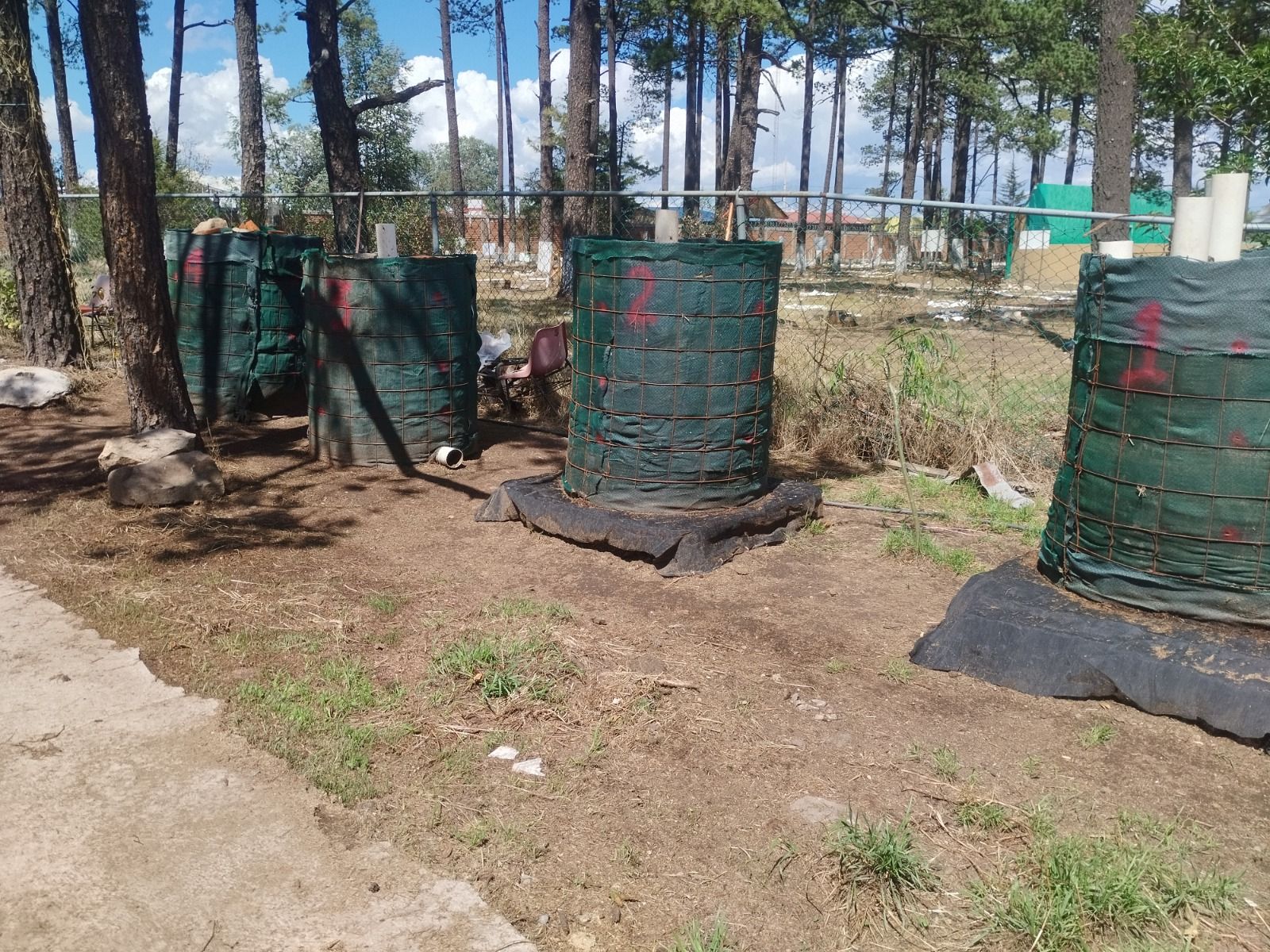
The increasing accumulation of organic solid waste represents an environmental and social threat on a global scale due to its contribution to greenhouse gas emissions, pollution, and the loss of recoverable resources. This study evaluated four composting bioreactor configurations based on the Johnson-Su system, installed at the Instituto Tecnológico de El Salto, Durango, to process domestic and agroforestry organic residues generated in the region. Temperature, moisture, and pH were monitored for six months. At the end of the process, the resulting materials were chemically characterized, and the applicable parameters were compared with the values established in the NMX-AA-180-SCFI-2018 standard. The results showed high organic matter and nutrient contents; however, differences among configurations were also identified in variables associated with salinity, sodicity and nitrogen conservation. The bioreactor R3 showed the most balanced chemical profile among the evaluated configurations. Overall, these bioreactors may contribute to the regional valorization of organic waste, provided that the resulting materials are applied as organic amendments at controlled rates and under appropriate technical criteria.
References
1. SEMARNAT (Secretaría de Medio Ambiente y Recursos Naturales). (07 de junio de 2024). Problemática de los residuos y los malos hábitos. https://www.gob.mx/semarnat/articulos/problematica-de-la-basura-y-malos-habitos?idiom=es.
2. United Nations Environment Programme (2024). Global Waste Management Outlook 2024: Beyond an age of waste-Turning rubbish into a resource. Nairobi. https://wedocs.unep.org/rest/api/core/bitstreams/daa56f4d-2479-4e10-88c6-4d65da463299/content
3. Kaza, S., Yao, L., Bhada-Tata, P., & Van Woerden, F. (2018). What a waste 2.0: a global snapshot of solid waste management to 2050. World Bank Publications.
4. Manea, E. E., Bumbac, C., Dinu, L. R., Bumbac, M., & Nicolescu, C. M. (2024). Composting as a sustainable solution for organic solid waste management: Current practices and potential improvements. Sustainability, 16(15), 6329. https://doi.org/10.3390/su16156329
5. Vargas Pineda, O. I., Trujillo González, J. M., & Torres Mora, M. A. (2019). El compostaje, una alternativa para el aprovechamiento de residuos orgánicos en las centrales de abastecimiento. Orinoquia, 23(2):123-129. https://doi.org/10.22579/20112629.575
6. U.S. Environmental Protection Agency. (01 December 2025). Composting. https://www.epa.gov/sustainable-management-food/composting
7. Oviedo Ocaña, E. R., Marmolejo Rebellon, L. F. & Torres Lozada, P. (2017). Avances en investigación sobre el compostaje de biorresiduos en municipios menores de países en desarrollo. Lecciones desde Colombia. Ingeniería, investigación y tecnología, 18(1):31-42. https://www.scielo.org.mx/pdf/iit/v18n1/1405-7743-iit-18-01-00031.pdf
8. Connolly, E. E. (2024). The New Earth Project: Youth-powered climate solutions through food waste reduction. CART. Retrieved from https://www.fws.gov/project/nature-based-solutions-new-earth-project-pilot.
9. Delgado Arroyo, M. D. M., Mendoza López, K. L., González, M. I., Tadeo Lluch, J. L., & Martín Sánchez, J. V. (2019). Evaluación del proceso de compostaje de residuos avícolas empleando diferentes mezclas de sustratos. Revista internacional de contaminación ambiental, 35(4), 965-977. https://doi.org/10.20937/rica.2019.35.04.15
10. Ellen MacArthur Foundation. (30 November 2015). Towards a circular economy: Business rationale for an accelerated transition. https://ellenmacarthurfoundation.org/towards-a-circular-economy-business-rationale-for-an-accelerated-transition
11. Medrano-Guerrero, J. E., Meza-López, P., Hernández, F. J., & Nájera-Luna󠄀, J. A. (2022). Cuantificación y caracterización de los residuos del proceso de aserrío en una fábrica de tarimas en El Salto, Durango, México. Investigación y Ciencia de la Universidad Autónoma de Aguascalientes, e3599, https://doi.org/10.33064/iycuaa2022863599
12. INEGI (Instituto Nacional de Geografía y Estadística). (2022). Aspectos geográficos de Durango. Compendio 2022. Instituto Nacional de Estadística y Geografía. https://www.inegi.org.mx/contenidos/productos/prod_serv/contenidos/espanol/bvinegi/productos/nueva_estruc/889463913276.pdf
13. Johnson, D., & DeSimio, P. (2017). Best management practices: Johnson-Su composting bioreactors. New Mexico State University College of Agriculture, Consumer, & Environmental Sciences. https://regenerationinternational.org/wp-content/uploads/2017/09/Johnson-Su-Bioreactor.pdf
14. Amlinger, F., Peyr, S., Hildebrandt, U., Müsken, J., Cuhls, C., & Clemens, J. (2009). The State of the Art of Composting–A guide to good practice. Austrian Ministry for Agriculture and Forestry. Environment and Water Management.
15. SE (Secretaría de Economía). (2018). Que establece los métodos y procedimientos para el tratamiento aerobio de la fracción orgánica de los residuos sólidos urbanos y de manejo especial, así como la información comercial y de sus parámetros de calidad de los productos finales (NMX-AA-180-SCFI-2018). Diario Oficial de la Federación. https://biblioteca.semarnat.gob.mx/janium/Documentos/Ciga/agenda/PPD1/NMX-AA-180-SCFI-2018.pdf
16. Bernal, M. P., Alburquerque, J. A., & Moral, R. (2009). Composting of animal manures and chemical criteria for compost maturity assessment. A review. Bioresource technology, 100(22), 5444-5453. https://doi.org/10.1016/j.biortech.2008.11.027
17. Iglesias Jiménez, I., Barral Silva, M. T., & Marhuenda Egea, F. C. (2008). 11 indicadores de la estabilidad y madurez del compost. En J. Moreno Casco y R. Moral herrero (Eds.). Compostaje. Ediciones Mundi-Prensa.
18. Sharma, B., Vaish, B., Monika, Singh, U. K., Singh, P., & Singh, R. P. (2019). Recycling of organic wastes in agriculture: an environmental perspective. International journal of environmental research, 13(2), 409-429. https://doi.org/10.1007/s41742-019-00175-y
19. Fernández-Marcos, M. L. (2011). Contaminación por fósforo procedente de la fertilización orgánica de suelos agrícolas. En: M. E. López Mosquera, M. J. Sainz Osés (coordinadoras). Gestión de residuos orgánicos de uso agrícola. Servizo de Publicacións e Intercambio Científico, Universidad de Santiago de Compostela, (25-31).
20. Rynk, R., Van de Kamp, M., Willson, G. B., Singley, M. E., Richard, T. L., Kolega, J. J., Gouin, F. R., Laliberty, L., Kay, D., Murphy, D. W., Hoitink, H. A., & Brinton, W. F. (1992). On-farm composting handbook. Northeast Regional Agricultural Engineering Service (NRAES) 54. Northeast Regional Agricultural Engineering Service, Cooperative Extension. College of Agriculture and Life Sciences (CALS). Cornell University.
21. Alloway, B. J. (Ed.). (2012). Heavy metals in soils: trace metals and metalloids in soils and their bioavailability. Springer Science & Business Media.
22. Michaud, A. M., Cambier, P., Sappin-Didier, V., Deltreil, V., Mercier, V., Rampon, J.-N., Trochard, R., Leclerc, B., Morel, C., Waterlot, C., & Houot, S. (2020). Mass balance and long-term soil accumulation of trace elements in arable crop systems amended with urban composts or cattle manure during 17 years. Environmental Science and Pollution Research, 27, 5367–5386. https://doi.org/10.1007/s11356-019-07166-8
23. Gondek, M., Weindorf, D. C., Thiel, C., & Kleinheinz, G. (2020). Soluble salts in compost and their effects on soil and plants: A review. Compost Science & Utilization, 28(2), 59–75. https://doi.org/10.1080/1065657X.2020.1772906
24. Qadir, M., Oster, J. D., Schubert, S., Noble, A. D., & Sahrawat, K. L. (2007). Phytoremediation of sodic and saline‐sodic soils. Advances in agronomy, 96, 197-247. https://doi.org/10.1016/S0065-2113(07)96006-X
25. Arcos Torres, J. F., Arcos Logroño, J. P., & Osorio Rivera, M. Á. (2022). El suelo y los abonos en la nutrición vegetal. (Primera Edición). Editorial I2D Investigación, Innovación y Desarrollo.
26. Hargreaves, J. C., Adl, M. S., & Warman, P. R. (2008). A review of the use of composted municipal solid waste in agriculture. Agriculture, ecosystems & environment, 123(1-3), 1-14. https://doi.org/10.1016/j.agee.2007.07.004
27. Quiroz Ramírez, J. V. (2025). Valoración de la calidad del suelo: Una herramienta para la gestión ambiental del suelo en Luyando. Tecnohumanismo, 4(4), 1–436. https://tecnohumanismo.online/index.php/tecnohumanismo/article/view/382