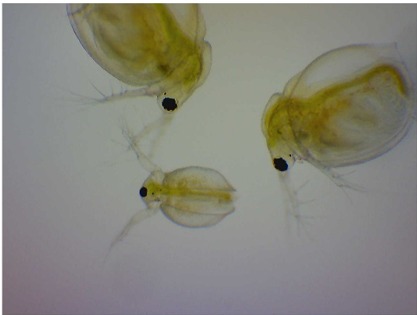
Ecotoxicological effect of methyl parathion on Moina macrocopa under different algal densities
DOI:
https://doi.org/10.68038/vb6xyb50Keywords:
Aquatic ecotoxicology, LC₅₀, Life tables, Methyl parathion, Zooplankton.Abstract
Organophosphate pesticides, such as methyl parathion, represent one of the main sources of pollution in freshwater ecosystems, directly affecting the structure and dynamics of zooplankton communities. The toxicity of these compounds can vary depending on their concentration and environmental factors such as food availability. In this context, the objective of this study was to evaluate the acute and chronic effects of methyl parathion on survival and life-history variables of Moina macrocopa under different levels of algal food. Acute bioassays were performed to determine the median lethal concentration (LC₅₀) at 24 h, and chronic bioassays were conducted using life tables. Two densities of Chlorella vulgaris (A= 0.5 × 10⁶ and B= 1.5 × 10⁶ cells mL⁻¹) and four concentrations of methyl parathion were used. The following life-table variables were analyzed: age-specific survival (lₓ), age-specific reproduction (mₓ), life expectancy (eₓ), gross and net reproductive rates (R₀), generation time (T), and the intrinsic rate of population increase (r). The LC₅₀ of M. macrocopa was 3.2 × 10⁻³ mg L⁻¹ (log10 C= −2.49) of methyl parathion. The life history variables were significantly affected by methyl parathion concentration (p <0.001). Algal density significantly influenced average lifespan, life expectancy, gross reproductive rate, generation time, and population growth rate. The interaction between food level and toxicant concentration only affected generation time and daily growth rate (p <0.001). The greatest effects on the studied variables were observed at low toxicant concentrations (0.002 mg L⁻¹; log₁₀ C = −2.70) and lower algal density. The increase in algal food density did not mitigate the compound's toxicity, suggesting a direct action of the pesticide on the organisms. These results confirm the high sensitivity of M. macrocopa as a bioindicator organism in ecotoxicological studies.
References
Arias-Castro E., Castrejón-Godínez M. L., Mussali-Galante P., Tovar-Sánchez, E., & Rodríguez, A. (2025). Pesticides degradation through microorganisms immobilized on agro-industrial waste: a promising approach for their elimination from aquatic environments. Processes, 13(4), 1073.
Borase H. P., Muley A. B., Patil S. V., & Singhal R. S. (2021). Enzymatic response of Moina macrocopa to different sized zinc oxide particles: an aquatic metal toxicology study. Environmental research, 194, 110609.
Borowitzka, M. A., & Borowitzka, L. J. (1988). Micro-algal biotechnology. Cambridge University Press. 315 p.
Cáceres T., Venkateswarlu K., & Megharaj M. (2019). Acute toxicity of the insecticide methyl parathion and its hydrolytic product p-nitrophenol to the native Australian cladoceran Daphnia carinata. Ecotoxicology, 28, 680-685. https://doi.org/10.1007/s10646-019-02064-8
Cameán, A. M., & Repetto, M. (2006). Toxicología alimentaria (pp. 705-705). Ediciones Díaz de Santos.
Cao, S., Liu, Z., Zhou, B., Jiang, Y., Xu, M., & Wang, Y. (2022). Post-ecological effect and risk assessment of using modified clay in harmful algal bloom mitigation: An attempt based on the responses of zooplankton Brachionus plicatilis and bivalve Mytilus edulis. Ecotoxicology and Environmental Safety, 230, 113134. https://doi.org/10.1016/j.ecoenv.2021.113134
Chen, T., Chen Chen, H., Wang, A., Yao, W., Xu, Z., Wang, B., & Wu, Y. (2023). Methyl parathion exposure induces development toxicity and cardiotoxicity in zebrafish embryos. Toxics, 11 (1): 84. https://doi.org/10.3390/toxics11010084
Chuah T. S., Loh J. Y., & Hii Y. S. (2007). Acute and chronic effects of the insecticide-endosulfan on freshwater cladoceran, Moina macrocopa Straus. Bulletin of environmental contamination and toxicology, 79(5), 557-561.
Fernández-Casalderrey, A., Ferrando, M. D., & Andreu-Moliner, E. (1992). Acute toxicity of pesticides to rotifers. (Brachionus calyciflorus). Bull. Environ. Contam. Toxicol, 48, 14–17. https://doi.org/10.1007/BF00197477
Finney, D. J. (1971). Probit analysis (3rd ed.). Cambridge University Press.
Ghosh, T. S., Rana, S., Pal, P., & Mallick, B. (2023). Herbicidal impacts on freshwater zooplankton. International Journal of Advanced Research Trends in Science, 2, 36-41. https://doi.org/10.70035/ijarts.2023.2136-41
Gobierno de México. Gobierno de México. Gobierno de México, https://www.gob.mx. Consultado el 18 mayo 2026.
González, Y. A. (1998). El plancton de las aguas continentales. Secretaría General de la OEA, Washington, D.C. USA. Monografía. No. 33. Pp.130
Goulden, C. E. (1968). The systematics and evolution of the Moinidae. Transactions of the American Philosophical Society, 58, 1–101. https://doi.org/10.2307/1006102
Goździejewska, A. M., Cymes, I., & Glińska-Lewczuk, K. (2024). Zooplankton functional diversity as a bioindicator of freshwater ecosystem health across land use gradient. Scientific Reports, 14, 18456. https://doi.org/10.1038/s41598-024-69577-z
Haddapitiye, M. T. R. S. (2003). Recovery patterns of Moina macrocopa exposed previously to different concentrations of cadmium and methyl parathion: Life-table demography and population growth studies [Doctoral dissertation, University of Peradeniya]. https://sucra.repo.nii.ac.jp/record/2000554/
Hernández-Zamora, M., Rodríguez-Miguel, A., Martínez-Jerónimo, L., & Martínez-Jerónimo, F. (2023). Combined toxicity of glyphosate (Faena®) and copper to the American cladoceran Daphnia exilis—A two-generation analysis. Water, 15(11), 2018.
Iannacone J. A., & Alvariño, L. (2002). Efecto del detergente doméstico alquil aril sulfonato de sodio lineal (LAS) sobre la mortalidad de tres caracoles dulceacuícolas en el Perú. Ecologia Aplicada, 1(2), 81–87. https://doi.org/10.21704/rea.v1i1-2.234
Iannacone J. A., Salazar, C. N., & Alvariño, L. (2003). Variabilidad del ensayo ecotoxicológico con Chironomus calligraphus goeldi (Diptera: Chironomidae) para evaluar cadmio, mercurio y plomo. Ecologia Aplicada, 2(1), 103–110.
Krebs, C. J. (1985). Ecology: The experimental analysis of distribution and abundance (3rd ed.). Harper & Row.
Mangas-Ramírez E., Sarma, S.S.S., & Nandini S. (2004). Recovery patterns of Moina macrocopa exposed previously to different concentrations of cadmium and methyl parathion: life-table demography and population growth studies. Hydrobiologia, 526(1), 255-265.
Mangas-Ramirez, E., Sarma, S. S. S. & Nandini, S. (2001). Acute and chornic toxicity of ammonium chloride to the cladoceran Daphnia pulex in relation to algal food density. Bulletin of Environmental Contamination and Toxicology, 67(6), 834-40. https://doi.org/10.1007/s001280198.
Mangas-Ramirez, E., Sarma, S. S. S., & Nandini S. (2000). Effect of ammonium chloride and algal food density (Chlorella vulgaris) on the life table demography of the cladoceran Moina macrocopa. p 134-35. Sociedad Mexicana de Planctología y Universidad de Guadalajara. 147 p.
Marcelino, C. N., Brandão, L. F., Correia, C. D. M., Ferreira, A. C., Petsch, D. K., & Portinho, J. L. (2025). Quantification and analysis of emerging threats studies on freshwater zooplankton (Copepoda, Cladocera and Rotifera) in Brazil from 2014 to 2023. Acta Limnologica Brasiliensia, 37, e30. https://doi.org/10.1590/S2179-975X1525
Margalef, R. (1983). Limnología. Ed. Omega, Barcelona, España 1010 pp
Nandini, S., & Sarma, S. S. S. (2019). Reproductive strategies of Moina (Cladocera) in relation to food type and concentration. Hydrobiology, 847, 1599 1612.
Nandini, S., & Sarma, S. S. S. (2022). Competition between Moina macrocopa and Ceriodaphnia dubia a life table demography study. Hydrobiology, 87(1), 85-95. https://doi.org/10.1002/1522-2632(200201)87:1<85::AID-IROH85>3.0.CO;2-D
OECD. (1984). Test No. 202: Daphnia sp. Acute immobilisation test. Organisation for Economic Co-operation and Development.
Patel, R. K., Singh, P., Pandey, R., Mishra, S., Soni, S. K., & Patel, B. (2021). Impact of methyl parathion organophosphate pesticides residues on human health and environment as toxicological outcome.
Pilotto, F., Golovko, O., & Hultberg, M. (2025). Water quality and pesticide contamination in agricultural streams: assessing white-rot fungi and biochar treatments as remediation strategies. Journal of Environmental Management, 394, 127282. https://doi.org/10.1016/j.jenvman.2025.127282
Robles, V. E. (1998). Contaminación química del agua, Memorias. Hacia una renovación ambiental en México. Universidad Autónoma del Estado de Morelos. Cuernavaca.
Rojas, F. (1991). Brevario de términos y conceptos sobre ecología y protección ambiental. 2º Edición. México. 324 pp
Sarma S. S., & Nandini, S. (2001). Lifetable demography and population growth of Brachionus variabilis Hempel, 1896 in relation to Chlorella vulgaris densities. Hydrobiology, 446 (447), 75-83. https://doi.org/10.1023/A:1017577206815
Sarma, S. S. S, Nandini S., & Fernández-Araiza, M. A. (1998). Effect of metyl parathion-treated prey (Brachionus calyciflorus) on the population growtn of the predator Asplanchna sieboldi (Rotifera). Bulletin of Environmental Contamination and Toxicology, 61(1), 135-142.
Sarma, S. S. S., & Nandini, S. (2026). Rotifers as environmental indicators: perspectives based on sampling strategies. Inland Waters, 1-48. https://doi.org/10.1080/20442041.2025.2606343
Sarma, S. S. S., Gama-Flores, J. L., & Fernández-Araiza, M. A. (1999). Combined Effects of Chlorella Density and Metyl Parathion Concentration on the Population Growth of Brachionus calyciflorus (Rotifera). Bulletin of Environmental Contamination and Toxicology, 62(6), 115-121.
Schultz, A., Owens, J., Demidenko, E., & Roy Chowdhury, P. (2024). Differential Toxicity of Arsenic in Daphnia pulex Under Phosphorus and Food Limitation. Environmental Toxicology and Chemistry, 43(8), 1807–1819. https://doi.org/10.1002/etc.5901
Suzuki, H., Makino, W., Takahashi, S., & Urabe, J. (2024). Assessment of toxic effects of imidacloprid on freshwater zooplankton: An experimental test for 27 species. Science of the Total Environment, 927, 172378. https://doi.org/10.1016/j.scitotenv.2024.172378
US EPA. (2002a). Methods for measuring the chronic toxicity of effluents and receiving waters to freshwater organisms. United States Environmental Protection Agency.
Van Dijk, T. C., Van Staalduinen, M. A., & Van der Sluijs, J. P. (2013). Macro-invertebrate decline in surface water polluted with imidacloprid. PloS one, 8(5), e62374. https://doi.org/10.1371/journal.pone.0062374
Weber, C. I. (1991). Methods for measuring the acute toxicity of effluents to freshwater and marine organisms. iving waters to freshwater and marine organisms. Washington, DC: Environmental Monitoring Systems Laboratory, Office of Research and Development, US Environmental Protection Agency, 197 p.