Graphene oxide as a stabilizing additive: effect of the oxidation degree on wettability, thermal stability, and dispersion
DOI:
https://doi.org/10.68038/z90hv790Keywords:
graphene oxide, oxidation degree, surface free energy, wettability.Abstract
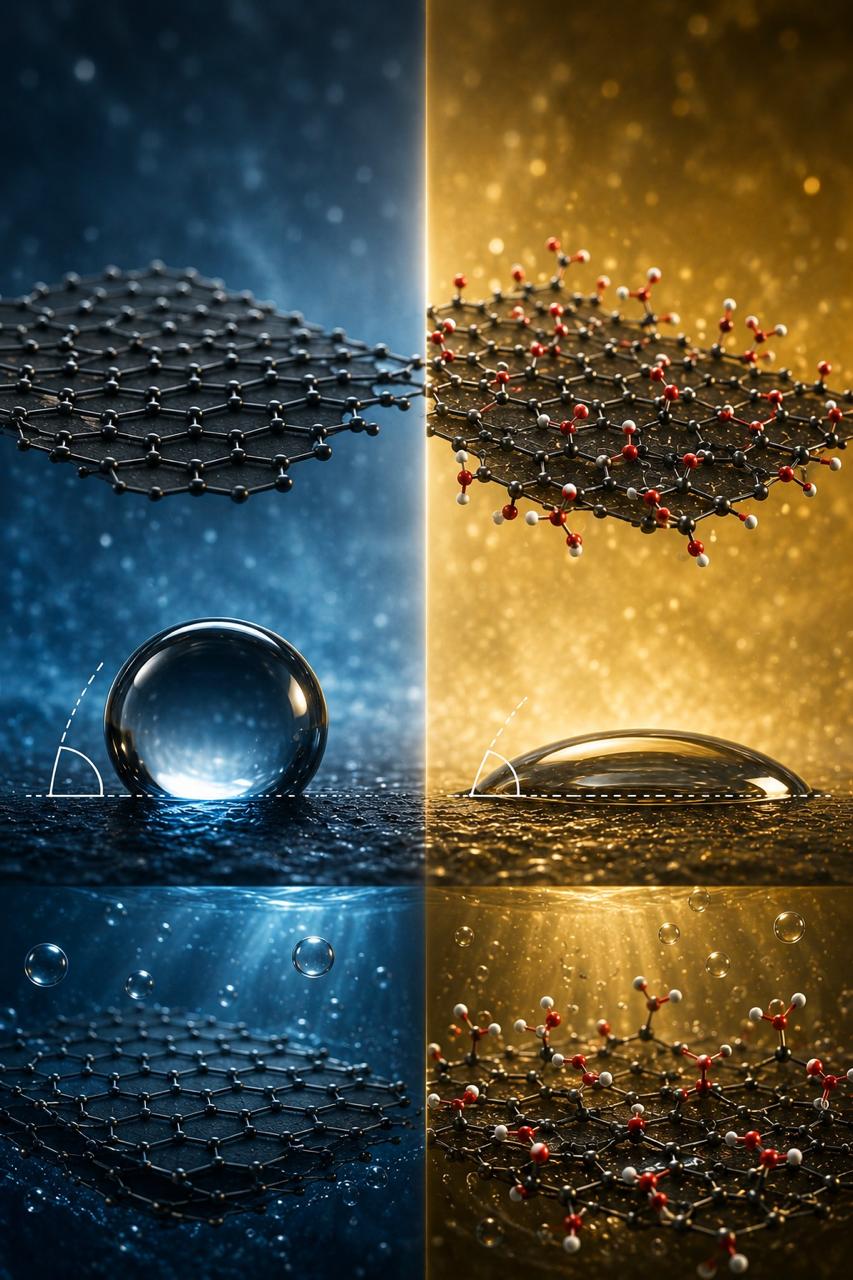
This work evaluated the influence of the oxidation degree of graphene oxide on its structural, thermal, and interfacial properties in order to assess its performance as a stabilizing additive in dispersed systems. Graphene oxide was synthesized by a modified Hummers method, varying the reaction time to obtain samples with different oxidation degrees.
FTIR spectroscopy and X-ray diffraction confirmed the incorporation of oxygen-containing functional groups and structural changes associated with oxidation, without showing a strictly proportional relationship between reaction time and oxidation degree. Thermogravimetric analysis revealed differences in thermal stability among the samples, related to the content and nature of oxygen functional groups. Contact angle and surface free energy measurements indicated that oxidation degree affects water affinity and amphiphilic character, although no linear trend with reaction time was observed.
Dispersion tests in liquid–liquid systems showed that the interfacial behavior of graphene oxide depends on both oxidation degree and medium pH. In particular, the sample obtained after 3 h of oxidation (GO 3H) exhibited the most favorable behavior, with greater sensitivity to pH changes and better redistribution between phases. These results indicate that controlling the oxidation degree is a key parameter for tuning the interfacial properties of graphene oxide for potential use as a stabilizing material.
References
Dimiev, A. M., & Tour, J. M. (2014). Mechanism of Graphene Oxide Formation. ACS Nano, 8(3), 3060-3068. https://doi.org/10.1021/nn500606a
Farivar, F., Lay Yap, P., Karunagaran, R. U., & Losic, D. (2021). Thermogravimetric Analysis (TGA) of Graphene Materials: Effect of Particle Size of Graphene, Graphene Oxide and Graphite on Thermal Parameters. C, 7(2), 41. https://doi.org/10.3390/c7020041
Huang, X., Zhao, W., Khalilov, F., & Xu, N. (2025). Graphene Oxide: Preparation and Medical Research. Materials, 18(12), 2855. https://doi.org/10.3390/ma18122855
Karnis, I., Krasanakis, F., Sygellou, L., Rissanou, A. N., Karatasos, K., & Chrissopoulou, K. (2024). Varying the degree of oxidation of graphite: Effect of oxidation time and oxidant mass. Physical Chemistry Chemical Physics, 26(13), 10054-10068. https://doi.org/10.1039/D3CP05268K
Kim, J., Cote, L. J., Kim, F., Yuan, W., Shull, K. R., & Huang, J. (2010). Graphene Oxide Sheets at Interfaces. Journal of the American Chemical Society, 132(23), 8180-8186. https://doi.org/10.1021/ja102777p
Liu, M., Zhu, W., & Wang, H. (2025). Materials Prepared via Pickering Emulsions Stabilized by Graphene Oxide: Overview and Prospects. Materials, 18(20), 4790. https://doi.org/10.3390/ma18204790
Lv, H., Wang, Z., An, J., Li, Z., Shi, L., & Shan, Y. (2023). Preparation and Emulsifying Properties of Carbon-Based Pickering Emulsifier. Processes, 11(4), 1070. https://doi.org/10.3390/pr11041070
Moazzeni, A., Riyahi Madvar, H., Hamedi, S., & Kordrostami, Z. (2025). Controlled oxidation levels in graphene oxide to achieve forming-free and analog resistive switching in RRAM. Scientific Reports, 15(1), 45074. https://doi.org/10.1038/s41598-025-32232-2
Morales-Acosta, D., Flores-Oyervides, J. D., Rodríguez-González, J. A., Sánchez-Padilla, N. M., Benavides, R., Fernández-Tavizón, S., & Mercado-Silva, J. A. (2019). Comparative methods for reduction and sulfonation of graphene oxide for fuel cell electrode applications. International Journal of Hydrogen Energy, 44(24), 12356-12364. https://doi.org/10.1016/j.ijhydene.2019.02.091
Ravera, F., Dziza, K., Santini, E., Cristofolini, L., & Liggieri, L. (2021). Emulsification and emulsion stability: The role of the interfacial properties. Advances in Colloid and Interface Science, 288, 102344. https://doi.org/10.1016/j.cis.2020.102344
Ribeiro, A., Lopes, J. C. B., Dias, M. M., & Barreiro, M. F. (2023). Pickering Emulsions Based in Inorganic Solid Particles: From Product Development to Food Applications. Molecules, 28(6), 2504. https://doi.org/10.3390/molecules28062504
Shojaeenezhad, S. S., Farbod, M., & Kazeminezhad, I. (2017). Effects of initial graphite particle size and shape on oxidation time in graphene oxide prepared by Hummers’ method. Journal of Science: Advanced Materials and Devices, 2(4), 470-475. https://doi.org/10.1016/j.jsamd.2017.09.003
Smith, A. T., LaChance, A. M., Zeng, S., Liu, B., & Sun, L. (2019). Synthesis, properties, and applications of graphene oxide/reduced graphene oxide and their nanocomposites. Nano Materials Science, 1(1), 31-47. https://doi.org/10.1016/j.nanoms.2019.02.004
Wang, B., Liu, Q., Fan, Z., Liang, T., Tong, Q., & Fu, Y. (2021). Fabrication of PDMS/GA Composite Materials by Pickering Emulsion Method and Its Application for Oil-Water Separation. Energies, 14(17), 5283. https://doi.org/10.3390/en14175283
Yang, Y., Fang, Z., Chen, X., Zhang, W., Xie, Y., Chen, Y., Liu, Z., & Yuan, W. (2017). An Overview of Pickering Emulsions: Solid-Particle Materials, Classification, Morphology, and Applications. Frontiers in Pharmacology, 8, 287. https://doi.org/10.3389/fphar.2017.00287
Yilbas, B. S., Ibrahim, A., Ali, H., Khaled, M., & Laoui, T. (2018). Hydrophobic and optical characteristics of graphene and graphene oxide films transferred onto functionalized silica particles deposited glass surface. Applied Surface Science, 442, 213-223. https://doi.org/10.1016/j.apsusc.2018.02.176
Zhao, H., Yang, Y., Chen, Y., Li, J., Wang, L., & Li, C. (2022). A review of multiple Pickering emulsions: Solid stabilization, preparation, particle effect, and application. Chemical Engineering Science, 248, 117085. https://doi.org/10.1016/j.ces.2021.117085
Zhao, L., Shu, M., Chen, H., Shi, K., & Li, Z. (2023). Preparation of graphene oxide–stabilized Pickering emulsion adjuvant for Pgp3 recombinant vaccine and enhanced immunoprotection against Chlamydia Trachomatis infection. Frontiers in Immunology, 14, 1148253. https://doi.org/10.3389/fimmu.2023.1148253