Design and implementation of a haptic thermal display device for virtual reality applications for education and in training purposes
Keywords:
Fuzzy control, Haptic, Human-Computer Interaction, Virtual reality.Abstract
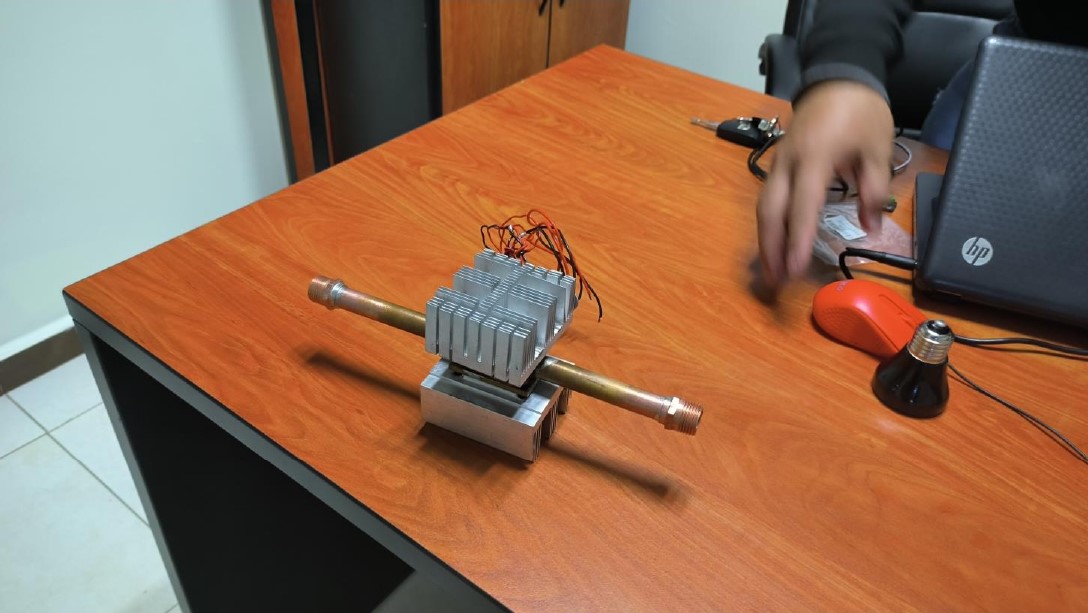
This work details the design and implementation of a thermal screen type device, focused on the presentation of information in the form of temperature. In this way, the user can perceive information when in contact with it and be used in virtual reality applications. The electronic control circuit, the design of a Sugeno-type fuzzy controller and the description of a virtual reality application developed in Unity for educational purposes are specified. The arrangement that allows returning to the initial operating condition by means of a network of cooling pipes by internal water circulation is described. The development is based on the premise of increasing realism in virtual reality applications by focusing the attention and focus of users during the learning process. As a result, the response curve to different temperature reference inputs is presented to evaluate the performance of the fuzzy controller. The dynamic temperature color scale is presented based on the temperature measurements made by the controller, providing thermal and visual information simultaneously through the device. Derived from the performance tests, the temperature-humidity haptic illusion was identified during the cooling stage, so in future work, further exploration of haptic illusions with virtual reality will be carried out.
References
1. Zhou, NN., & Deng, YL. (2009). “Virtual Reality: A State-of-the-Art Survey.” International Journal of Automation and Computing 6(4):319–25. doi: 10.1007/s11633-009-0319-9.
2. Carmigniani, J., & Furht, B. (2011). “Augmented reality: an overview”. Handbook of augmented reality, 3-46.
3. Izard, S. G., Juanes Méndez, J. A., & Palomera, P. R. (2017). “Virtual reality educational tool for human anatomy”. Journal of medical systems, 41, 1-6.
4. Buentello-Montoya, D. A., Lomelí-Plascencia, M. G., & Medina-Herrera, L. M. (2021). “The role of reality enhancing technologies in teaching and learning of mathematics”. Computers & Electrical Engineering, 94, 107287.
5. Neroni, M. A., Oti, A., & Crilly, N. (2021). “Virtual Reality design-build-test games with physics simulation: opportunities for researching design cognition”. International Journal of Design Creativity and Innovation, 9(3), 139-173.
6. Cheng, A., Yang, L., & Andersen, E. (2017). “Teaching language and culture with a virtual reality game”. In Proceedings of the 2017 CHI conference on human factors in computing systems, 541-549.
7. Collaço, E., Kira, E., Sallaberry, L. H., Queiroz, A. C., Machado, M. A., Crivello Jr, O., & Tori, R. (2021). “Immersion and haptic feedback impacts on dental anesthesia technical skills virtual reality training”. Journal of Dental Education, 85(4), 589-598.
8. Sapkaroski, D., Baird, M., McInerney, J., & Dimmock, M. R. (2018). “The implementation of a haptic feedback virtual reality simulation clinic with dynamic patient interaction and communication for medical imaging students”. Journal of medical radiation sciences, 65(3), 218-225.
9. Richard, E., Tijou, A., Richard, P., & Ferrier, J. L. (2006). “Multi-modal virtual environments for education with haptic and olfactory feedback”. Virtual Reality, 10, 207-225.
10. Lontschar, S., Deegan, D., Humer, I., Pietroszek, K., & Eckhardt, C. (2020). “Analysis of haptic feedback and its influences in virtual reality learning environments”. In 2020 6th International Conference of the Immersive Learning Research Network (iLRN), 171-177. IEEE.
11. Edwards, B. I., Bielawski, K. S., Prada, R., & Cheok, A. D. (2019). “Haptic virtual reality and immersive learning for enhanced organic chemistry instruction”. Virtual Reality, 23, 363-373.
12. Grajewski, D., Górski, F., Hamrol, A., & Zawadzki, P. (2015). “Immersive and haptic educational simulations of assembly workplace conditions”. Procedia Computer Science, 75, 359-368.
13. Noghabaei, M., & Han, K. (2021). “Object manipulation in immersive virtual environments: Hand Motion tracking technology and snap-to-fit function”. Automation in Construction, 124, 103594.
14. Motaharifar, M., Norouzzadeh, A., Abdi, P., Iranfar, A., Lotfi, F., Moshiri, B., ... & Taghirad, H. D. (2021). “Applications of haptic technology, virtual reality, and artificial intelligence in medical training during the COVID-19 pandemic”. Frontiers in Robotics and AI, 8, 612949.
15. Sanfilippo, F., Blazauskas, T., Salvietti, G., Ramos, I., Vert, S., Radianti, J., ... & Oliveira, D. (2022). “A perspective review on integrating VR/AR with haptics into STEM education for multi-sensory learning”. Robotics, 11(2), 41.
16. Gallo, S., Rognini, G., Santos-Carreras, L., Vouga, T., Blanke, O., & Bleuler, H. (2015). “Encoded and crossmodal thermal stimulation through a fingertip-sized haptic display”. Frontiers in Robotics and AI, 2, 25.
17. Kim, S. W., Kim, S. H., Kim, C. S., Yi, K., Kim, J. S., Cho, B. J., & Cha, Y. (2020). “Thermal display glove for interacting with virtual reality”. Scientific reports, 10(1), 11403.
18. Hirai, S., & Miki, N. (2019). “A thermal tactile sensation display with controllable thermal conductivity”. Micromachines, 10(6), 359.
19. Carnahan, H., Dubrowski, A., & Grierson, L. E. (2010). “Temperature influences both haptic perception and force production when grasping”. International Journal of Industrial Ergonomics, 40(1), 55-58.
20. Kuhtz-Buschbeck, J. P., & Hagenkamp, J. (2020). “Cold and heavy: grasping the temperature–weight illusion”. Experimental brain research, 238, 1107-1117.
21. Ho, H. N., Chow, H. M., Tsunokake, S., & Roseboom, W. (2019). “Thermal-tactile integration in object temperature perception”. IEEE transactions on haptics, 12(4), 594-603.
22. Trojan, J., Fuchs, X., Speth, S. L., & Diers, M. (2018). “The rubber hand illusion induced by visual-thermal stimulation”. Scientific reports, 8(1), 12417.
23. Ho, H. N., Iwai, D., Yoshikawa, Y., Watanabe, J., & Nishida, S. Y. (2014). “Combining colour and temperature: A blue object is more likely to be judged as warm than a red object”. Scientific reports, 4(1), 5527.
24. Gil, J. J., Diaz, I., Justo, X., & Ciäurriz, P. (2014). “Educational haptic controller based on Arduino platform”. In 2014 XI Tecnologias Aplicadas a la Ensenanza de la Electronica (Technologies Applied to Electronics Teaching) (TAEE), 1-7. IEEE.
25. Sanfilippo, F., & Pettersen, K. Y. (2015). “A sensor fusion wearable health-monitoring system with haptic feedback”. In 2015 11th International conference on innovations in information technology (IIT), 262-266. IEEE.
26. Lira-Cortés, L., González Rodríguez, O. J., & Méndez-Lango, E. (2008). “Sistema de medición de la conductividad térmica de materiales sólidos conductores, diseño y construcción”. In Simposio de Metrología Santiago de Querétaro: Querétaro, Mexico.
27. Jingzhuo, W., & Chenglong, G. (2007). “Research on 1-wire bus temperature monitoring system”. In 2007 8th international conference on electronic measurement and instruments,3-722. IEEE.
28. Sattar, H., Bajwa, I. S., Amin, R. U., Sarwar, N., Jamil, N., Malik, M. A., ... & Shafi, U. (2019). “An IoT-based intelligent wound monitoring system”. IEEE Access, 7, 144500-144515.
29. Campbell, I. (2008). “Body temperature and its regulation”. Anaesthesia & Intensive Care Medicine, 9(6), 259-263.
30. Han, T., Wang, S., Wang, S., Fan, X., Liu, J., Tian, F., & Fan, M. (2020). “Mouillé: Exploring wetness illusion on fingertips to enhance immersive experience in vr”. In Proceedings of the 2020 CHI Conference on Human Factors in Computing Systems,1-10.
31. Peiris, R. L., Chan, L., & Minamizawa, K. (2018). “LiquidReality: wetness sensations on the face for virtual reality”. In Haptics: Science, Technology, and Applications: 11th International Conference, EuroHaptics 2018, Pisa, Italy, June 13-16, 2018, Proceedings, Part II 11, 366-378. Springer International Publishing.