Influence of MgFe₂O₄ on the magnetic properties of glass-Ceramics derived from sol-gel synthesis
Keywords:
Ferrites, MgFe2O4, Sol-Gel, Glass-ceramics.Abstract
Magnetic glass-ceramics are composed of a magnetic phase, usually an iron oxide, integrated in a glass matrix. When bioactive glass is used as the matrix, these materials not only exhibit remarkable magnetic properties, but also acquire bioactivity properties. Among iron oxides, those incorporating magnesium, an essential cation in the human body stands out due to their impact on various metabolic processes. This addition enhances the properties of the glass-ceramics, providing superior biocompatibility, superparamagnetic behavior, and efficiency in induction heating, making them ideal for medical applications such as magnetic hyperthermia.
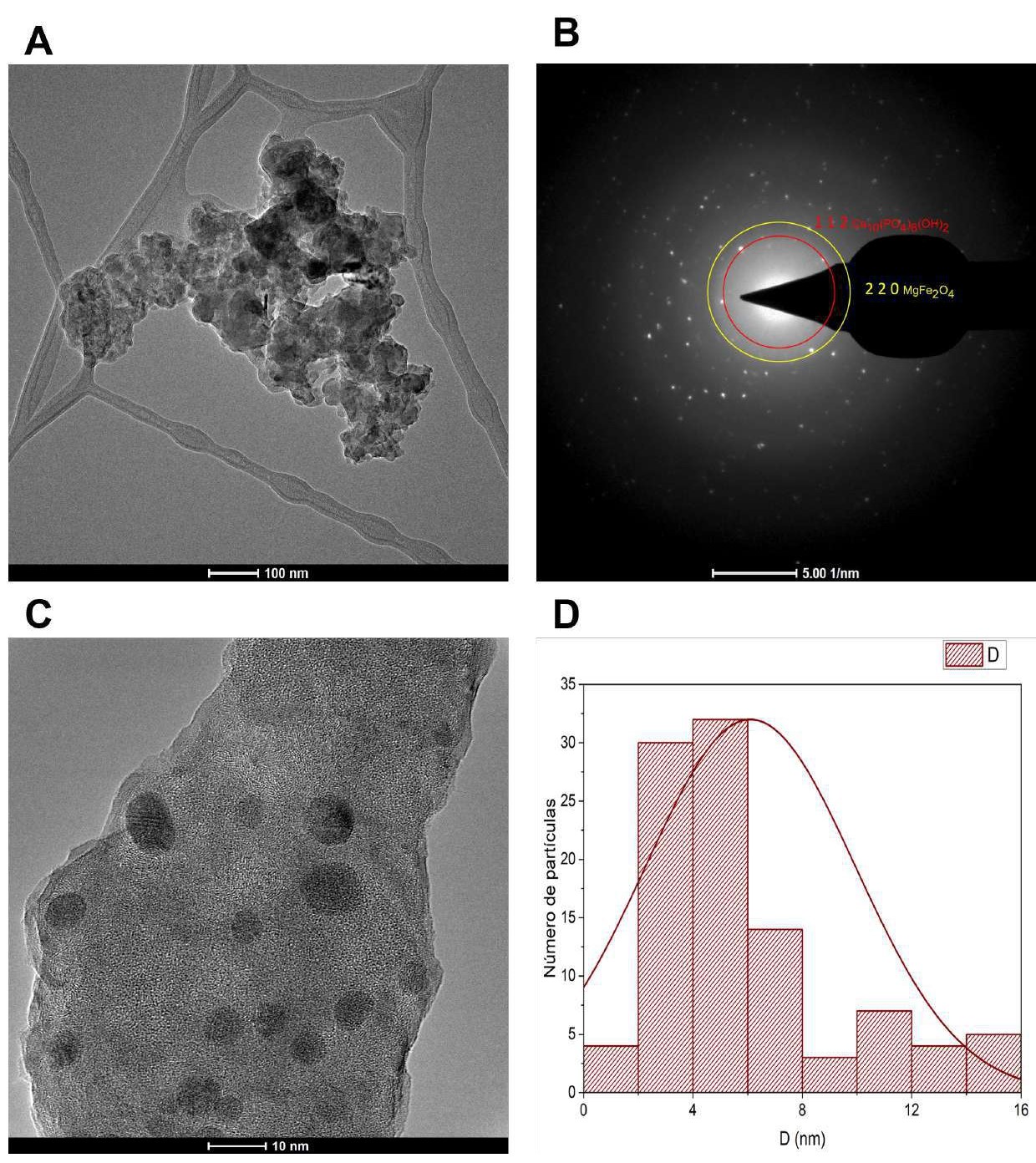
In this study, magnetic glass-ceramics with 5, 10, 15, and 20 wt% of MgFe₂O₄ were synthesized using the sol-gel method. In order to evaluate the effect of the percentage of MgFe₂O₄ addition on the magnetic properties. The materials obtained were characterized using XRD, FTIR, VSM, and TEM. XRD and FTIR analyses revealed the presence of the MgFe₂O₄ phase and the formation of the hydroxyapatite phase. Hysteresis curves demonstrated superparamagnetic behavior, with a saturation magnetization of 7.95 emu/g in the samples containing 20% MgFe₂O₄. TEM analysis identified nanoparticles with spherical morphologies, with an average particle size of 6.10 nm.
References
Abdel-Hameed, S. A. M. M., El-Kady, A. M., & Marzouk, M. A. (2014). Magnetic glass ceramics for sustained 5-fluorouracil delivery: Characterization and evaluation of drug release kinetics. Materials Science and Engineering C, 44, 293–309. https://doi.org/10.1016/j.msec.2014.08.022
Anand, V., Chaudhary, A., Meenakshi, Bhatia, G., Heera, P., & Thakur, S. (2023). Magnetic biomaterials with nanostructures for improved medication delivery and bone regeneration. First-level investigation. Journal of Asian Ceramic Societies, 11(4), 526–534. https://doi.org/10.1080/21870764.2023.2251245
B. D. Cullity, C. D. G.-. (2008). Introduction to magnetic materials.
Borges, R., Ferreira, L. M., Rettori, C., Lourenço, I. M., Seabra, A. B., Muller, F. A., Ferraz, E. P., Marques, M. M., Miola, M., Baino, F., Mamani, J. B., Gamarra, L. F., & Marchi, J. (2022). Superparamagnetic and highly bioactive SPIONS/bioactive glass nanocomposite and its potential application in magnetic hyperthermia. Materials Science and Engineering: C, March 2021, 112655. https://doi.org/10.1016/j.msec.2022.112655
De Hoyos-Sifuentes, D. H., Reséndiz-Hernández, P. J., Díaz-Guillén, J. A., Ochoa-Palacios, R. M., & Altamirano-Guerrero, G. (2022). Synthesis and characterization of MgFe2O4nanoparticles and PEG-coated MgFe2O4nanocomposite. Journal of Materials Research and Technology, 18, 3130–3142. https://doi.org/10.1016/j.jmrt.2022.03.117
Díez-Tercero, L., Delgado, L. M., Bosch-Rué, E., & Perez, R. A. (2021). Evaluation of the immunomodulatory effects of cobalt, copper and magnesium ions in a pro inflammatory environment. Scientific Reports, 11(1), 1–13. https://doi.org/10.1038/s41598-021-91070-0
Farid, S. B. H. H. (2019). Bioceramics: For Materials Science and Engineering (Vol. 1).
Ghaebi Panah, N., Atkin, R., & Sercombe, T. B. (2021). Effect of low temperature crystallization on 58S bioactive glass sintering and compressive strength. Ceramics International, 47(21), 30349–30357. https://doi.org/10.1016/j.ceramint.2021.07.215
Goudouri, O. M., Chatzistavrou, X., Kontonasaki, E., Kantiranis, N., Papadopoulou, L., Chrissafis, K., & Paraskevopoulos, K. M. (2009). Study of the bioactive behavior of thermally treated modified 58S bioactive glass. Key Engineering Materials, 396–398, 131–134. https://doi.org/10.4028/www.scientific.net/kem.396-398.131
Hench, L. L. (2000). (ii) The challenge of orthopaedic materials. Current Orthopaedics, 14(1), 7–15. https://doi.org/10.1054/cuor.1999.0074
Hench, L. L. (2006). The story of Bioglass®. Journal of Materials Science: Materials in Medicine, 17(11), 967–978. https://doi.org/10.1007/s10856-006-0432-z
Hurley, K. R., Ring, H. L., Kang, H., Klein, N. D., & Haynes, C. L. (2015). Characterization of Magnetic Nanoparticles in Biological Matrices. Analytical Chemistry, 87(23), 11611–11619. https://doi.org/10.1021/acs.analchem.5b02229
Joughehdoust, S., & Manafi, S. (2012). Synthesis and in vitro investigation of sol-gel derived bioglass-58S nanopowders. Materials Science- Poland, 30(1), 45–52. https://doi.org/10.2478/s13536-012-0007-2
Kaou, M. H., Furkó, M., Balázsi, K., & Balázsi, C. (2023). Advanced Bioactive Glasses: The Newest Achievements and Breakthroughs in the Area. Nanomaterials, 13(16), 1–33. https://doi.org/10.3390/nano13162287
Luderer, A. A., Borrelli, N. F., Panzarino, J. N., Mansfield, G. R., Hess, D. M., Brown, J. L., Barnett, E. H., & Hahn, E. W. (1983). Glass-ceramic-mediated, magnetic-field-induced localized hyperthermia: Response of a murine mammary carcinoma. Radiation Research, 94(1), 190–198. https://doi.org/10.2307/3575874
Marghussian, V. (2015). Magnetic Properties of Nano-Glass Ceramics. In Nano-Glass Ceramics. Elsevier. https://doi.org/10.1016/b978-0-323-35386-1.00004-9
Poddar, A., Halder, S., Liba, S. I., Hoque, S. M., & Sikder, S. S. (2022). Study of the Effect of Quenching on Microstructural and Magnetic Properties of Cu-Doped Mg-Ferrite. Advances in Condensed Matter Physics, 2022. https://doi.org/10.1155/2022/3354087
Predescu, A. M., Matei, E., Berbecaru, A. C., Pantilimon, C., Drăgan, C., Vidu, R., Predescu, C., & Kuncser, V. (2018). Synthesis and characterization of dextran-coated iron oxide nanoparticles. Royal Society Open Science, 5(3). https://doi.org/10.1098/rsos.171525
Sandu, V., Kuncser, V., Damian, R., & Sandu, E. (2012). Magnetic glass-ceramics. 1(2), 138–143. https://doi.org/10.1007/s40145-012-0010-4
Shahjuee, T., Masoudpanah, S. M., & Mirkazemi, S. M. (2019). Thermal Decomposition Synthesis of MgFe2O4 Nanoparticles for Magnetic Hyperthermia. Journal of Superconductivity and Novel Magnetism, 32(5), 1347–1352. https://doi.org/10.1007/s10948-018-4834-1
Shearer, A., Montazerian, M., & Mauro, J. C. (2023). Modern definition of bioactive glasses and glass-ceramics. Journal of Non-Crystalline Solids, 608, 1–20. https://doi.org/10.1016/j.jnoncrysol.2023.122228
Thompson, Z., Rahman, S., Yarmolenko, S., Sankar, J., Kumar, D., & Bhattarai, N. (2017). Fabrication and characterization of magnesium ferrite-based PCL/Aloe vera nanofibers. Materials, 10(8), 1–12. https://doi.org/10.3390/ma10080937
Yeap, S. P., Lim, J. K., Ooi, B. S., & Ahmad, A. L. (2017). Agglomeration, colloidal stability, and magnetic separation of magnetic nanoparticles: collective influences on environmental engineering applications. Journal of Nanoparticle Research, 19(11). https://doi.org/10.1007/s11051-017-4065-6
Zhu, Y., Zhang, X., Chang, G., Deng, S., & Chan, H. F. (2024). Bioactive Glass in Tissue Regeneration: Unveiling Recent Advances in Regenerative Strategies and Applications. Advanced Materials, 2312964, 1–16. https://doi.org/10.1002/adma.202312964