Optimization and Evaluation of Photocatalytic Coatings with TiO2 Nanoparticles for the Elimination of Pathogenic Microorganisms in Critical Environments
Keywords:
TiO2 photocatalysis, Antibacterial coatings, Pathogen elimination, Escherichia coli, Staphylococcus aureus.Abstract
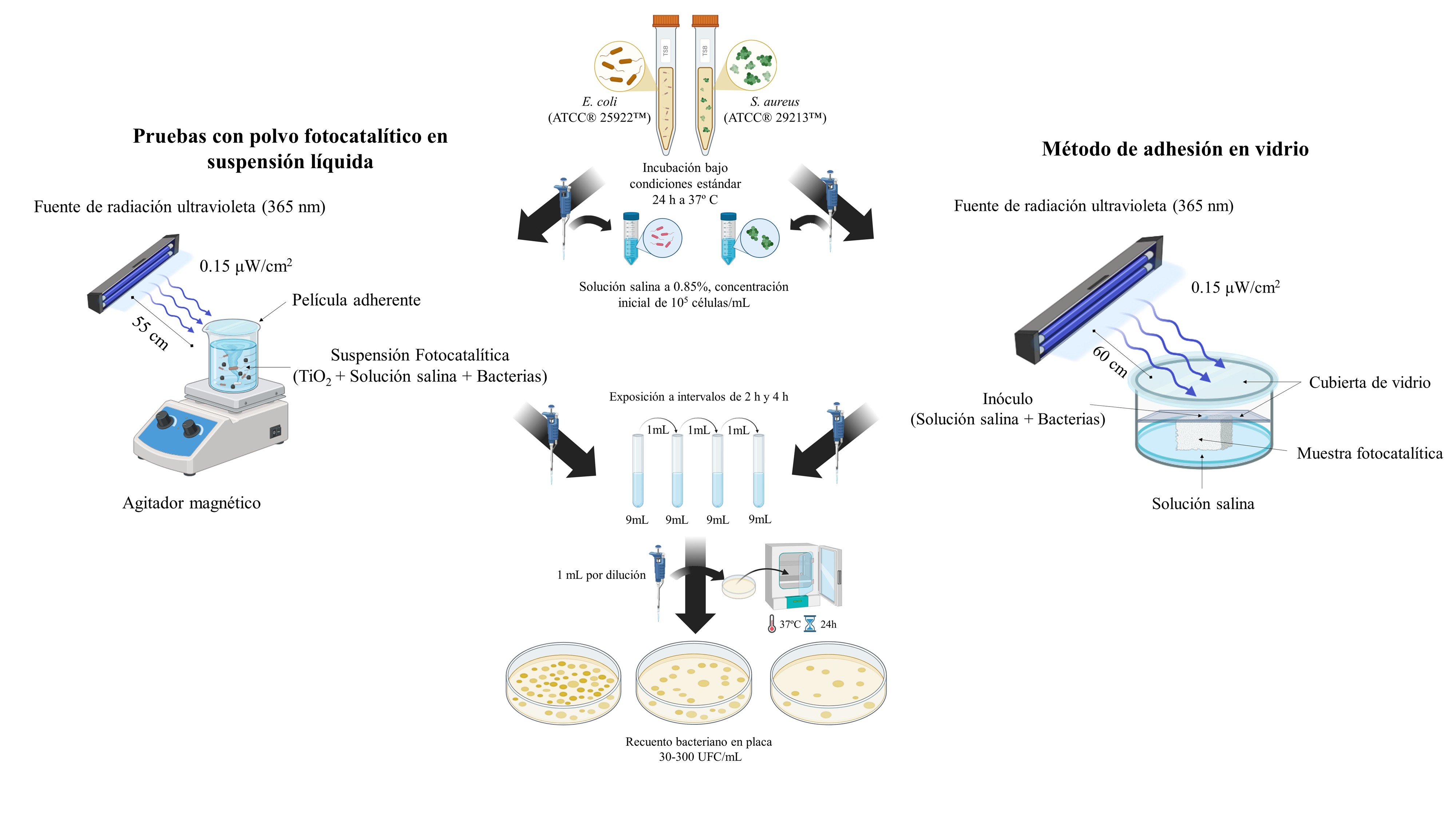
Humid indoor environments facilitate the proliferation of microorganisms, posing significant risks to public health. This study focuses on the efficacy of photocatalytic coatings with Degussa P25 titanium dioxide (TiO2) nanoparticles in eliminating Escherichia coli and Staphylococcus aureus under UV irradiation. The aim was not only to demonstrate the effectiveness of these coatings but also to improve the evaluation methodology for future photocatalytic materials. Two methodologies were applied: the glass adhesion method, based on ISO 27447:2009, and a photocatalytic powder test in liquid suspension, adapted from the scientific literature. The results showed a significant reduction in the number of bacterial colony-forming units (CFUs) with the photocatalytic coatings, in contrast to the controls where bacterial concentrations remained constant. Several relevant methodological improvements were implemented, such as extending the range of UV intensities and times, enhancing coating application methods, evaluating variable testing conditions, and optimizing inoculum and photocatalytic suspension distribution. These methodological improvements are crucial for the evaluation of new photocatalytic materials with potential applications in critical environments such as hospitals and schools, thus promoting public health and safety by reducing the spread of pathogens.
References
1. Ni, J., Huang, S., Liang, Z., Chen, Z., Zhang, S., Li, G., & An, T. (2024). Concentration, pathogenic composition, and exposure risks of bioaerosol in large indoor public environments: A comparative study of urban and suburban areas. Science of The Total Environment, 957, 177790. https://doi.org/10.1016/j.scitotenv.2024.177790
2. World Health Organization. (2011). Report on the burden of endemic health care-associated infection worldwide. Geneva: World Health Organization. Retrieved from https://apps.who.int/iris/handle/10665/80135
3. Asegu, L. M., Kitschen, A., Neuwirth, M. M., & others. (2024). The economic burden of nosocomial infections for hospitals: Evidence from Germany. BMC Infectious Diseases, 24, 1294. https://doi.org/10.1186/s12879-024-10176-8
4. Kurt, G., & Serdaroğlu, H. U. (2024). Prevalence of infectious diseases in children at preschool education institutions and stakeholder opinions. Children, 11(4), 447. https://doi.org/10.3390/children11040447
5. Rock, C., & Dannenberg, M. S. (2014). Human pathogenic Enterobacteriaceae. In Reference Module in Biomedical Sciences. Elsevier. https://doi.org/10.1016/B978-0-12-801238-3.00136-7
6. Seyyed Mousavi, M. N., Mehramuz, B., Sadeghi, J., Alizadeh, N., Ahangar Oskouee, M., & Samadi Kafil, H. (2017). The pathogenesis of Staphylococcus aureus in autoimmune diseases. Microbial Pathogenesis, 111, 503–507. https://doi.org/10.1016/j.micpath.2017.09.028
7. Green, B. N., Johnson, C. D., Egan, J. T., Rosenthal, M., Griffith, E. A., & Evans, M. W. (2012). Methicillin-resistant Staphylococcus aureus: An overview for manual therapists. Journal of Chiropractic Medicine, 11(1), 64–76. https://doi.org/10.1016/j.jcm.2011.12.001
8. Täubel, M., Castagnoli, E., Salthammer, T., Morawska, L., & Salonen, H. (2024). The impact of cleaning on the microbiomes of indoor surfaces. Indoor Environments, 1(3), 100021. https://doi.org/10.1016/j.indenv.2024.100021
9. Foster, H. A., Ditta, I. B., Varghese, S., & Steele, A. (2011). Photocatalytic disinfection using titanium dioxide: Spectrum and mechanism of antimicrobial activity. Applied Microbiology and Biotechnology, 90(6), 1847–1868. https://doi.org/10.1007/s00253-011-3213-7
10. Ayorinde, T., & Sayes, C. M. (2023). An updated review of industrially relevant titanium dioxide and its environmental health effects. Journal of Hazardous Materials Letters, 4, 100085. https://doi.org/10.1016/j.hazl.2023.100085
11. Tasisa, Y. E., Sarma, T. K., Krishnaraj, R., & Sarma, S. (2024). Band gap engineering of titanium dioxide (TiO₂) nanoparticles prepared via green route and its visible light driven for environmental remediation. Results in Chemistry, 11, 101850. https://doi.org/10.1016/j.rechem.2024.101850
12. Abu-Dalo, M., Jaradat, A., Albiss, B. A., & Al-Rawashdeh, N. A. F. (2019). Green synthesis of TiO₂ NPs/pristine pomegranate peel extract nanocomposite and its antimicrobial activity for water disinfection. Journal of Environmental Chemical Engineering, 7(5), 103370. https://doi.org/10.1016/j.jece.2019.103370
13. Younis, A. B., Milosavljevic, V., Fialova, T., & others. (2023). Synthesis and characterization of TiO₂ nanoparticles combined with geraniol and their synergistic antibacterial activity. BMC Microbiology, 23, 207. https://doi.org/10.1186/s12866-023-02955-1
14. Moradpoor, H., Safaei, M., Golshah, A., Mozaffari, H. R., Sharifi, R., Imani, M. M., & Mobarakeh, M. S. (2021). Green synthesis and antifungal effect of titanium dioxide nanoparticles on oral Candida albicans pathogen. Inorganic Chemistry Communications, 130, 108748. https://doi.org/10.1016/j.inoche.2021.108748
15. Bregnocchi, A., Jafari, R., & Momen, G. (2022). Design strategies for antiviral coatings and surfaces: A review. Applied Surface Science Advances, 8, 100224. https://doi.org/10.1016/j.apsadv.2022.100224
16. Wei, Y., Meng, H., Wu, Q., Bai, X., & Zhang, Y. (2023). TiO₂-based photocatalytic building material for air purification in sustainable and low-carbon cities: A review. Catalysts, 13(12), 1466. https://doi.org/10.3390/catal13121466
17. ISO. (2009). ISO 27447:2009 - Test method for antibacterial activity of semiconducting photocatalytic materials. International Organization for Standardization.
18. Verdier, T., Coutand, M., Bertron, A., & Roques, C. (2014). Antibacterial activity of TiO₂ photocatalyst alone or in coatings on E. coli: The influence of methodological aspects. Coatings, 4(3), 670–686. https://doi.org/10.3390/coatings4030670
19. Hsu, C.-Y., Mahmoud, Z. H., Abdullaev, S., Ali, F. K., Naeem, Y. A., Mizher, R. M., Karim, M. M., Abdulwahid, A. S., Ahmadi, Z., Habibzadeh, S., & Kianfar, E. (2024). Nano titanium oxide (nano-TiO₂): A review of synthesis methods, properties, and applications. Case Studies in Chemical and Environmental Engineering, 9, 100626. https://doi.org/10.1016/j.cscee.2024.100626
20. Kumaravel, V., Nair, K. M., Mathew, S., Bartlett, J., Kennedy, J. E., Manning, H. G., Whelan, B. J., Leyland, N. S., & Pillai, S. C. (2021). Antimicrobial TiO₂ nanocomposite coatings for surfaces, dental and orthopaedic implants. Chemical Engineering Journal, 416, 129071. https://doi.org/10.1016/j.cej.2021.129071
21. Nishu, & Kumar, S. (2023). Smart and innovative nanotechnology applications for water purification. Hybrid Advances, 3, 100044. https://doi.org/10.1016/j.hybadv.2023.100044
22. Rotini, A., Tornambè, A., Cossi, R., Iamunno, F., Benvenuto, G., Berducci, M. T., Maggi, C., Thaller, M. C., Cicero, A. M., Manfra, L., & Migliore, L. (2017). Salinity-based toxicity of CuO nanoparticles, CuO-bulk and Cu ion to Vibrio anguillarum. Frontiers in Microbiology, 8, 2076. https://doi.org/10.3389/fmicb.2017.02076
23. Zeng, F., Cao, S., Jin, W., Zhou, X., Ding, W., Tu, R., Han, S.-F., Wang, C., Jiang, Q., Huang, H., & Ding, F. (2020). Inactivation of chlorine-resistant bacterial spores in drinking water using UV irradiation, UV/hydrogen peroxide and UV/peroxymonosulfate: Efficiency and mechanism. Journal of Cleaner Production, 243, 118666. https://doi.org/10.1016/j.jclepro.2019.118666
24. Seiß, V., Thiel, S., & Eichelbaum, M. (2022). Preparation and real world applications of titania composite materials for photocatalytic surface, air, and water purification: State of the art. Inorganics, 10(9), 139. https://doi.org/10.3390/inorganics10090139
25. Pleskova, S. N., Golubeva, I. S., & Verevkin, Y. K. (2016). Bactericidal activity of titanium dioxide ultraviolet-induced films. Materials Science and Engineering: C, 59, 807–817. https://doi.org/10.1016/j.msec.2015.10.021
26. Tong, Y., Shi, G., Hu, G., Hu, X., Han, L., Xie, X., Xu, Y., Zhang, R., Sun, J., & Zhong, J. (2021). Photo-catalyzed TiO₂ inactivates pathogenic viruses by attacking viral genome. Chemical Engineering Journal, 414, 128788. https://doi.org/10.1016/j.cej.2021.128788
27. Rokicka-Konieczna, P., & Morawski, A. W. (2024). Photocatalytic bacterial destruction and mineralization by TiO₂-based photocatalysts: A mini review. Molecules, 29(10), 2221. https://doi.org/10.3390/molecules29102221
28. Ohno, T., Sarukawa, K., Tokieda, K., & Matsumura, M. (2001). Morphology of a TiO₂ photocatalyst (Degussa, P-25) consisting of anatase and rutile crystalline phases. Journal of Catalysis, 203(1), 82–86. https://doi.org/10.1006/jcat.2001.3316
29. Reddy, P. V. L., Kavitha, B., Reddy, P. A. K., & Kim, K.-H. (2017). TiO₂-based photocatalytic disinfection of microbes in aqueous media: A review. Environmental Research, 154, 296–303. https://doi.org/10.1016/j.envres.2017.01.018
30. Armaković, S. J., Savanović, M. M., & Armaković, S. (2023). Titanium dioxide as the most used photocatalyst for water purification: An overview. Catalysts, 13(1), 26. https://doi.org/10.3390/catal13010026
31. Gatou, M.-A., Syrrakou, A., Lagopati, N., & Pavlatou, E. A. (2024). Photocatalytic TiO₂-based nanostructures as a promising material for diverse environmental applications: A review. Reactions, 5(1), 135–194. https://doi.org/10.3390/reactions5010007