Analysis of anticorrosive behavior of Ni-Nb binary eutectic metallic glasses in a basic medium using electrochemical techniques
Keywords:
Corrosion, Melt Spinner, Ni-Nb, Passivation, Metallic glasses.Abstract
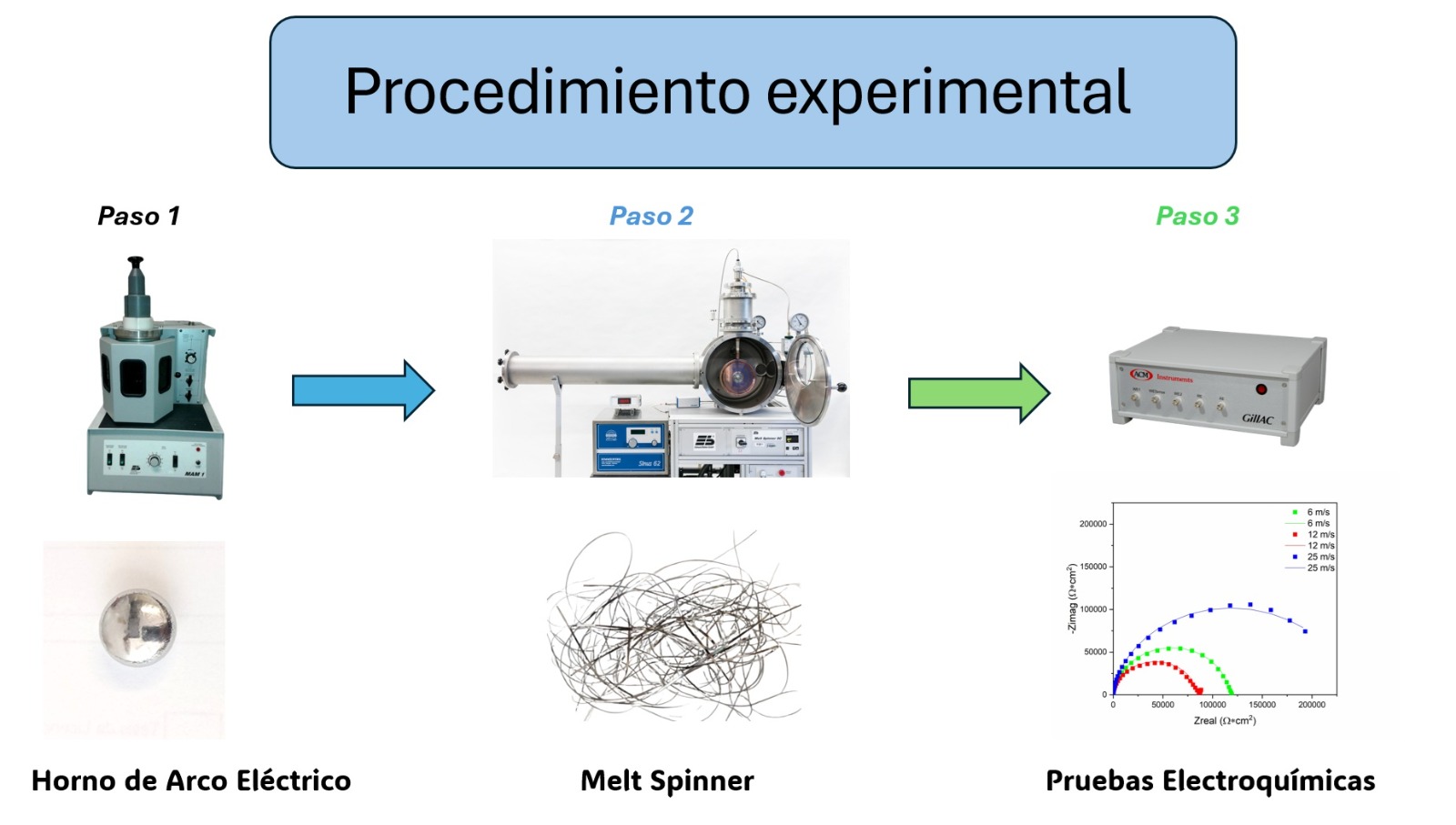
Metallic glasses have emerged as innovative materials in the manufacture of everyday electronic devices such as mobile phones, smartwatches, memory cards, and hard drives. Due to these applications, they are frequently exposed to alkaline pH substances in products such as soaps, lotions, and creams, posing challenges in terms of chemical stability and corrosion resistance. An electrochemical corrosion study was therefore carried out on Ni-Nb binary metallic glasses with eutectic composition (Ni₅₉.₅ Nb₄₀.₅) in 1M NaOH. The synthesis method was with fast solidification by Melt Spinner, three tape thicknesses obtained by varying the wheel spinning speed (6, 12 and 25 m/s) were studied. The structure of the ribbons was characterized by X-ray diffraction (XRD) to corroborate the vitrification. The electrochemical techniques used to evaluate the anticorrosive behavior of the metallic glasses were: Electrochemical impedance spectroscopy (EIS) and cyclic polarization curves (CPC). The XRD results revealed that the vitrification of the material is maintained in the different thickness worked. The Electrochemical tests in alkaline medium indicated that the thickest sample exhibited the highest corrosion potential (Ecorr) and the lowest corrosion rate. Additionally, the CPC results a pseudo-passivation behavior was observed at 10⁻³ mA/cm². Upon potential reversal, a negative hysteresis was observed, which has been reported in the literature as indicative of immunity to localized corrosion. These findings suggest that Ni-Nb metallic glasses demonstrate high corrosion resistance in alkaline environments, reinforcing their potential for applications in electronic devices exposed to aggressive conditions.
References
[1] Baker, H., & Okamoto, H. (1992). ASM handbook. vol. 3. alloy phase diagrams. ASM International, Materials Park, Ohio 44073-0002, USA, 1992. 501. https://doi.org/10.31399/asm.hb.v03.9781627081634
[2] Yang, L., Zhang, H. R., Zhang, S., Shi, Z. L., Wei, C., Ma, M. Z., & Liu, R. P. (2023). “Effect of Cu content on the corrosion behavior of Ti-based bulk amorphous alloys in HCl solution”. Materials Letters, 337, 133742. https://doi.org/10.1016/j.matlet.2022.133742
[3] Tamilselvam, K., Saini, J. S., Xu, D., & Brabazon, D. (2022). “Corrosion behavior of new rare-earth free CU-based metallic glasses in NaCl solution of different molarity”, Journal of Materials Research and Technology, 16, 482-494.https://doi.org/10.1016/j.jmrt.2021.12.027
[4] Liu, C., Wang, Q., Han, B., Luan, J., Kai, J., Wu, G., & Lü, J. (2021). “Second phase effect on corrosion of nanostructured Mg-Zn-Ca dual-phase metallic glasses”, Journal of Magnesium and Alloys, 9(5), 1546-1555. https://doi.org/10.1016/j.jma.2021.03.016
[5] Jiang, L., Bao, M., Dong, Y., Yuan, Y., Zhou, X., & Meng, X. (2023). “Processing, production and anticorrosion behavior of metallic glasses: A critical review”. Journal of Non-Crystalline Solids, 612, 122355. https://doi.org/10.1016/j.jnoncrysol.2023.122355
[6] Wang, Z. M., Zhang, J., Chang, X. C., Hou, W. L., & Wang, J. Q. (2010). “Structure inhibited pit initiation in a Ni–Nb metallic glass”. Corrosion Science, 52(4), 1342-1350.
https://doi.org/10.1016/j.corsci.2009.12.014
[7] Chae, W. S., Yusof, N. M., Lee, K. H., Kwan, S. K., Park, H. W., Jiang, J. Z., & Caron, A. (2022). “Corrosion effects on the nanotribology of a Ni62Nb38 metallic glass”. Applied Surface Science, 573, 151628. https://doi.org/10.1016/j.apsusc.2021.151628
[8] Wu, Z. F., Cao, Q. P., Ma, Y., Wang, C., Liu, S. Y., Qian, X., ... & Jiang, J. Z. (2014). “Thickness-dependent pitting corrosion behavior in Ni–Nb thin film metallic glass”. Thin solid films, 564, 294-298. https://doi.org/10.1016/j.tsf.2014.06.019
[9] Zhang, M., Huang, T., Zhang, J., Deng, L., Gong, P., & Wang, X. (2022). “Influence of oxidation on structure, performance, and application of metallic glasses”. Advanced Materials, 34(52), 2110365. https://doi.org/10.1002/adma.202110365
[10] Wang, Y., Si, J., Si, Y., & Shi, Z. (2023). “Preparation and electrochemical corrosion performances of Zr-Ti-Ni-Cu-Be high-entropy bulk metallic glasses”. Materials Science and Engineering: B, 289, 116267. https://doi.org/10.1016/j.mseb.2023.116267
[11] Sun, J., Zhang, M., Ding, G., Wang, Y., Yu, M., LiuWang, F., Sun, Y., Zhu, K., Zhao, X., & Liu, L. (2022). “Hydrophobic and corrosion resistance properties of the electrochemically etched ZR-based bulk metallic glasses after annealing and cryogenic thermal cycling treatment”, Colloids and Surfaces A: Physicochemical and Engineering Aspects, 635, 128107. https://doi.org/10.1016/j.colsurfa.2021.128107
[12] Nguyen, T.T., Arrighi C., Thai T.T., Dangreau L., Gonon M.F., Trinh A.T., Olivier M.-G. (2023). “Inhibitive effect of the Ce (III) chloride and nitrate on the corrosion resistance of Zn alloyed sacrificial coatings: Effect of alloying compounds of the sacrificial layer”. Electrochimica Acta, 142296. https://doi.org/10.1016/j.electacta.2023.142296
[13] Carnot, A., Frateur, I., Zanna, S., Tribollet, B., Dubois-Brugger, I., & Marcus, P. (2003). “Corrosion mechanisms of steel concrete moulds in contact with a demoulding agent studied by EIS and XPS.” Corrosion science, 45(11), 2513-2524. https://doi.org/10.1016/S0010-938X(03)00076-3
[14] Parau, A. C., Juravlea, G. A., Raczkowska, J., Vițelaru, C., Dinu, M., Awsiuk, K., Vrânceanu, D. M., Ungureanu, E., Cotruț, C. M., & Vlădescu, A. (2023). “Comparison of 316L and TI6AL4V biomaterial coated by ZRCU-based thin films Metallic glasses: structure, morphology, wettability, protein adsorption, corrosion resistance, biomineralization”, Applied Surface Science, 612, 155800. https://doi.org/10.1016/j.apsusc.2022.155800
[15] Xu, Y., D. G. (2021). Anticorrosive behavior of epoxy coating modified with hydrophobic nano-silica on phosphatized carbon steel. Progress in Organic Coatings, 106051.
[16] Liao, H., Wu, M., Deng, D., Zhong, W., Xiong, B., & Tong, Y. (2022). “Effects of Ti content on the microstructure, mechanical properties and corrosion behavior of TixZrNb alloys”. Journal of Materials Research and Technology, 19, 1433-1443. https://doi.org/10.1016/j.jmrt.2022.05.140
[17] Pourbaix, M., & Burbank, J. (1964). “Atlas D-equilibres electrochimiques”. Journal of The Electrochemical Society, 111(1), 14C. https://doi.org/10.1149/1.2426051