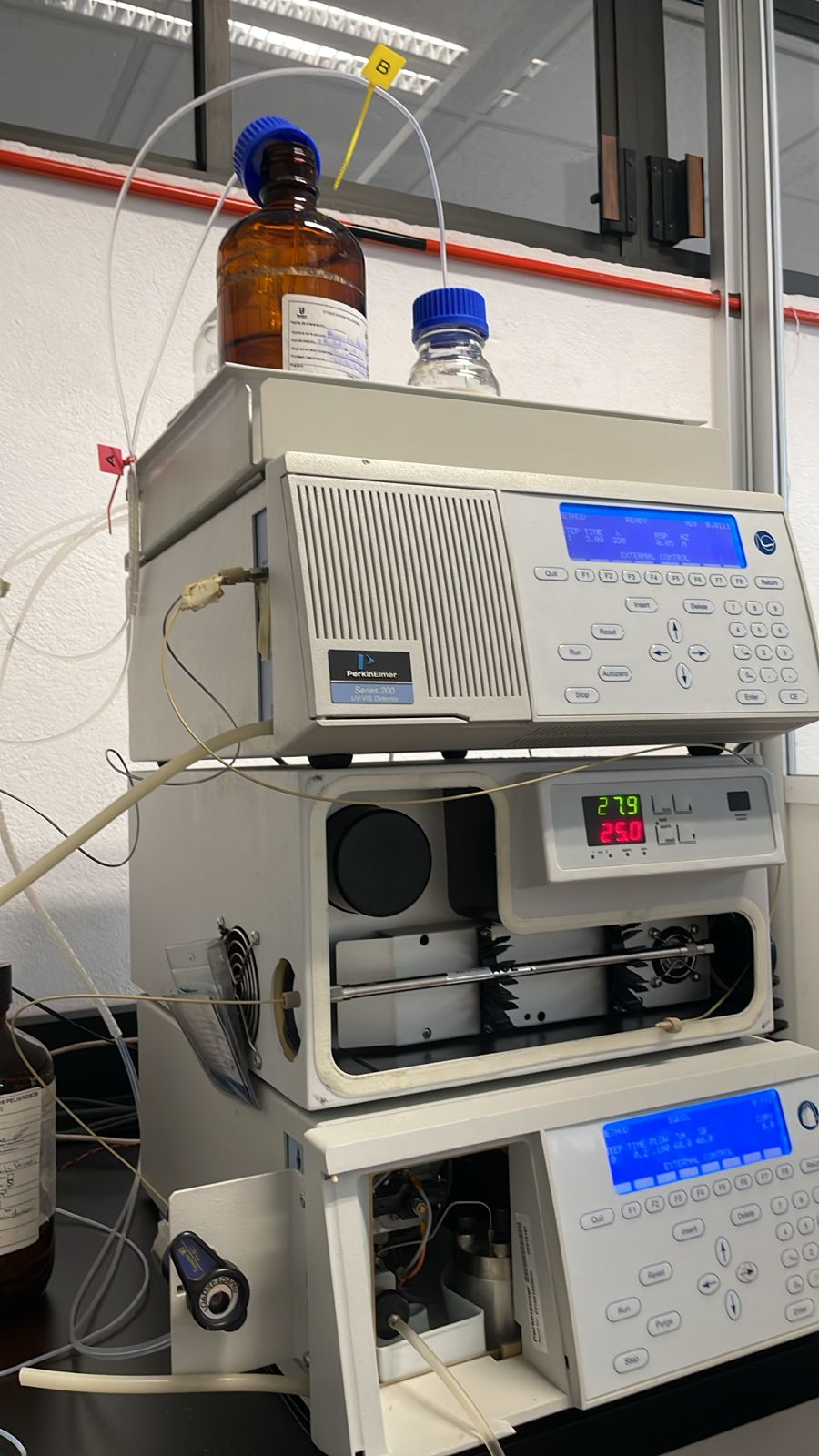
Development of an analytical method for the determination of ciprofloxacin, diclofenac, acetaminophen, and carbamazepine by High-Performance Liquid Chromatography
DOI:
https://doi.org/10.68038/6nct2t93Keywords:
Chromatography, emerging pollutants, pharmaceuticals.Abstract
The drugs used in this study are commonly used in Mexico to treat joint pain (diclofenac), fever (acetaminophen), bacterial infections (ciprofloxacin), and epilepsy (carbamazepine). High-Performance Liquid Chromatography (HPLC) has been reported for the analysis of various compounds present in biological and environmental fluids. The objective of this study was to develop a rapid and simple method for determining the aforementioned medications in water samples. For this purpose, the HPLC method with ultraviolet detection at 277 nm, an isocratic mobile phase, and a quantification range of 1 to 50 μg∙mL-1 was used. The retention times were 6.49, 8.45, 9.56 and 8.56 minutes for diclofenac, ciprofloxacin, acetaminophen, and carbamazepine, respectively, at the same wavelength. Precision and accuracy exceeded 95%, and the total elution time was 12 minutes per sample. An analytical method for the determination of diclofenac, ciprofloxacin, acetaminophen and carbamazepine in water was developed and implemented. This method was sufficiently sensitive, accurate, and reproducible, with a degree of error of less than 5%, making it suitable for use in future studies.
References
[1] Ahmed, R. (2024). High-Performance Liquid Chromatography (HPLC): Principles, Applications, Versatility, Efficiency, Innovation and Comparative Analysis. Clinical Investigation, 14(9). ISSN: 2041-6792. Doi:
[2] Hussein J. (2025). Principles and Applications of High-Performance Liquid Chromatography (HPLC): A Review. Biomedical and Pharmacology Journal. 18(2). Doi: https://dx.doi.org/10.13005/bpj/3154
[3] Khan, M. A., Dalwadi, M., & Upadhayay, U. M. (2024). A review on high performance liquid chromatography technique for pharmaceutical analysis. International Journal of Pharmaceutical Research and Applications, 9(2), 2385-2389. ISSN: 2456-4494. Doi: 10.35629/4494-090223852389.
[4] Thermo Fisher Scientific. (2024, October 28). Conceptos básicos de la HPLC. Retrieved from Thermo Fisher Scientific: https://www.thermofisher.com/mx/es/home/industrial/chromatography/chromatography-learning-center/liquid-chromatography-information/hplc-basics.html
[5] Dhirendra K.M, Mahato A.K. & Koiri S. (2024). HPLC method development and validation: A review. World Journal of Pharmaceutical and Medical Research. 10 (1); 233-241. ISSN: 2455-3301. Retrieved from:
[6] Avilés-Flores, M., Sánchez-Zarza, M., & Tapia-Acosta, J. (2016). Proyecto "Métodos analíticos para determinación de contaminantes emergentes en agua" TC 1602.1. Morelos, México: Instituto Mexicano de Tecnología del Agua.
[7] Schieppati, D., Patience, N. A., Campisi, S., & Patience, G. S. (2021). Experimental methods in chemical engineering: High performance liquid chromatography—HPLC. In Canadian Journal of Chemical Engineering (Vol. 99, Issue 8, pp. 1663–1682). John Wiley and Sons Inc. https://doi.org/10.1002/cjce.24050
[8] Bounegru, A. V., Dinu Iacob, A., Iticescu, C., & Georgescu, P. L. (2025). Electrochemical Sensors and Biosensors for the Detection of Pharmaceutical Contaminants in Natural Waters—A Comprehensive Review. In Chemosensors (Vol. 13, Issue 2). Multidisciplinary Digital Publishing Institute (MDPI). https://doi.org/10.3390/chemosensors13020065
[9] Omitoyin, B. O., Ajani, E. K., Adesina, B. T., & Okunade, O. A. (2021). Acute effects of acetaminophen on the developmental, swimming performance and cardiovascular activities of African catfish embryos/larvae (Clarias gariepinus). Ecotoxicology and Environmental Safety, 208, 111482. https://doi.org/10.1016/j.ecoenv.2020.111482
[10] Patrolecco , L., Ademollo, N., Grenni, P., Tolomei, A., Caracciolo, A., & Capri, S. (2013). Simultaneous determination of human pharmaceuticals in water samples by solid phase extraction and HPLC with UV-fluorescence detection. Microchemical Journal, 107: 165-171. doi:https://doi.org/10.1016/j.microc.2012.05.035
[11] Tiwari, B., Sellamuthu, B., Ouarda, Y., Drogui, P., Tyagi, R., & Buelna, G. (2017). Review on Fate and Mechanism of removal of pharmaceutical pollutants from wastewaterusing biological approach. Bioresource Technology, 224: 1-12. doi:https://doi.org/10.1016/j.biortech.2016.11.042
[12] Mandaric, I., Celic, M. M., & Petrovic, M. (2016). Introduction on emerging contaminants in rivers and their enviromental risk. In M. Petrovic, S. Sabater, A. Elosegi, & D. Barceló, Emerging Contaminants in River Ecosystems: Occurrence and Effects Under Multiple Stress Conditions (p. 219). Suiza, Suiza: Springer.
[13] PerkinElmer. (2000). Curso básico de cromatografía de líquidos. México, CDMX: PerkinElmer de México, S.A.
[14] Scherer , R., Pereira , J., Firme , J., Lemos, M., & Lemos, M. (2014). Determination of Ciprofloxacin in Pharmaceutical Formulations Using HPLC Method with UV Detection. Indian Journal of Pharmaceutical Sciences, 76(6):541-4. doi:PMCID: PMC4293686 PMID: 25593388
[15] Sibinovi, P., Melcerovi, A., Palic, R., Dordevic, S., & Marinkovic, V. (2005). Ruggedness testing of an HPLC method for the determination of ciprofloxacin. Journal of the Serbian Chemical Society, 70 (7) 979–986. doi:10.2298/JSC0507979S
[16] Fukushima, A. R., Peña-Muñoz, J. W., Leoni, L. A. B., Nicoletti, M. A., Ferreira, G. M., Delorenzi, J. C. M. O. B., Ricci, E. L., Brandão, M. E., Pantaleon, L. de P., Gonçalves-Junior, V., Waziry, P. A. F., Maiorka, P. C., & Spinosa, H. de S. (2022). Development, Optimization, and Validation of Forensic Analytical Method for Quantification of Anticholinesterase Pesticides in Biological Matrices from Suspected Cases of Animal Poisoning. Toxics, 10(5). https://doi.org/10.3390/toxics10050269
[17] Long, G., & Winefordner, J. (1983). Limit of detection. A closer look at the IUPAC definition. Analytical chemistry, 55 (7): 712A-724A. doi:10.1021/ac00258a001
[18] Shah, V., Midha, K. K., Dighe, S., McGilveray, I. J., Skelly, J. P., Yacobi, A., . . . Spector, S. (1992). Analytical Methods Validation: Bioavailability, Bioequivalence and Pharmacokinetic Studies. Pharmaceutical Research, 9: 588–592.
[19] Frank, E., Prieto, A., & Castillo, M. (2009). Metodología de identificación cualitativa y cuantitativa de fibras textiles naturales. Córdoba: Sustentabilidad Productiva de Pequeños Rumiantes en Áreas.
[20] Synder, Lloyed R., Kirkland Joseph J. & Dolan, John (2010). Introduction to modern liquid chromatography, 3rd edition. Wiley & Sons Ltd. 960 pages, Hardcover. ISBN:9780470508183. Doi:10.1002/9780470508183
[21] Qasim, B., Razzak, A. A., Motelica-Heino, M., Kamil, G. M., & Morabito, D. (2020). Quantitative determination of fluoroquinolones in contaminated soils by HPLC with solid-phase extraction. Baghdad Science Journal, 17(1), 48–566. https://doi.org/10.21123/bsj.2020.17.1.0048
[22] Stafiej, A., Pyrzynska, K., & Regan, F. (2007). Determination of anti-inflammatory drugs and estrogens in water by HPLC with UV detection. Journal of Separation Science, 30 (7): 985-991. doi:https://doi.org/10.1002/jssc.200600433
[23] Opuni, K. F. M., Boadu, J. A., Amponsah, S. K., & Okai, C. A. (2021). High performance liquid chromatography: A versatile tool for assaying antiepileptic drugs in biological matrices. In Journal of Chromatography B: Analytical Technologies in the Biomedical and Life Sciences (Vol. 1179). Elsevier B.V. https://doi.org/10.1016/j.jchromb.2021.122750
[24] Said, A., El-Nabtity, S., Mobarez, E., & Abdel-Hafeez, M. (2015). Residues of Ciprofloxacin in Rabbit Tissues by HPLC. Zagazig Veterinary Journal, 43 ( 3): 28-36. doi:10.21608/zvjz.2015.28439
[25] Mongolodi Dimpe K. & Nomngongo P.N. (2019). Original Application of activated carbon-decorated polyacrylonitrile nanofibers as an adsorbent in dispersive solid-phase extraction of fluoroquinolones from wastewater. Journal of Pharmaceutical Analysis. 9: 117-126. DOI:10.1016/j.jpha.2019.01.003
[26] Jiménez Alemán, Narda M., Calero Carbonell, Jorge E., Padrón Yaquis, Alejandro S., & Izquierdo Lozano, Julio C.. (2007). Método analítico por cromatografía líquida de alta resolución para la determinación de carbamazepina en plasma humano. Revista Cubana de Farmacia, 41(1) R Retrieved from http://scielo.sld.cu/scielo.php?script=sci_arttext&pid=S0034-75152007000100007&lng=es&tlng=es.
[27] Farré M., Abanades S., Álvarez Y., Barral D. & Roset P.N. (2004). Paracetamol. Dolor. 19:5-15. Retrieved from https://www.researchgate.net/publication/287337779_Paracetamol
[28] Christianah M. Adeyeye & Pui-Kai Li (1990). Diclofenac Sodium. Analytical Profiles of Drug Substances, Academic Press. 19: 123-144. ISSN 0099-5428. ISBN 9780122608193. https://doi.org/10.1016/S0099-5428(08)60366-4.
[29] Brito, J. C. M., Bernardoni, V., da Silva, T. M. L., Ramos, L. S. X. S., Gomes, M. P., & de Assis, D. C. S. (2022). Development and Validation of a Rapid and Reliable HPLC-FLD Method for the Quantification of Ciprofloxacin and Enrofloxacin Residues in Zea mays. Journal of the Brazilian Chemical Society, 33(2), 128–134. https://doi.org/10.21577/0103-5053.20210129
[30] Mohamed, M., Mahgoub, S., Elsherief, A., khaled, rehab, Mahmoud, M., & Binsaleh, A. (2023). Validated stability indicating Eco-friendly RP-HPLC method for the concurrent quantification of Gabapentin and Diclofenac K in wastewater and pharmaceutical formulations. Egyptian Journal of Chemistry, 0(0), 0–0. https://doi.org/10.21608/ejchem.2023.213243.8018
[31] Bala, A., & Mandal, S. (2024). Spectrophotometric and HPLC analysis of amoxicillin trihydrate in presence of acetaminophen in different pH media. Future Journal of Pharmaceutical Sciences, 10(1), 174. https://doi.org/10.1186/s43094-024-00747-6
[32] Gupta, V., Jain, A., Gill, N., & Gupta, K. (2012).G Development and validation of HPLC method - a review. Int. Res J Pharm. App Sci., 2(4): 17-25. Retrieved from https://scienztech.org/index.php/irjpas/article/view/307
[33] Bhardwaj , S., Dwivedia, K., & Agarwal, D. (2015). A Review: HPLC Method Development and Validation. International Journal of Analytical and Bioanalytical Chemistry, 5(4): 76-81. Obtenido de https://www.researchgate.net/profile/Dr-Santosh-Bhardwaj/publication/284717827_A_Review_HPLC_Method_Development_and_Validation/links/569cfff508ae03384dd03f82/A-Review-HPLC-Method-Development-and-Validation.pdf
[34] Kim, D., Choi, D., Cheon, S., Ko, S., & Kang, S. (2020). Addition of biochar into activated sludge improves removal of antibiotic ciprofloxacin. Journal of water process engineering, 33: 101019. doi:https://doi.org/10.1016/j.jwpe.2019.101019
[35] Ozbay, T., Gurbetoglu, G. P., Sarracoglu, N., Doganay, A. A., & Pinarbasli, O. (2023). A validated RP-HPLC assay method for Tofacitinib in pharmaceutical drug products. Journal of Chemical Metrology, 17(2), 139–147. https://doi.org/10.25135/jcm.97.2307.2859
[36] Ahmed, M. T. (2024). Validation of An Efficient 2D-HPLC Method for The Determination of Pentazocine. Indonesian Journal of Chemistry, 24(3), 742–754. https://doi.org/10.22146/ijc.87947
[37] Falquez-Manotas, A., & Sarmiento-Rubiano, L. (2013). desarrollo y validación deun método analítico para la determinación deciprofloxacina en suero por cromatografía liquida dealta precisión con detección ultravioleta. Archivos de Medicina (Manizales), 13 (2): 119-126.