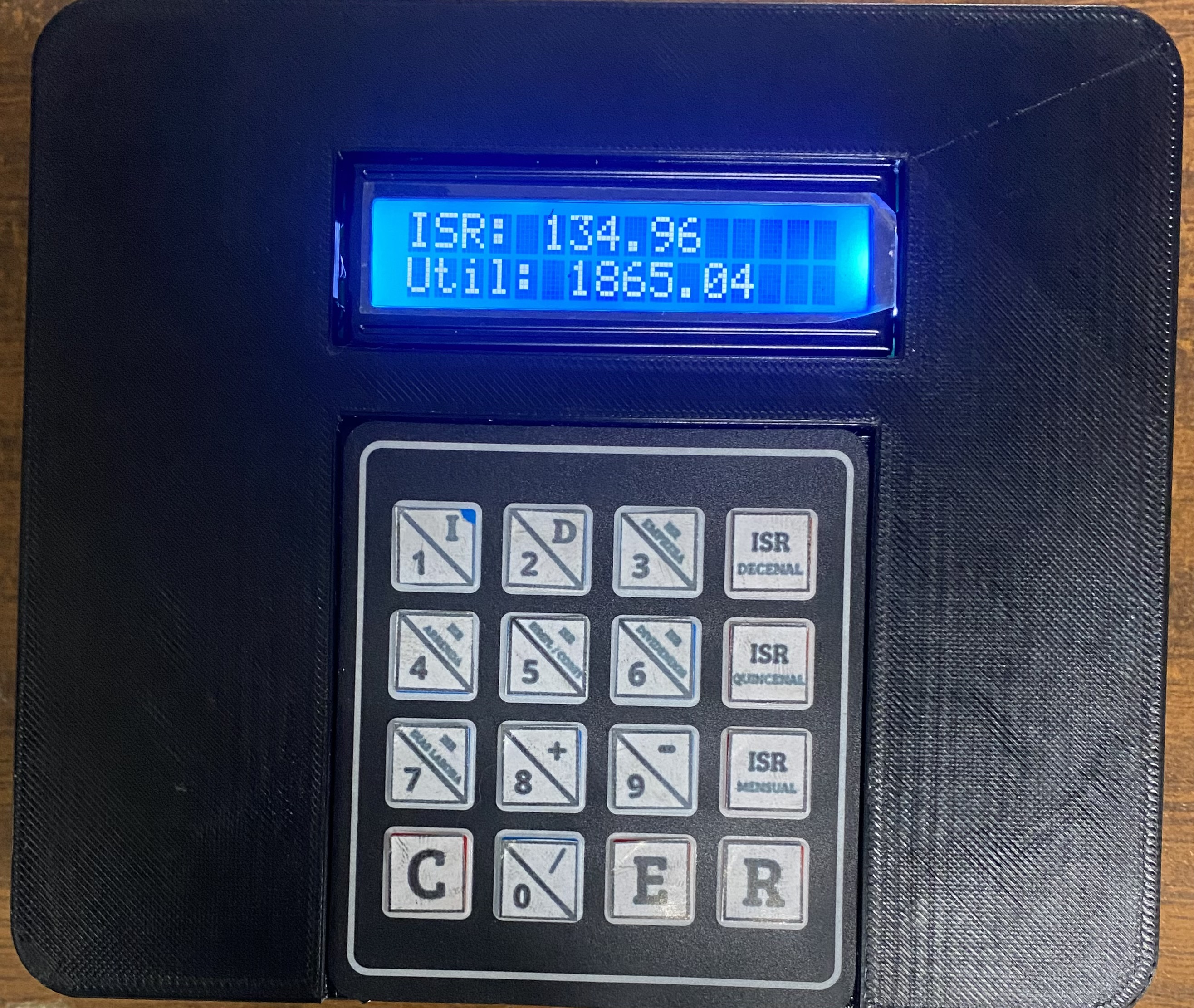
Autonomous Device for Income Tax (ISR) Calculation in Individuals
DOI:
https://doi.org/10.68038/84csy388Keywords:
Income tax, autonomous device, tax complianceAbstract
The purpose of this work is to present the development and evaluation of an autonomous physical device designed to calculate ISR for individuals without relying on an internet connection or data storage, thereby differentiating it from current mobile applications. The prototype integrates a processing board connected to a screen and an alphanumeric keyboard, powered by a 9-volt battery. This configuration allows for simple interaction, independent of an internet connection, with the additional advantage of not storing data, thus ensuring the privacy of the user’s tax information. To assess the quality of the device, the ISO/IEC 25002:2024 standard was applied, which provides a structured framework for measuring the quality of systems, software, data, and services in the field of information and communication technologies (ICT). The analysis focused on seven characteristics: functionality, usability, reliability, performance, security, maintainability, and portability. Validation was carried out under controlled laboratory conditions with the participation of ten individuals who interacted with the prototype by performing different tax calculations. The results, obtained through a 5-point Likert scale, demonstrated favorable performance in most dimensions: functionality (4.8), reliability (4.7), portability (4.8), performance (5.0), and usability (4.5). Regarding processing times, the averages were 6.70 seconds for decennial tax, 7.39 for biweekly, 8.18 for monthly, 15.09 for business activity regime, 15.44 for rental regime, 6.70 for simplified trust regime, and 6.42 for dividend tax (all values are in seconds). These values reflect relevant differences in computational load depending on the type of tax calculation. Nevertheless, areas for improvement were identified. Security received a score of 3.6, highlighting the need to implement advanced data protection mechanisms, such as encryption and authentication. Likewise, maintainability obtained the lowest score (2.9), since updates to tax rates and tables currently require manual processes. In conclusion, the prototype represents a pioneering technological innovation in Mexico, as no such device currently exists. It has the potential to facilitate tax compliance for individuals through an autonomous, reliable, and low-cost tool.
References
Abbas, K. (2025). "Management accounting and artificial intelligence: A comprehensive literature review and recommendations for future research." The British Accounting Review, p. 1-26. doi.org/10.1016/j.bar.2025.101551.
Aldape, A., Benítez, J., & Zorrilla, F. (2020). "Aplicación inteligente en la práctica profesional del contador público en el área fiscal." Revista Iberoamericacana para la Investigación y Desarrollo Educativo, 11 (21), p. 1-20. doi.org/10.23913/ride.v11i21.740
Bhimani, A., Cinquini, L., & Malmi, T. (2025). "What happens at the interface of digitalisation and accounting?". The British Accounting Review, p. 1-9. doi.org/10.1016/j.bar.2025.101742.
Duve, M., & Schutte, D. (2025). "Unmooring tax compliance: The impact of information technology in the Zimbabwean small firms under presumptive taxation." Social Sciences & Humanities Open, 11(25), p. 1-11. /doi.org/10.1016/j.ssaho.2025.101422.
HuiFang, L. (2025). "Modern Technology’s role in accounting cost calculation of industrial enterprises: Informatization as a key strategy to improve management efficiency." Heliyon, 11 (25), p. 1-17. doi.org/10.1016/j.heliyon.2024.e41523.
Liangliang, H., Yunqiao, W., Jiaqi, S., & Zheyu, S. (2025). "How does digital technology application affect tax compliance?" Finance Research Letters, 85(25), p. 107-120. doi.org/10.1016/j.frl.2025.107932.
Mary, B., & Kurt, G. (2024). "Accounting and innovation: Paths forward for research." Journal of Accounting and Economics, 78(24), p. 1-9. doi.org/10.1016/j.jacceco.2024.101733 .
Masca, S., Comsa, I., Uifalean, E., Ihut, A., Munteanu, E., & Scoropan, D. (2021). Calculadora electrónica de impuestos. disponible en SSRN: https://ssrn.com/abstract=4227245
Mendonça, P. (2025). "Challenges of the digital landscape: An investigation into the influence of technology and information systems on financial performance of B2B key account managers." Industrial Marketing Management, 129(25), p. 1-17. doi.org/10.1016/j.indmarman.2025.07.008.
Rachmawati, N., Ramayanti, R., & Setiawan, R. (2025). "Financial reporting and tax calculator application Account Tax: Is it feasible to develop for MSMEs in Indonesia?" Jati: Journal Akuntansi Terpan Indonesia, 8(01), p. 46-61. doi.org/10.18196/jati.v8i1.24374
Sánchez, P., Aguilar, E., & Rodríguez, F. (2016). "Diseño y construcción de un prototipo de calculadora fiscal." Revista de análisis cuantitativo y estadístico, 3(06), p. 43-49.
Yen, T., Thao, C., & Quoc, P. (2025). "Transformational leadership and firm performance: The mediating roles of innovation capacity and management accounting systems usage." Sustainable Futures, 10(25), p. 1-12. doi.org/10.1016/j.sftr.2025.100988.