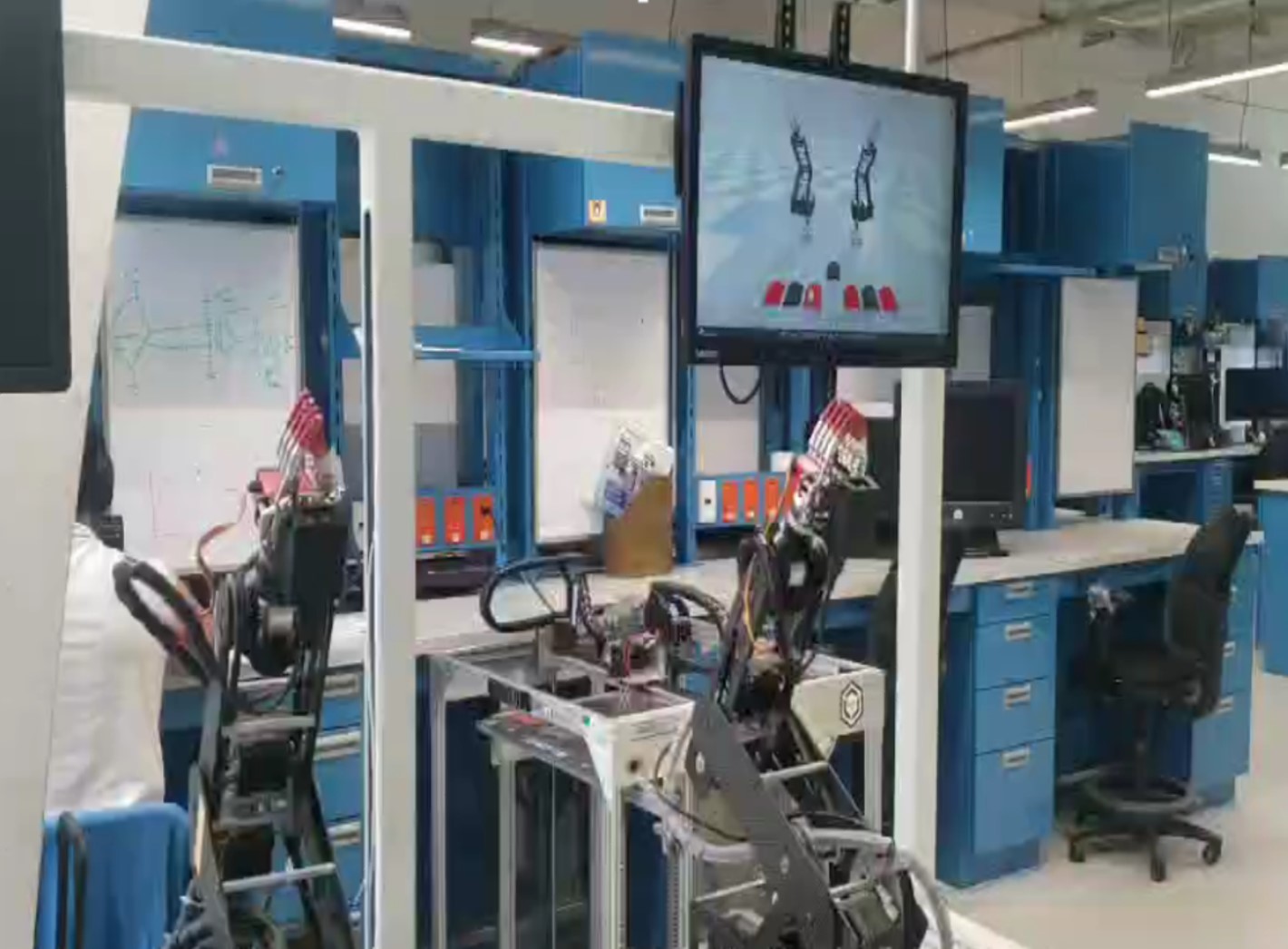
Development of a digital twin-based solver for simulation and control of the Dorna® robotic arm
Keywords:
Manufacturing, Digital twin, Robotic arm, Intelligent system.Abstract
Globally, manufacturing activities are migrating towards more complex strategies, which include digitalization for real-time decision-making in process and plant operations. In this context, current technology is being revolutionized to generate digital twins (DTs) that allow for the modification of manufacturing activities and their analysis for rapid optimization. This is because these activities have a profound impact on a country' seconomy through associated economic sectors such as logistics, technology development, and new business processes. Plant analysis software is generally expensive and depends on licensing, which is prohibitive for many entities, thereby limiting appropriate decision-making and increasing associated costs. In this regard, this work presents the development of a solver for simulation software for flexible production lines based on DTs. This was achieved through the digitalization of a Dorna® robot, the development of a PyBullet environment, a graphical interface, and a comparison between the digitalized and physical robots through visual inspection and statistical analysis. The results suggest that a concordance between the physical and digital models occurred, which was verified through observations of the interaction between the physical and digital robots. Additionally, a statistical linear regression analysis was performed, revealing a correlation of approximately 99% between the physical and digital robot movements. This suggests a statistical agreement between the physical and digital robots. Therefore, these results indicate that the models, compared visually and statistically, exhibited strong agreement, suggesting an accurate correlation between the physical and digital phenomena. Finally, the development of a solver for simulation software for flexible production lines based on DTs promotes and encourages the creation of low-cost solutions for analyzing manufacturing systems. This will foster solutions for digital manufacturing in open-source software environments and the creation of cutting-edge technology based on digital manufacturing principles.
References
Bringas-Posadas, D., Devillet-Castellanos, H. D., Cruz-González, C. E., Vargas-Arista, B., Guzmán-Flores, I., & Franco-Urquiza, E. A. (2025). Development of a digital twin and lab-scale manufacturing system for production sequences planning. The International Journal of Advanced Manufacturing Technology, 136, 5515–5530.
Bringas-Posadas, D., Trejo-Morales, A., Franco-Urquiza, E. A., & Cruz-González, C. E. (2025). Exploratory statistical analysis for decision-making in a scaled manufacturing system of medical equipment. The International Journal of Advanced Manufacturing Technology, 138, 555–568.
Colledani, M., Yemane, A., Lugaresi, G., Borzi, G., & Callegaro, D. (2018). A software platform for supporting the design and reconfiguration of versatile assembly systems. Procedia CIRP, 72, 808-813.
Diputados.Gob. (16 de 04 de 2025). Obtenido de Ley de austeridad republicana artículo 12: https://www.diputados.gob.mx/LeyesBiblio/pdf/LFAR.pdf
DornaCAD. (25 de 07 de 2025). Obtenido de https://drive.google.com/file/d/19kcPUnuemhYqBeXViNxjs8llj91vV8vv/view
Flores, L. (19 de 01 de 2024). Tres claves para optimizar procesos [Manufactura 4.0]. Obtenido de Tesselar: https://www.tesselar.mx/blog/tres-claves-para-optimizar-procesos-manufactura-4.0#:~:text=1.,e%20informes%20en%20tiempo%20real.
Fornari, F., Compagnucci, I., De Donato, M. C., Bertrand, Y., Beyel, H. H., Carrión, E., . . . Valderas, P. (2025). Digital Twins of Business Processes: A Research Manifesto. Internet of Things, 30, 1-14.
ISA-95 Series of Standards: Enterprise-Control System Integration. (2000). International Society of Automation.
London Consulting Group. (04 de 06 de 2024). Obtenido de Como optimizar los procesos de manufactura: https://londoncg.com/blog/como-optimizar-los-procesos-con-un-sistema-de-manufactura#:~:text=%C2%BFQu%C3%A9%20es%20la%20optimizaci%C3%B3n%20de,de%20producci%C3%B3n%20en%20una%20empresa.
Lugaresi, G., Aglio, G., Folgheraiter, F., & Matta, A. (2019). Real-time Validation of Digital Models for Manufacturing Systems: a Novel Signal-processing-based Approach. 2019 IEEE 15th International Conference on Automation Science and Engineering (CASE) (págs. 450-455). Vancouver, BC, Canada: IEEE Xplore.
Lugaresi, G., Alva, V. V., & Matta, A. (2021). Lab-scale Models of Manufacturing Systems for Testing Real-time Simulation and Production Control Technologies. Journal of Manufacturing Systems, 58, 93-108.
Lugaresi, G., Travaglini, D., & Matta, A. (2019). A LEGO® Manufacturing System as Demonstrator for A Real-Time Simulation Proof of Concept. Proceedings of the 2019 Winter Simulation Conference (págs. 1-12). National Harbor, Maryland, USA: IEEE Xplore.
ONUDI. (24 de 07 de 2021). Obtenido de ¿Por que el desarrollo industrial es más importante que nunca?: https://ods9.org/news/448/por-que-el-desarrollo-industrial-es-mas-importante-que-nunca
Ramirez, O. (19 de 03 de 2025). México, Potencia en Desarrollo de Software en América Latina. Obtenido de Bambú Mobile: https://bambu-mobile.com/mexico-potencia-en-desarrollo-de-software-en-america-latina/#:~:text=El%20mercado%20de%20desarrollo%20de,del%206.28%25%20anual%20hasta%202027.
Rockwell Automation. (2025). Obtenido de 10.º informe anual sobre la situación de la fabricación inteligente: https://www.rockwellautomation.com/es-mx/capabilities/digital-transformation/state-of-smart-manufacturing.html?utm_source=Google&utm_medium=Paid_Search&utm_campaign=MultiInitiative_MultiIndustry_Global_ES_CMP-07522-S6S3W2&utm_term=industria%204%200&utm_co
Salado-Morales, E. (s.f.). Los mejores software de Producción y Fabricación en 2025. Obtenido de SoftDoit: https://www.softwaredoit.es/software-erp/software-produccion.html#:~:text=Un%20ERP%20de%20producci%C3%B3n%20permite,fabricaci%C3%B3n%20para%20optimizar%20la%20planificaci%C3%B3n.
Salvagnini. (2024). Recuperado el 27 de 03 de 2026, de La competitividad no es solo velocidad. Es sobre todo eficiencia.: https://www.salvagninigroup.com/es-ES/empresa/automatizacion-flexible#:~:text=*%20Salvagnini%20ES.%20*%20Empresa.%20*%20Automatizaci%C3%B3n%20flexible.
Secretaría de medio ambiente CDMX. (s.f.). (Gobierno de la ciudad de México) Recuperado el 24 de 07 de 2025, de Glosario definición: https://proyectos.sedema.cdmx.gob.mx/datos/glosario-definicion/Econom%C3%ADa#:~:text=Dado%20que%20los%20recursos%20del,se%20producen%20dentro%20del%20pa%C3%ADs.
STATISTA. (01 de 11 de 2024). Obtenido de La industria manufacturera en México – Datos estadísticos: https://es.statista.com/temas/7853/la-industria-manufacturera-en-mexico/#:~:text=La%20industria%20manufacturera%20es%20la,9%2C7%20millones%20de%20trabajadores.