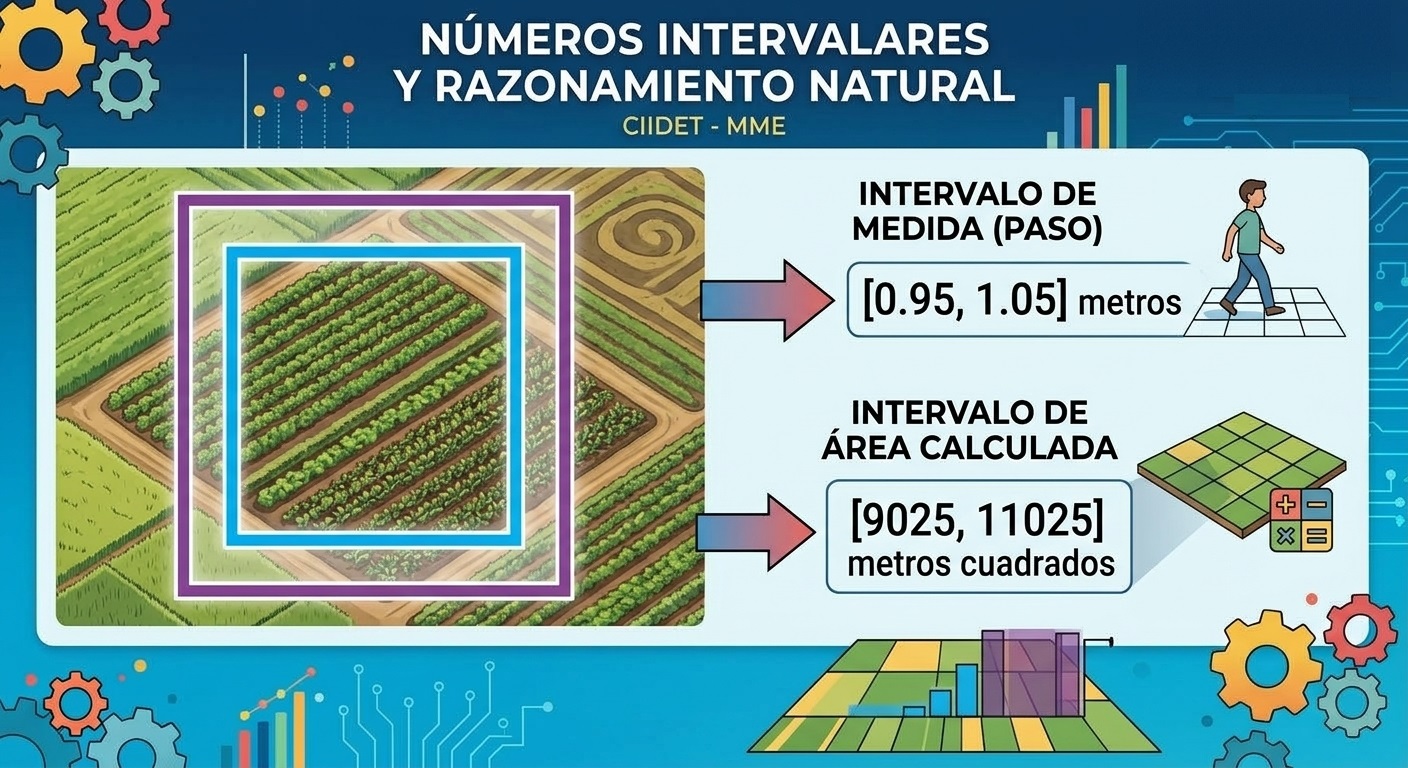
Interval numbers and their arithmetic: Describing magnitudes and operating them according to natural human reasoning
Keywords:
Interval numbers, arithmetic operations, natural language.Abstract
Human beings possess abilities that allow them to observe, study, understand, and modify their environment. These processes have enabled humanity to generate knowledge and develop technology. Mathematics, constructed and developed by humankind, is taught from early childhood, with an emphasis on the symbols that represent magnitudes and their operations. This work presents interval numbers as an alternative for representing magnitudes based on how humans understand, assign meaning to, and make inferences about their environment. Furthermore, it provides definitions for the operations that can be performed with these numbers. Formal definitions are presented, alongside an effort to describe their application in realistic contexts of human life.
References
Altúzar Rodríguez, S. N. (2024). La enseñanza de la concepción de números a través del conteo en preescolar {Teaching the conception of numbers through counting in preschool}. Revista Neuronum, 10(2), 103116. doi: https://orcid.org/0009-0006-5589-3004
Chen, G., & Pham, T. T. (2000). Introduction to fuzzy sets, fuzzy logic, and fuzzy control systems. CRC Press.
Chen, G., & Pham, T. T. (2006). Introduction to fuzzy systems. Chapman & Hall/CRC.
Chen, G., & Shieh, L. S. (1997). Model conversions of uncertain linear systems using interval multipoint Padé approximation. Applied Mathematical Modelling, 21(9), 543–553.
Chui, C. K., & Chen, G. (1990). An interval Kalman filter for systems with uncertain parameters. IEEE Transactions on Aerospace and Electronic Systems, 26(5), 854–859.
Dorinda Mato-Vázquez, A. C.-F., Rocío Chao-Fernández. (2019). Efectos de enseñar matemáticas a través de actividades musicales {Effects of teaching mathematics through music activities}. Revista Latinoamericana de Investigación en Matemática Educativa, 22(2), 163– 184. doi: https://doi.org/10.12802/relime.19.2222
Dubois, D., & Prade, H. (1988). Possibility theory: An approach to computerized processing of uncertainty. Plenum Press.
Elsa Hernández-Centeno, R. R.-R. (2023). La importancia de los cantos en educación preescolar como apoyo en la enseñanza de las matemáticas. Ciencia Latina Revista Científica Multidisciplinar, 7(6), 7451- 7466. doi: https://doi.org/10.37811/cl rcm.v7i6.9287
Hansen, E., & Walster, G. W. (2003). Global optimization using interval analysis: Revised and expanded (2ª ed.). Marcel Dekker.
Jaulin, L., Kieffer, M., Didrit, O., & Walter, É. (2001). Applied interval analysis: With examples in parameter and state estimation, robust control and robotics. Springer.
Li, Z., Halang, W. A., & Chen, G. (Eds.). (2006). Integration of fuzzy logic and chaos theory. Springer.
Lu, J. G., & Chen, G. (2009). Robust stability and stabilization of fractional-order interval systems: An LMI approach. IEEE Transactions on Automatic Control, 54(6), 1294–1299.
Moore, R. E. (1966). Interval analysis. Prentice-Hall.
Moore, R. E., Kearfott, R. B., & Cloud, M. J. (2009). Introduction to interval analysis. Society for Industrial and Applied Mathematics
Neumaier, A. (1990). Interval methods for systems of equations. Cambridge University Press.
Reséndiz-Balderas, E. (2020). Análisis del discurso y desarrollo de la noción de número en preescolar y el uso de las tic {Discourse analysis, development of number sense in preschool education and ICT use}. CienciaUAT, 14(2), 72- 86. doi: https://doi.org/10.29059/cienciauat.v14i2.1237
Santana-Espitia, O. Y.-T.-O. H., A.C. (2022). Aprendizaje del conteo y los números naturales en preescolar: una revisión sistemática de la literatura {Preeschol children’s Learning of Counting and the Natural Numbers: A Systematics Literature Review}. Universitas Psychologica, 21, 1- 16. doi: https://doi.org/10.11144/Javeriana.upsy21.acnn
Sunaga, T. (1958). Theory of an interval algebra and its application to numerical analysis. RAAG Memoirs, 2, 29–46.
Sunaga, T. (2009). Theory of an interval algebra and its application to numerical analysis. Japan Journal of Industrial and Applied Mathematics, 26(2-3), 125–143.
Trejo-Guerrero, L. (2023). La enseñanza de la adición con números naturales en la escuela primaria multi-grado {Teaching natural number sums in multi-grade primary school }. Educación matemática, 35(1), 142168. doi: https://doi.org/10.24844/em3501.06
Warmus, M. (1956). Calculus of approximations. Bulletin de l'Académie Polonaise des Sciences, Classe Troisième, 4(5), 253–257.
Zadeh, L. A. (1965). Fuzzy sets. Information and Control, 8(3), 338–353.