“Between Sky, Sea, and Land: The Coastal Dune in the Mexican Caribbean”
Keywords:
Coastal dune, Topographic profile, Vegetation, Mexican Caribbean.Abstract
The coastal dune (CD) is a natural sand formation that extends along seas and oceans, generally aligned parallel to the shoreline. Its height can range from a few centimeters to up to 130 meters, forming continuous or interrupted sand ridges that may extend several kilometers inland. The development, morphology, and stabilization of the dune system are determined by wind direction and velocity, sand availability, and the amount and type of vegetation present. The topographic profile of the dune system is composed of an embryonic dune, a primary foredune, and secondary and tertiary foredunes. Its structure and species composition vary from areas near the sea to more protected inland zones, where the accumulation of organic matter, water availability, pH, and salt spray become more stable. The vegetation types and species composition in tropical, subtropical, and temperate regions are typically diverse. Overall, dunes and their associated vegetation provide coastal protection against the erosive effects of storms and hurricanes, reducing impacts by approximately 36% and 64%, respectively. In addition, they provide food and shelter for a wide range of coastal fauna.
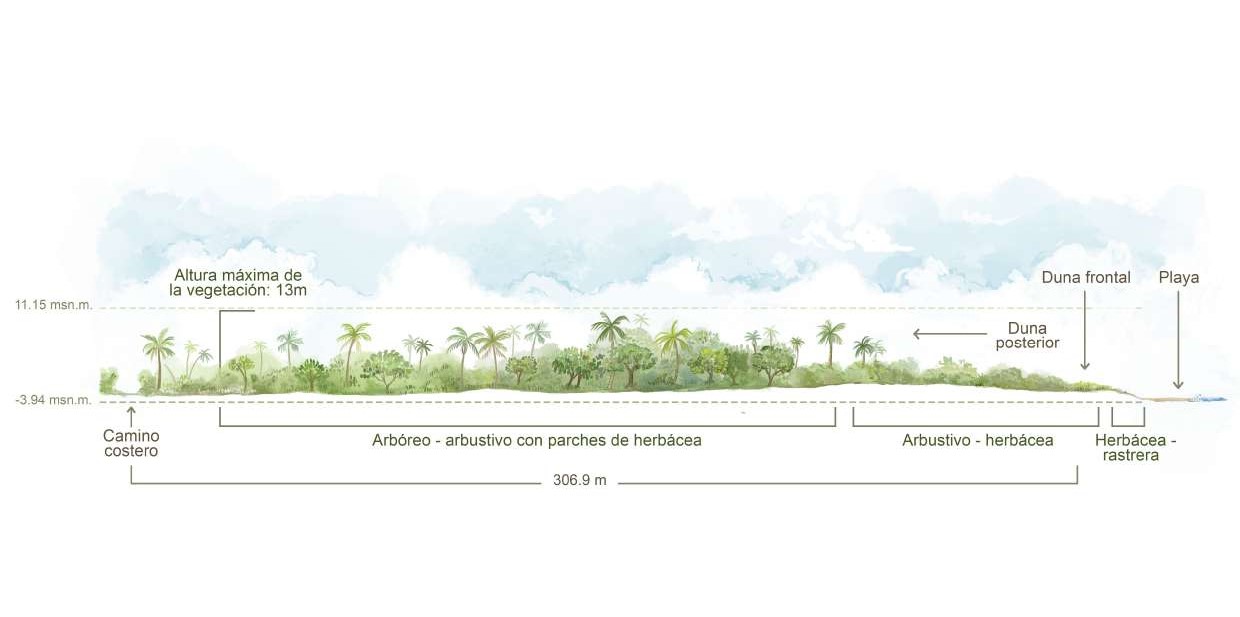
In the Mexican Caribbean (MC), a frontal dune ecosystem develops as a sand ridge extending along the coastline, either continuously or discontinuously, with variable width and elevations ranging from 5 m to over 12 m. Approximately 3% of this ecosystem is located in the southern portion of the MC, where the present study area is situated, between El Placer and Pulticub. This study aims to demonstrate the effectiveness of aerial photogrammetry integrated with LiDAR sensors for the rapid and efficient monitoring and analysis of coastal environments. The evaluated area is characterized by a relatively narrow beach associated with an immediate frontal dune exhibiting a gentle slope (0.5 m to 1 m). Its topographic profile lacks clearly distinguishable embryonic and primary dunes. Creeping herbaceous vegetation develops in areas close to the shoreline, extending across the beach and dune slope, transitioning into shrub–herbaceous vegetation from the crest up to approximately 85 m inland, adjacent to the coastal road. The floristic community is in a good state of conservation, with substantial vegetation cover and plant heights ranging from 3 m to 13 m. The establishment of sampling sites, combined with the use of drones and LiDAR sensors for the characterization and analysis of coastal dunes and their associated vegetation, proved to be an efficient technological approach. The implementation of these technologies can support improved decision-making and the development of conservation and monitoring strategies for coastal ecosystems.
References
1. Moreno-Casasola, P.; Peresbarbosa Rojas, E.; Travieso-Bello, A.C. 2006. Playas y dunas. En: P. Moreno-Casasola, E, Peresbarbosa y A.C. Travieso-Bello. Editores. Estrategias para el manejo integral de la zona costera: un enfoque municipal; Primera edición.; Instituto de Ecología: Xalapa, Ver. México; ISBN 978-970-709-039-2. Disponible en línea: https://ebusca.uv.mx/Record/207197%20207197 (Acceso el 01 de agosto 2025).
2. Martínez, M.L. 2009. Las playas y las dunas costeras. Un hogar en movimiento; LA CIENCIA PARA TODOS; Fondo de Cultura Económica (FCE): Ciudad de México; Vol. 226; 189 p. Disponible en línea: https://www.fondodeculturaeconomica.com/Ficha/9786071601513/F (Acceso el 01 de agosto 2025).
3. Martínez, M L (2008) Dunas costeras. Investig. Cienc. 38, 26-35.
4. Hesp, P. 2024. 2.29 Coastal Dunes: Types, Initiation, Morphology, Evolution, and Relationships to Surfzone-Beach Systems and Climate. In Treatise on Estuarine and Coastal Science (Second Edition). Volume 2, Pages 866-903. https://doi.org/10.1016/B978-0-323-90798-9.00074-3
5. Martínez, M.L.; Moreno-Casasola, P.; Espejel, I.; Jiménez-Orocio, O.; Infante Mata, D.; Rodríguez-Revelo, N.; Cruz González, J.C. 2014. Diagnóstico de Las Dunas Costeras de México; CONAFOR; ISBN 978-607-8383-17-7. Disponible en línea: https://www.cienagasyhumedales.org/diagnosticoge (Acceso el 25 de agosto 2025).
6. Ley-Vega de Seoane, C.; Gallego-Fernández, J.; Pascual, C. 2007. Manual de Restauración de Dunas Costeras. Dir. Gen. Costas. Disponible en línea: https://www.researchgate.net/publication/235247789_Coastal_dunes_Restoration_Manual (Acceso el 25 agosto 2025).
7. Hesp, P. 2002. Foredunes and Blowouts: Initiation, Geomorphology and Dynamics. Geomorphology 48, 245–268, doi:10.1016/S0169-555X(02)00184-8.
8. Psuty, N.P. 2004. The Coastal Foredune: A Morphological Basis for Regional Coastal Dune Development. In Coastal Dunes: Ecology and Conservation; Martínez, M.L., Psuty, N.P., Eds.; Springer: Berlin, Heidelberg; pp. 11–27 ISBN 978-3-540-74002-5. https://doi.org/10.1007/978-3-540-74002-5_2.
9. Maun, M. A. 2009. The Biology of Coastal Sand Dunes. Oxford University Press. Available online: https://doi.org/10.1093/oso/9780198570356.001.0001 (Acceso el 27 noviembre 2025)
10. Pedroza, D; Cid, A; García, O; Silva, R; Villatoro, M; Delgadillo-Calzadilla, M.A; Mendoza, E; Espejel, I; Moreno-Casasola, P; Martínez, M. 2013. Manejo de ecosistemas de dunas costeras, criterios ecológicos y estrategias; Secretaría de Medio Ambiente y Recursos Naturales: Ciudad de México, Mexico, 2013; ISBN 978-607-8246-59-5. Available online: https://www.researchgate.net/publication/323487322_Manejo_de_Ecosistemas_de_Dunas_Costeras_Criterios_Ecologicos_y_Estrategias (acceso el 12 de abril de 2026).
11. López-Chan, J. A; Cutz-Pool, L. Q; Ortiz-León, H. J; Castro-Pérez, J. M; Ibarra-Garibay, L. E; Ramírez-Medina. M. 2014. Microartrópodos de dunas Costeras en la parte norte de Quintana Roo. Entomología mexicana, 1: 476-480.
12. Jiménez-Orocio, O; Espejel, I; Martínez, M. L. 2015. La investigación científica sobre dunas costeras de México: origen, evolución y retos. Revista mexicana de biodiversidad, 86(2), 486-507. https://doi.org/10.1016/j.rmb.2015.04.022
13. Liceaga-Correa, M.A. 2020. Hábitats críticos y hotspots de tortugas marinas. En: Atlas de línea base ambiental del golfo de México (tomo VII). Consorcio de Investigación del Golfo de México. Online: https://www.researchgate.net/publication/354220295_Habitats_criticos_y_hotspots_de_tortugas_marinas (acceso 12 de abril de 2026)
14. Rodríguez-Martínez R. E; Quintana-Pali G; Trujano-Rivera K. I; Herrera R; García-Rivas M. D. C; Ortíz A; Castañeda G; Maldonado G; Jordán-Dahlgren E. 2021. Sargassum landings have not compromised nesting of loggerhead and green sea turtles in the Mexican Caribbean. J Environ Manage. Dec 1;299:113614. doi: 10.1016/j.jenvman.2021.113614.
15. Knott, D. 2010. Atlantic ghost crab (Ocypode quadrata): distribution and ecology in Western Atlantic beaches. online: https://www.dnr.sc.gov/marine/sertc/Ghost%20Crab.pdf (acceso 12 de abril de 2026)
16. Chaves, G. 2013. Phyllodactylus tuberculosus distribution in Mexico and Central America. Zoologica Scripta.
17. Hernández-Gallegos, O; López-Moreno, A. E; Méndez- Sánchez, J. F; Rheubert, J. L; Méndez-de la Cruz, F. R. 2015. Home range of Aspidoscelis cozumela (Squamata: Teiidae): a parthenogenetic lizard microendemic to Cozumel Island, México. Revista de Biología Tropical.
18. Sosa-Escalante, J. E; Pech-Canché, J. M; Mac_Swiney-González, M. C; Hernández Betancourt, S. 2013. Mamíferos terrestres de la península de Yucatán, México: riqueza, endemismo y riesgo. Revista Mexicana De Biodiversidad, 84(3). https://doi.org/10.7550/rmb.33285
19. Pérez-Flores J; Arias-Domínguez H; Arias-Domínguez N. 2020. First documented predation of a Baird’s tapir by a jaguar in the Calakmul region, Mexico. Neotropical Biology and Conservation 15(4): 453-461. https://doi.org/10.3897/neotropical.15.e57029
20. Pardo-López, L; Gutiérrez-Ríos, R.M. 2021. Distribución de bacterias. En S. Z. Herzka, R. A. Zaragoza Álvarez, E. M. Peters y G. Hernández Cárdenas. (Coord. Gral.). Atlas de línea base ambiental del golfo de México (tomo X), México: Consorcio de Investigación del Golfo de México.
21. Del Vecchio, S; Rova, S; Fantinato, E; Pranovi, F; Buffa, G. 2022. Disturbance affects the contribution of coastal dune vegetation to carbon storage and carbon sequestration rate. Plant Sociology 59(1): 37-48. https://doi.org/10.3897/pls2022591/04
22. Feagin, R.A.; Furman, M.; Salgado, K.; Martinez, M.L.; Innocenti, R.A.; Eubanks, K.; Figlus, J.; Huff, T.P.; Sigren, J.; Silva, R. 2019. The Role of Beach and Sand Dune Vegetation in Mediating Wave Run up Erosion. Estuar. Coast. Shelf Sci. 219, 97–106, doi:10.1016/j.ecss.2019.01.018.
23. Martínez, M.L.; Silva, R.; López-Portillo, J.; Feagin, R.A.; Martínez, E. 2020. Coastal Ecosystems as an Ecological Membrane. J. Coast. Res. 95, 97–101, doi:10.2112/SI95-019.1.
24. Hesp, P.A. 2008. Coastal Dunes in the Tropics and Temperate Regions: Location, Formation, Morphology and Vegetation Processes. In Coastal Dunes: Ecology and Conservation; Martínez, M.L., Psuty, N.P., Eds.; Springer: Berlin, Heidelberg; Vol. 171, pp. 29–49 ISBN 978-3-540-74002-5. https://doi.org/10.1007/978-3-540-74002-5_3.
25. Flor, G.; Flor-Blanco, G. 2014. Componentes de viento generadores de morfologías y campos de dunas costeras en Asturias (no de España). Cuaternario Geomorfol. 28, 47–68. Disponible en línea: https://recyt.fecyt.es/index.php/CUGEO/article/view/29823 (Acceso el 01 de agosto 2025).
26. Miller, T. E; Gornish, E. S; Buckley, H. L. 2010. Climate and coastal dune vegetation: Disturbance, recovery, and succession. Plant Ecology, 206(1), 97-104. https://doi.org/10.1007/s11258-009-9626-z
27. Macías-Rodríguez, M. Á; Alburquerque, F; Azcárate, J. G. 2024. Análisis de la vegetación de las dunas costeras del estado de Jalisco, México. Acta Botanica Mexicana, 131, Article 131. https://doi.org/10.21829/abm131.2024.2308
28. Castillo-Campos, G; Martínez, M. L; García-Franco, J. G; Vázquez, G; Pérez-Maqueo, O; Pale-Pale, J. 2021. First record of naturalization of Scaevola taccada (Gaertn.) Roxb. (Goodeniaceae) in southeastern Mexico. Check List, 17(2). https://doi.org/10.15560/17.2
29. Moreno-Casasola, P; Espejel, I. 1986. Classification and ordination of coastal sand dune vegetation along the Gulf and Caribbean Sea of Mexico. Vegetatio, 66(3), 147-182. https://doi.org/10.1007/BF00039908
30. de Almeida, L.R.; Silva, R.; Martínez, M.L. 2022. The Relationships between Environmental Conditions and Parallel Ecosystems on the Coastal Dunes of the Mexican Caribbean. Geomorphology 397, 108006, doi:10.1016/j.geomorph.2021.108006.
31. Mendoza-González, G.; Aguirre Fierro, J.C.; Badillo Alemán, M.; Hernández-Mendoza, V.B.; Popoca Cruz, P.E.; Tellez-Valdes, O.; Carnevali, G.; Chiappa-Carrara, X. 2025. Catálogo de vegetación de la duna costera de la península de Yucatán; 1st ed.; Escuela Nacional de Estudios Superiores, Mérida, de la Universidad Nacional Autónoma de México: Ucú, Yucatán., ISBN 978-607-587-568-2. Disponible en línea: https://zenodo.org/records/15756437 (acceso el 16 de septiembre de 2025).
32. Guimarais, M.; Zúñiga-Ríos, A.; Cruz-Ramírez, C.J.; Chávez, V.; Odériz, I.; van Tussenbroek, B.I.; Silva, R. 2021. The Conservational State of Coastal Ecosystems on the Mexican Caribbean Coast: Environmental Guidelines for Their Management. Sustainability, 13, 2738, doi:10.3390/su13052738.
33. Rioja-Nieto R,;Álvarez-Filip L. 2019. Coral reef systems of the Mexican Caribbean: Status, recent trends and conservation. Mar Pollut Bull. Mar;140:616-625. doi: 10.1016/j.marpolbul.2018.07.005. Epub 2018 Jul 11. PMID: 30005908.
34. Alcérreca-Huerta, J.C; Cruz-Ramírez, C.J; de Almeida, L.R; Chávez, V; Silva, R. 2022. Interconnections between Coastal Sediments, Hydrodynamics, and Ecosystem Profiles on the Mexican Caribbean Coast. Land, 11, 524, doi:10.3390/land11040524.
35. Gayosso-Soto, E. 2015. Estructura espacial de la vegetación de duna costera de la zona norte y sur de la reserva de la biosfera de Sian Ka´an, Quintana Roo, México. DOI: 10.13140/RG.2.2.10880.81929.
36. Elizondo, N.C; Infante-Mata, D.C; Rincón-Pérez, M; García-Alfaro, R; Islebe, G.A; Valdéz, M; Troche-Souza, C.H; Camacho-Sandoval, T; Weissenberger; López-Merlín, D. 2016. Diagnóstico sobre el estado actual del ecosistema de duna costera en la costa norte, centro y sur de la Reserva de la Biosfera Sian Ka’an; CONANP, p. 245. Disponible en línea: https://iefectividad.conanp.gob.mx/i-efectividad/I-efectividad atendido/RB Sian Ka´an/DOCUMENTOS/DIAGNOSTICO DEL ESTADO ACTUAL DE LAS DUNAS COSTERAS RBSK 2016.pdf (acceso el 01 de marzo 2024).
37. Espejel, I; Jiménez-Orocio, O; Castillo-Campos, G; Garcillán, P. P; Álvarez, L; Castillo-Argüero, S; Durán, R; Ferrer, M; Infante-Mata, D; Iriarte, S; León de la Luz, J. L; López-Rosas, H; Medel-Narváez, A; Monroy, R; Moreno-Casasola, P; Rebman, J. P; Rodríguez-Revelo, N; Sánchez-Escalante, J; Vanderplank, S. 2017. Flora en playas y dunas costeras de México. Acta Botanica Mexicana 121: 39-81. DOI: http://dx.doi.org/10.21829/abm121.2017.1290
38. Martínez, M.L; Intralawan, .; Vázquez, G; Pérez-Maqueo, O; Sutton, P; Landgrave, R. 2007. The Coasts of Our World: Ecological, Economic and Social Importance. Ecological Economics, 63, 254–272, doi:10.1016/j.ecolecon.2006.10.022.
39. Martínez, M; Lithgow, D; Vázquez, G; Garcia-Franco, J.G. 2016. Capítulo 18. Diagnóstico de Las Necesidades y Probabilidades de Restauración En Las Dunas Costeras de Quintana Roo. In Experiencias Mexicanas en la Restauración de los Ecosistemas.; UNAM; CRIM; UAEM; CONABIO: Ciudad de México, México; pp. 409–431 ISBN 978-607-02-8157-0.
40. Santiago-Contreras, J. F; González-Salvatierrra, C; Carrillo-Bastos, A; Cutz Pool, L. Q; Rosas-Luis, R. 2021. Diversidad, estructura y composición Florística de la duna costera de Mahahual- Xcalak, Quintana Roo. ECTI, EXPERIENCIAS CIENTÍFICAS, TECNOLÓGICAS Y DE INNOVACIÓN. Vol. 1. 100-104.
41. DOF. 2010. NORMA Oficial Mexicana NOM-059-SEMARNAT-2010, Protección Ambiental-Especies Nativas de México de Flora y Fauna Silvestres-Categorías de Riesgo y Especificaciones Para Su Inclusión, Exclusión o Cambio-Lista de Especies En Riesgo Disponible en línea: https://www.dof.gob.mx/normasOficiales/4254/semarnat/semarnat.htm (acceso el 26 November 2025).
42. Collantes-Chávez-Costa, A; Alanís-Rodríguez, E; Yam-Uicab, O; López-Contreras, C; Sarmiento-Muñoz, T; Tapia-Muñoz, J. L. (2019). Composition, structure and diversity of coastal vegetation in the northeastern of Cozumel, Mexico. Botanical Sciences, 97(2), 135-147. https://doi.org/10.17129/botsci.2044
43. Gutiérrez-Báez, C; Avendaño-Reyes, S; Zamora-Crescencio, P. (2020). Listado florístico de las dunas costeras de la Península de Yucatán, México. Foresta Veracruzana, 22(2), 1–6.