Physicochemical and bioactive properties of biopolymer-based oral films incorporating pomegranate juice and peppermint essential oil
Keywords:
biopolymers, oral films, pomegranate, antioxidant activity.Abstract
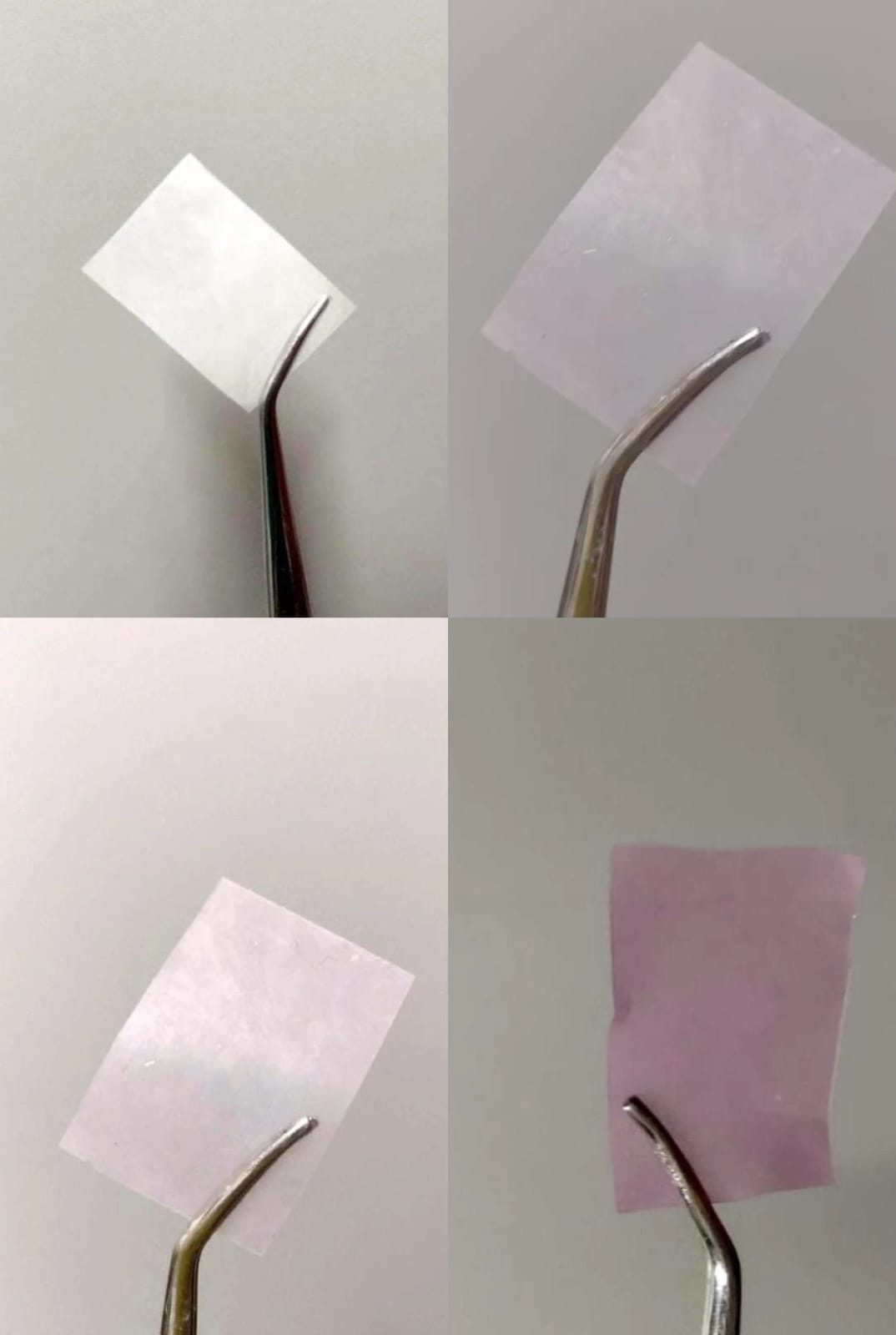
Oral films (OFs) were developed using gelatin (2%), maltodextrin (1%), and Tween 80 (0.5%), incorporating pomegranate juice at three different concentrations—30% (OF1), 40% (OF2), and 50% (OF3)—along with peppermint essential oil (2%), to characterize their physicochemical (proximal analysis, pH, thickness, degradation time, and color) and functional (antioxidant activity) properties. The recorded thicknesses ranged from 0.04 to 0.05 mm, while the pH varied from 6.83 ± 0.26 to 3.56 ± 0.38, indicating thin films with an acidic character. Regarding the colorimetric analysis, the obtained parameters were: L* values between 87.52 ± 1.03 and 74.86 ± 1.42, a* values between 0.40 ± 0.18 and 14.61 ± 1.00, and b* values between 5.41 ± 0.24 and 1.25 ± 0.20, reflecting luminous matrices with a reddish hue and a slight tendency toward yellow. The dissolution time ranged from 28.33 ± 3.51 to 52.33 ± 3.06 s, a behavior associated with the hydrophilic nature of the films. This trend was also reflected in the thermal analysis, where the glass transition temperature (T g) was 93.89 °C for formulation OF1 and decreased to 63.07 °C for OF3, suggesting lower polymeric matrix stability in the latter. Fourier-transform infrared (FTIR) spectra showed no significant variations among the evaluated formulations. Finally, the free radical inhibition capacity, determined through ABTS (89.70 ± 0.54%) and DPPH (68.14 ± 1.57%) assays for treatment OF3, revealed an antioxidant activity attributable to the presence of phenolic compounds, flavonoids, and anthocyanins.
References
1. Li, Y., et al., Advances in oral dissolving film research in the food field. Food Production, Processing and Nutrition, 2025. 7(1): p. 9.
2. Bala, R., et al., Orally dissolving strips: A new approach to oral drug delivery system. International journal of pharmaceutical investigation, 2013. 3(2): p. 67-76.
3. Himani, et al., Edible and Oral Thin Films: Formulation, Properties, Functions, and Application in Food Packaging and Pharmaceutical Industry, in Edible Food Packaging : Applications, Innovations and Sustainability, A. Poonia and T. Dhewa, Editors. 2022, Springer: Singapore. p. 411-432.
4. Xu, G., et al., Breath freshening film, C.P. Co., Editor. 2002, Colgate Palmolive Co.: New York, US.
5. Jain, A., H.T. Ahirwar, S. , and P. Mohanty, Fast dissolving oral films: a tabular update. Journal of Drug Delivery and Therapeutics, 2018. 8(4): p. 10-19.
6. Park, C.-H., C. Ganbat, and J.-A. Han, Hydrocolloid-specific performance of orally disintegrating films: physicochemical, dissolution, and sensory insights. Food Science and Biotechnology, 2026. 35(4): p. 895-905.
7. Dahiya, M., S. Saha, and F.A. Shahiwala, A Review on Mouth Dissolving Films. Current Drug Delivery, 2009. 6(5): p. 469-476.
8. Sevinç Özakar, R. and E. Özakar, Current Overview of Oral Thin Films. Turkish journal of pharmaceutical sciences, 2021. 18(1): p. 111-121.
9. Calixto, S., et al., Gelatin as a Photosensitive Material. Molecules (Basel, Switzerland), 2018. 23(8): p. 2064.
10. Shaikh, S., M. Yaqoob, and P. Aggarwal, An overview of biodegradable packaging in food industry. Current research in food science, 2021. 4: p. 503-520.
11. Lu, Y., et al., Application of Gelatin in Food Packaging: A Review. Polymers, 2022. 14(3): p. 436.
12. Sharma, D., et al., Fast Dissolving Oral Films Technology: A Recent Trend For An Innovative Oral Drug Delivery System. International Journal of Drug Delivery, 2015. 7: p. 60-75.
13. Hofman, D.L., V.J. van Buul, and F.J. Brouns, Nutrition, Health, and Regulatory Aspects of Digestible Maltodextrins. Critical reviews in food science and nutrition, 2016. 56(12): p. 2091-100.
14. Takeiti, C.Y., T.G. Kieckbusch, and F.P. Collares-Queiroz, Morphological and Physicochemical Characterization of Commercial Maltodextrins with Different Degrees of Dextrose-Equivalent. International Journal of Food Properties, 2010. 13(2): p. 411-425.
15. Cupone, I.E., et al. Orodispersible Film (ODF) Platform Based on Maltodextrin for Therapeutical Applications. Pharmaceutics, 2022. 14, DOI: 10.3390/pharmaceutics14102011.
16. Olechno, K., A. Basa, and K. Winnicka, “Success Depends on Your Backbone”—About the Use of Polymers as Essential Materials Forming Orodispersible Films. Materials, 2021. 14(17).
17. Shah, K.A., et al., Development and Characterizations of Pullulan and Maltodextrin-Based Oral Fast-Dissolving Films Employing a Box-Behnken Experimental Design. Materials (Basel), 2022. 15(10).
18. Karki, S., et al., Thin films as an emerging platform for drug delivery. Asian Journal of Pharmaceutical Sciences, 2016. 11(5): p. 559-574.
19. Tian, Y., et al., Recent progress in orodispersible films-mediated therapeutic applications: A review. MedComm – Biomaterials and Applications, 2023. 2(2): p. e34.
20. Fawole, O.A., U.L. Opara, and K.I. Theron, Chemical and Phytochemical Properties and Antioxidant Activities of Three Pomegranate Cultivars Grown in South Africa. Food and Bioprocess Technology, 2012. 5(7): p. 2934-2940.
21. Jamróz, E. and P. Kopel, Polysaccharide and Protein Films with Antimicrobial/Antioxidant Activity in the Food Industry: A Review. Polymers, 2020. 12(6): p. 1289.
22. Zhang, M., et al., Pomegranate: A Comprehensive Review of Functional Components, Health Benefits, Processing, Food Applications, and Food Safety. Journal of Agricultural and Food Chemistry, 2025. 73(10): p. 5649-5665.
23. Ferrazzano, G.F., et al., In Vitro Antibacterial Activity of Pomegranate Juice and Peel Extracts on Cariogenic Bacteria. BioMed research international, 2017. 2017: p. 2152749-2152749.
24. Uzuner, S., Pomegranate, in Nutritional Composition and Antioxidant Properties of Fruits and Vegetables, A.K. Jaiswal, Editor. 2020, Academic Press: Bolu, Turkey. p. 549-563.
25. Nabeel Ahmad, H., et al., Development of novel carboxymethyl cellulose/gelatin-based edible films with pomegranate peel extract as antibacterial/antioxidant agents for beef preservation. Food Chem, 2024. 443: p. 138511.
26. Valdés-Miramontes, E.H., et al., Potencial antioxidante de tres subproductos de granada (Punica granatum L.). Archivos latinoamericanos de nutrición, 2024. 74(3): p. 155-164.
27. Chaemsanit, S., N. Matan, and N. Matan, Effect of peppermint oil on the shelf-life of dragon fruit during storage. Food Control, 2018. 90: p. 172-179.
28. Kang, J., et al., Antibacterial and anti-biofilm activities of peppermint essential oil against Staphylococcus aureus. LWT, 2019. 101: p. 639-645.
29. Khaksar, G., K. Assatarakul, and S. Sirikantaramas, Effect of cold-pressed and normal centrifugal juicing on quality attributes of fresh juices: do cold-pressed juices harbor a superior nutritional quality and antioxidant capacity? Heliyon, 2019. 5(6): p. e01917.
30. AOAC, Official Methods of Analysis of AOAC International. 18 ed. 2005, MD, USA.
31. Singleton, V.L., R. Orthofer, and R.M. Lamuela-Raventós, [14] Analysis of total phenols and other oxidation substrates and antioxidants by means of folin-ciocalteu reagent, in Methods in Enzymology. 1999, Academic Press. p. 152-178.
32. Arvouet-Grand, A., et al., [Standardization of propolis extract and identification of principal constituents]. Journal de pharmacie de Belgique., 1994. 49(6): p. 462-8.
33. Giusti, M.M. and R.E. Wrolstad, Characterization and Measurement of Anthocyanins by UV-Visible Spectroscopy. Current Protocols in Food Analytical Chemistry, 2001. 00(1): p. F1.2.1-F1.2.13.
34. Re, R., et al., Antioxidant activity applying an improved ABTS radical cation decolorization assay. Free Radical Biology and Medicine, 1999. 26(9): p. 1231-1237.
35. Brand-Williams, W., M.E. Cuvelier, and C. Berset, Use of a free radical method to evaluate antioxidant activity. LWT - Food Science and Technology, 1995. 28(1): p. 25-30.
36. Borges, J.G., et al., Lecithin, gelatin and hydrolyzed collagen orally disintegrating films: functional properties. International Journal of Biological Macromolecules, 2016. 86: p. 907-916.
37. Cilurzo, F., et al., Fast dissolving films made of maltodextrins. Eur J Pharm Biopharm, 2008. 70(3): p. 895-900.
38. Irfan, M., et al., Orally disintegrating films: A modern expansion in drug delivery system. Saudi Pharmaceutical Journal, 2016. 24(5): p. 537-546.
39. Himani, et al., Physical, Mechanical, Functional, and Thermal Characterization of Chitosan: Maltodextrin Blends Edible Oral Film Incorporated with Aqueous Clove Extract. Starch - Stärke, 2021. 73(1-2): p. 1900220.
40. Nair, A.B., et al., In vitro techniques to evaluate buccal films. Journal of Controlled Release, 2013. 166(1): p. 10-21.
41. Wu, Z., et al., Chemical Composition and Antioxidant Properties of Essential Oils from Peppermint, Native Spearmint and Scotch Spearmint. Molecules, 2019. 24(15): p. 2825.
42. Espino-Manzano, S.O., et al., Application of Nanoemulsions (W/O) of Extract of Opuntia oligacantha C.F. Först and Orange Oil in Gelatine Films. Molecules, 2020. 25(15).
43. Berdeja, M., et al., Caracterización bromatológica y microbiológica de la cáscara de granada (Punica granatum L.) como fuente de ingredientes funcionales. Investigación y Desarrollo en Ciencia y Tecnología de Alimentos, 2019. 4: p. 799-804.
44. Kandylis, P. and E. Kokkinomagoulos, Food Applications and Potential Health Benefits of Pomegranate and its Derivatives. Foods, 2020. 9(2): p. 122.
45. Labbe, M., et al., Characterization of chemical compositions and bioactive compounds in juices from pomegranates (’Wonderful’, ’Chaca’ and ’Codpa’) at different maturity stages. Chilean journal of agricultural research, 2016. 76: p. 479-486.
46. Ejjilani, A., et al., Pomegranate morpho-chemodiversity: computational investigations based on in-vivo and in-vitro screening. Heliyon, 2022. 8(5): p. e09345.
47. Catania, P., et al., Effects of the Extraction Technology on Pomegranate Juice Quality. Agronomy, 2020. 10(10): p. 1483.
48. Bopitiya, D. and T. Madhujith, Antioxidant Potential of Pomegranate (Punica granatum L.) Cultivars Grown in Sri Lanka. Tropical Agricultural Research, 2015. 24(1): p. 71–81.
49. Kaoutar, E., et al., Quality attributes, chemical properties, and selected bioactive compounds of pomegranate juice (Punica granatum L.) processed from arils after freezing storage. African & Mediterranean Agricultural Journal, 2022: p. 236-255.
50. Fernandes, L., et al., Physicochemical composition and antioxidant activity of several pomegranate (Punica granatum L.) cultivars grown in Spain. European Food Research and Technology, 2017. 243.
51. Gözlekçi, S., et al., Total phenolic distribution of juice, peel, and seed extracts of four pomegranate cultivars. Pharmacognosy Magazine, 2011. 7(26): p. 161-4.
52. Hmid, I., et al., Comparative study of phenolic compounds and their antioxidant attributes of eighteen pomegranate (Punica granatum L.) cultivars grown in Morocco. Arabian Journal of Chemistry, 2017. 10: p. S2675-S2684.
53. El Kar, C., et al., Pomegranate (Punica granatum) juices: chemical composition, micronutrient cations, and antioxidant capacity. Journal of food science, 2011. 76(6): p. C795-800.
54. Habib, H.M., et al., Antioxidant, Anti-Inflammatory, Antimicrobial, and Anticancer Activities of Pomegranate Juice Concentrate. Nutrients, 2023. 15(12).
55. Gil, M.I., et al., Antioxidant Activity of Pomegranate Juice and Its Relationship with Phenolic Composition and Processing. Journal of Agricultural and Food Chemistry, 2000. 48(10): p. 4581-4589.
56. Aykin-Dinçer, E., A. Koç, and M. Erbas, Extraction and physicochemical characterization of broiler (Gallus gallus domesticus) skin gelatin compared to commercial bovine gelatin. Poultry science, 2017. 96(11): p. 4124-4131.
57. Kishore, D., S. Kundu, and A.M. Kayastha, Thermal, chemical and pH induced denaturation of a multimeric β-galactosidase reveals multiple unfolding pathways. PLoS One, 2012. 7(11): p. e50380.
58. Rodríguez, G.M., et al., Antioxidant active packaging based on papaya edible films incorporated with Moringa oleifera and ascorbic acid for food preservation. Food Hydrocolloids, 2020. 103: p. 105630.
59. Navas Guzmán, N. and P. Espitia, Development and characterization of edible films based on colombian tropicall fruits. . Italian Journal of Food Science, 2019. 31: p. 61-68.
60. Lim, L.M. and K. Hadinoto, High-Payload Buccal Delivery System of Amorphous Curcumin–Chitosan Nanoparticle Complex in Hydroxypropyl Methylcellulose and Starch Films. International Journal of Molecular Sciences, 2021. 22(17).
61. Garcia, V.A.d.S., et al., Orally disintegrating films based on gelatin and pregelatinized starch: new carriers of active compounds from acerola. Food Hydrocolloids, 2020. 101: p. 105518.
62. Neagu, O.M., et al., Formulation and Characterization of Mucoadhesive Polymeric Films Containing Extracts of Taraxaci Folium and Matricariae Flos. Molecules, 2023. 28(10): p. 4002.
63. Bharti, K., P. Mittal, and B. Mishra, Formulation and characterization of fast dissolving oral films containing buspirone hydrochloride nanoparticles using design of experiment. Journal of Drug Delivery Science and Technology, 2019. 49: p. 420-432.
64. Pimparade, M.B., et al., Development and evaluation of an oral fast disintegrating anti-allergic film using hot-melt extrusion technology. European journal of pharmaceutics and biopharmaceutics : official journal of Arbeitsgemeinschaft fur Pharmazeutische Verfahrenstechnik e.V., 2017. 119: p. 81-90.
65. Speer, I., et al., Comparative study on disintegration methods for oral film preparations. European Journal of Pharmaceutics and Biopharmaceutics, 2018. 132: p. 50-61.
66. Low, A., et al., A New Test Unit for Disintegration End-Point Determination of Orodispersible Films. Journal of Pharmaceutical Sciences, 2015. 104(11): p. 3893-3903.
67. Dixit, R.P. and S.P. Puthli, Oral strip technology: overview and future potential. J Control Release, 2009. 139(2): p. 94-107.
68. Chen, L., et al., Effect of Anthocyanins on Colorimetric Indicator Film Properties. Coatings, 2023. 13(10).
69. Hanani, Z.A.N., F.C. Yee, and M.A.R. Nor-Khaizura, Effect of pomegranate (Punica granatum L.) peel powder on the antioxidant and antimicrobial properties of fish gelatin films as active packaging. Food Hydrocolloids, 2019. 89: p. 253-259.
70. Welch, C.R., Q. Wu, and J.E. Simon, Recent Advances in Anthocyanin Analysis and Characterization. Current analytical chemistry, 2008. 4(2): p. 75-101.
71. Kumar, N., et al., Preparation and characterization of chitosan - pullulan blended edible films enrich with pomegranate peel extract. Reactive and Functional Polymers, 2019. 144: p. 104350.
72. Panraksa, P., et al., Formulation of Orally Disintegrating Films as an Amorphous Solid Solution of a Poorly Water-Soluble Drug. Membranes, 2020. 10(12): p. 376.
73. Kumar, N., et al., Chitosan Edible Films Enhanced with Pomegranate Peel Extract: Study on Physical, Biological, Thermal, and Barrier Properties. Materials (Basel), 2021. 14(12).
74. Alkahtani, M.E., et al., Fabrication and Characterization of Fast-Dissolving Films Containing Escitalopram/Quetiapine for the Treatment of Major Depressive Disorder. Pharmaceutics, 2021. 13(6): p. 891.
75. Bodini, R.B., et al., Antioxidant and anti-inflammatory properties of orally disintegrating films based on starch and hydroxypropyl methylcellulose incorporated with Cordia verbenacea (erva baleeira) extract. International Journal of Biological Macromolecules, 2020. 159: p. 714-724.
76. Le, T., et al., Influence of Various Phenolic Compounds on Properties of Gelatin Film Prepared from Horse Mackerel Trachurus japonicus Scales. J Food Sci, 2018. 83(7): p. 1888-1895.
77. Grzebieniarz, W., et al., Multifunctional Biopolymer Films Based on Gelatin and Chitosan Enriched with Plant Extracts: From Functional Characterisation to Food Application and Environmental Impact. Materials, 2026. 19(10): p. 2009.
78. Bhatia, S., et al., A Comparative Study of the Properties of Gelatin (Porcine and Bovine)-Based Edible Films Loaded with Spearmint Essential Oil. Biomimetics, 2023. 8(2): p. 172.
79. Matwijczuk, A., et al., Classification of Honey Powder Composition by FTIR Spectroscopy Coupled with Chemometric Analysis. Molecules, 2022. 27(12).
80. López-Díaz, A.S., et al., Effect of short wave ultraviolet radiation on selected properties of edible films formulated with pomegranate juice and chitosan. Revista Mexicana de Ingeniería Química, 2018. 17(1): p. 63-73.
81. Agatonovic-Kustrin, S., et al., Essential Oil Quality and Purity Evaluation via FT-IR Spectroscopy and Pattern Recognition Techniques. Applied Sciences, 2020. 10(20).
82. Melgarejo-Sánchez, P., et al., Pomegranate variety and pomegranate plant part, relevance from bioactive point of view: a review. Bioresources and Bioprocessing, 2021. 8(1): p. 2.
83. Liu, T., et al., Development and Characterization of Novel Active Chitosan Films Containing Fennel and Peppermint Essential Oils. Coatings, 2020. 10(10): p. 936.
84. Gómez-Guillén, M.C., et al., Functional and bioactive properties of collagen and gelatin from alternative sources: A review. Food Hydrocolloids, 2011. 25(8): p. 1813-1827.
85. Borges, J.G. and R.A. De Carvalho, Orally Disintegrating Films Containing Propolis: Properties and Release Profile. Journal of Pharmaceutical Sciences, 2015. 104(4): p. 1431-1439.
86. Mabrouk, O., et al., Evaluation of Bioactive Compounds in Pomegranate Fruit Parts as an Attempt for Their Application as an Active Edible Film. Journal of Biomaterials, 2019. 3: p. 7-17.
87. Otálora González, C.M., et al., Cassava Starch Films with Anthocyanins and Betalains from Agroindustrial by-Products: Their Use for Intelligent Label Development. Foods, 2022. 11(21).
88. Sánchez-Rangel, J.C., et al., The Folin–Ciocalteu assay revisited: improvement of its specificity for total phenolic content determination. Analytical Methods, 2013. 5(21): p. 5990-5999.
89. Enaru, B., et al., Anthocyanins: Factors Affecting Their Stability and Degradation. Antioxidants, 2021. 10(12): p. 1967.