Comprehensive treatment of university wastewater through an anaerobic up flow reactor
Keywords:
anaerobic reactor, biogas, university wastewater, upflow.Abstract
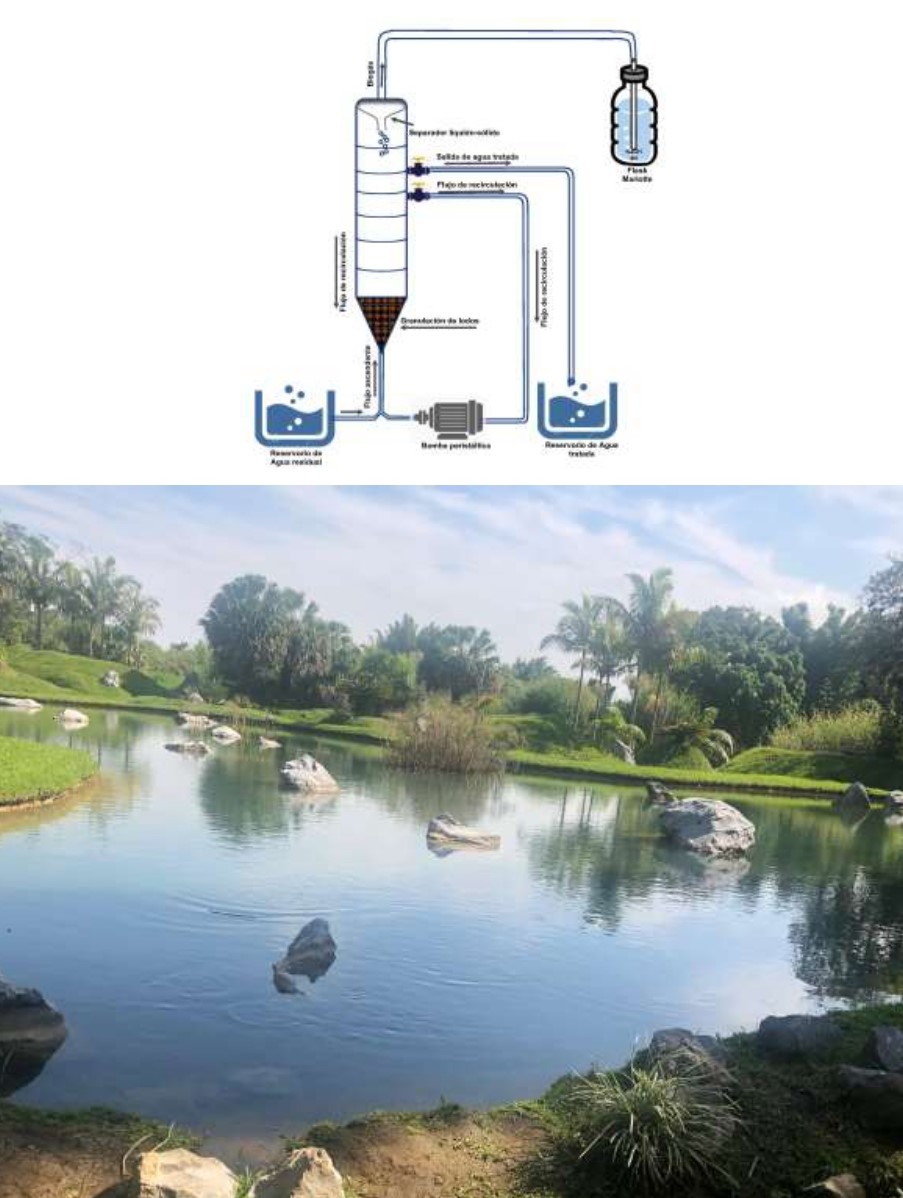
Water suffers a complex and alarming deterioration due to the various pollutants present in it as a result of anthropogenic activities. Therefore, several technologies have been used for its treatment, an example of these are the up flow anaerobic reactors, which are a compact alternative that, due to their structure, take advantage of gravity together with the mineralizing action of microorganisms to eliminate the pollution present in the effluent up to considerable levels. Under this premise, the present work aims to evaluate the optimal operating conditions of a laboratory level anaerobic reactor for biogas production and wastewater treatment under five different volumetric loads rate (VLR) (4, 8, 12, 16 and 20 g COD/L*day) at room temperature (25 ± 5 °C). The parameters evaluated were: pH, biogas, percentage of methane in the biogas, chemical oxygen demand removal and suspended solids. In addition, to ensure the integral management of the treated effluent, its phytotoxicity in radish and its impact on the growth rate of azalea (Rhododendron simsii) and mint (Mentha x piperita) were evaluated. The largest amount of biogas (115.33 mL) and methane (45 mL) occurred in the 4 g COD/L*day loading. The above results are attributed to the effect of temperature, microbial activity limited by hydraulic retention times (TRH) and relatively low organic load of the substrate. These conditions allowed the microorganisms to focus more on biomass production (68.37 – 77.30%) than on methane gas (CH4) generation (22.70–31.63%). On the other hand, the maximum removal of COD (98%), fixed suspended solids (90.16%), volatile solids (94.18%) and total suspended solids (92.87%), occurred at the lowest VLR (4 g COD/L*day). It was also demonstrated that the treated effluent is not phytotoxic and was able to increase the growth rate of the evaluated crops. In conclusion, the up flow anaerobic reactors proved to be a simple, efficient and recommendable technology for the treatment of wastewater of university origin, because high percentages of pollutants removal (COD and suspended solids) and the potential in the biogas generation.
References
[1] Fernández Cirelli, A. (2012). El agua: Un recurso esencial. Química Viva, 11(3), 147–170. https://www.redalyc.org/articulo.oa?id=86325090002
[2] Houbron, E., Canul Chan, M., González López, G. I., Rodríguez Guzmán, A., Rustrián Portilla, E., y Buendía Díaz, V. H. (2020). Agua y cambio climático. En Veracruz, una década ante el cambio climático (pp. 75–100). Gobierno del Estado de Veracruz.
[3] Rojas, R. (2002). Sistemas de tratamiento de aguas residuales. 1–19.
[4] Ramalho, R. S. (1990). Tratamiento de aguas residuales. Reverte.
[5] CONAGUA. (2018). Infraestructura hidráulica. En Estadísticas del agua en México (pp. 100–132). Gobierno de México. https://doi.org/10.16309/j.cnki.issn.1007-1776.2003.03.004
[6] Reynolds, K. A. (2002). Tratamiento de aguas residuales en Latinoamérica. Agua Latinoamericana, 1–4.
[7] Pérez, A., y Torres, P. (2008). Índices de alcalinidad para el control del tratamiento anaerobio de aguas residuales fácilmente acidificables. Ingeniería y Competitividad, 10(2), 41–52. http://www.redalyc.org/articulo.oa?id=291323482002
[8] Pérez Montiel, J. I., Aldana Villasmil, G. J., y Rojano Alvarado, R. E. (2016). Evaluación hidráulica de un reactor anaerobio de flujo ascendente (RAFA) usando un modelo de dispersión axial. Revista Internacional de Contaminación Ambiental, 32(3). https://doi.org/10.20937/RICA.2016.32.03.03
[9] Galindo Pardo, F. V., Jacobo-Salcedo, M. del R., Cueto-Wong, J. A., Reta Sánchez, D. G., García Hernández, J. L., y Vázquez-Vázquez, C. (2020). Caracterización de aguas residuales tratadas de la comarca lagunera y su viabilidad en el riego agrícola. Revista mexicana de ciencias agrícolas, 11(1), 189–201.
[10] Mateo-Sagasta, J. (2017). Reutilización de aguas para agricultura en América Latina y el Caribe: Estado, principios y necesidades. FAO.
[11] Torres, P. (2012). Perspectivas del tratamiento anaerobio de aguas residuales domésticas en países en desarrollo. Revista EIA, 18(1), 115–129. https://doi.org/10.24050/reia.v9i18.264
[12] Sosa Villalobos, C. A. (2013). Aplicación de un tratamiento biológico a las aguas residuales provenientes de una destilería de alcohol de caña, utilizando un reactor UASB. Universidad Politécnica de Madrid.
[13] Varnero Moreno, M. T. (2011). Manual del biogás. FAO.
[14] Cajigas Cerón, A. A., Pérez Vidal, A., y Torres Lozada, P. (2005). Importancia del pH y la alcalinidad en el tratamiento anaerobio de las aguas residuales del proceso de extracción de almidón de yuca. Scientia Et Technica, 11(27), 243–248. https://www.redalyc.org/pdf/849/84911698045.pdf
[15] Metcalf y Eddy. (2013). Wastewater Engineering: Treatment and Reuse. McGraw-Hill Education.
[16] Madigan, M. T. (2015). Brock: Biología de los microorganismos (14va ed.). Prentice-Hall.
[17] Orozco Gaviria, C. A., Triviño Cabrera, C. C., y Manrique Losada, L. (2014). Arranque de un Reactor UASB para el tratamiento de aguas residuales domésticas en condiciones andino-amazónicas. Revista Facultad de Ciencias Básicas, 10(2). https://revistas.unimilitar.edu.co/index.php/rfcb/article/view/328/125
[18] Arango Bedoya, O., y Sanches E Sousa, L. (2009). Tratamiento de aguas residuales de la industria láctea en sistemas anaerobios tipo UASB. Biotecnología en el Sector Agropecuario y Agroindustrial, 7(2), 24–31.
[19] Lorenzo, Y., y Obaya, M. C. (2006). La digestión anaerobia y los reactores UASB. Generalidades. ICIDCA. Sobre los Derivados de la Caña de Azúcar, 40(1), 13–21. http://www.redalyc.org/articulo.oa?id=223121549002
[20] Salazar-Larrota, L., Uribe-García, L., Gómez-Torres, L., Zafra-Mejía, C., Salazar-Larrota, L., Uribe-García, L., Gómez-Torres, L., y Zafra-Mejía, C. (2019). Análisis de la eficiencia de reactores UASB en una planta de tratamiento de aguas residuales municipales. DYNA, 86(209), 319–326. https://doi.org/10.15446/dyna.v86n209.70332
[21] Guadarrama-Brito, M. E., y Galván Fernández, A. (2015). Impacto del uso de agua residual en la agricultura. CIBA Revista Iberoamericana de las Ciencias Biológicas y Agropecuarias, 4(7).
[22] García-López, J. I., Ruiz-Torres, N. A., Lira-Saldivar, R. H., Vera-Reyes, I., y Méndez-Argüello, B. (2014). Técnicas para evaluar germinación, vigor y calidad fisiológica de semillas sometidas a dosis de nanopartículas. Agro Nanotecnología, 129–140.
[23] Hernández Aguilar, H. N. (2020). Evaluación del índice de germinación en semillas de rábano (raphanus sativus) usando aguas tratadas. Universidad de Ciencias y Artes de Chiapas.
[24] Shaughnessy, D., Polomski, R. F., y Ham, D. L. (2019). Azalea Care. Home & Garden Information Center | Clemson University, South Carolina.
[25] Guzmán Palomino, J. M., y López Gálvez, J. (2004). Ferti-Riego: Tecnologías y programación en agroplasticultura. CYTED.
[26] Drost, D., y Buckland, K. (2020). Mint in the Garden. Horticulture, 1–2.
[27] Delgadillo, O., Camacho, A., Pérez, L. F., y Andrade, M. (2010). Depuración de aguas residuales por medio de humedales artificiales. Centro Andino para la Gestión y Uso del Agua.