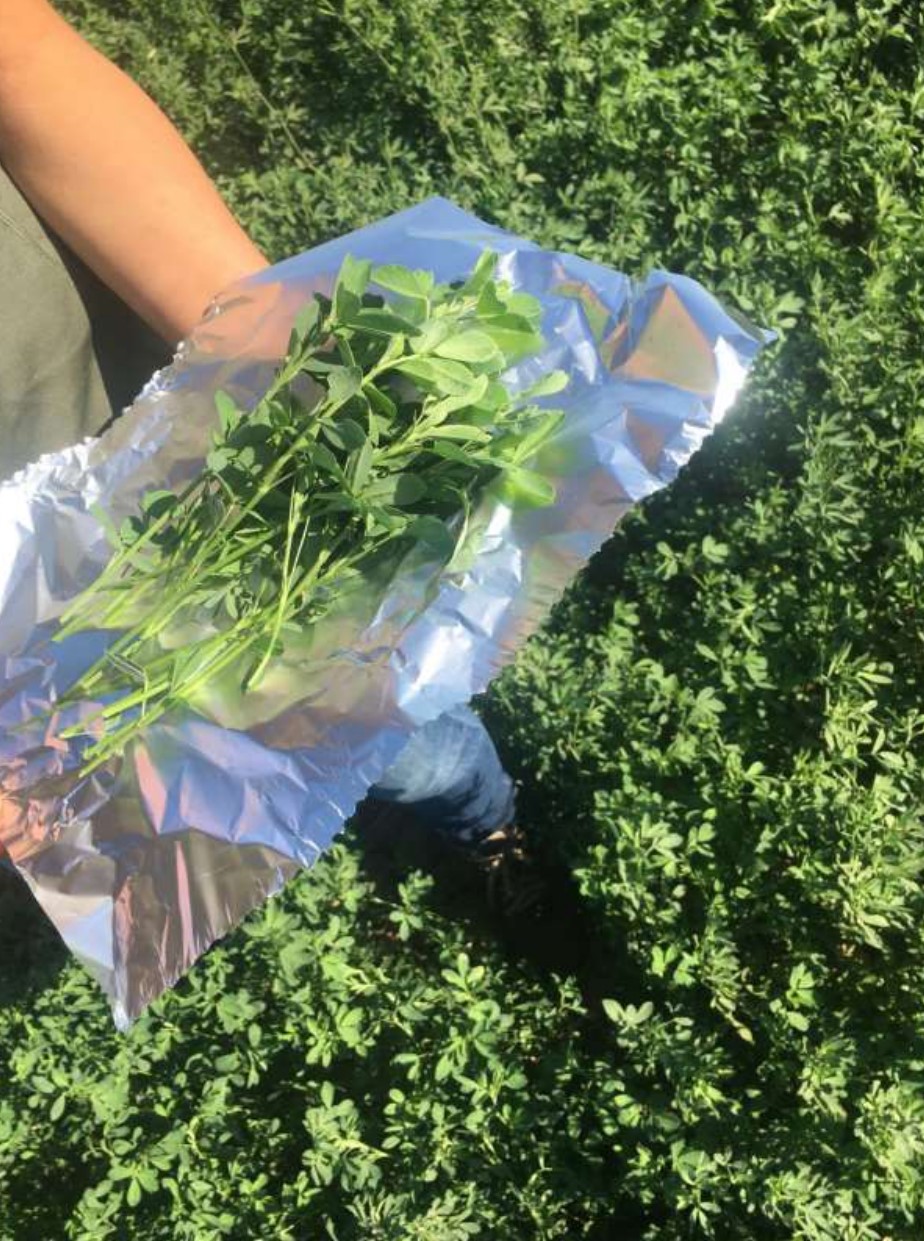
Exploratory study of alfalfa (Medicago sativa L.) as a productive activity in the Mexicali valley, Mexico
Keywords:
alfalfa producers; surveys; forage; research; production.Abstract
Currently, the regional production of alfalfa (Medicago sativa L.) in the Mexicali Valley stands as one of the main agricultural and economic activities. Considered the queen of forage crops, alfalfa production in the Baja California area has crossed borders, positioning itself as one of the main export products. However, information about the productive aspects is limited. Therefore, the main objective of the study was to carry out an analysis of the productive activity of alfalfa production systems in the Mexicali Valley based on semi-structured surveys. The study was carried out in the agricultural area of the Mexicali Valley, where 13 production units distributed among six communal farms were visited; producers were personally surveyed. The analyzes revealed that the CUF-101 variety has remained the main one throughout all production units; the availability of water is the main limitation faced by farmers and they highlighted the importance of water for their development and production in the state. Therefore, the production units of the alfalfa systems need to be reassessed, analyzed and explored for a better development and use of the resource in Baja California.
References
1. Yang, H, An F, Yang F, Wang Z. (2019). “The impact of irrigation on yield of alfalfa and soil chemical properties of saline-sodic soils”, PeerJ: 7e7148. https://doi.org/10.7717/peerj.7148.
2. Acharya, JP, López Y, Gouveia TB, de Bem Oliveira I, Resende Jr FR, Muñoz PR, Ríos EF. (2020). “Breeding Alfalfa (Medicago sativa L.) Adapted to Subtropical Agroecosystems”, Agronomy 10(5):742. https://doi.org/10.3390/agronomy10050742.
3. Bingzhe, Fu; Zhigang L, Xueqin G, Longguo W, Jian L, Wendong, P. (2021). “Effects of subsurface drip irrigation on alfalfa (Medicago sativa L.) growth and soil microbial community structures in arid and semi-arid areas of northern China”, Applied Soil Ecology 159:103859. https://doi.org/10.1016/j.apsoil.2020.103859.
4. Sánchez-Santillán, P, Maldonado-Peralta MA, Rojas-García AR, Torres-Salado N, Herrera-Pérez J, Bottini-Luzardo, MB, Wilson-García CY, Quero-Carrillo AR. (2019). Productividad de variedades de alfalfa en el Valle de México. Acta Universitaria; 29. http://doi.org/10.15174.au.2019.2202.
5. Martínez-Varela, KJ, Ceceña-Durán C, González-Mendoza D, Grimaldo-Juárez O. (2015). “Control de la marchitez Fusarium oxisporum f. sp. Medicaginis en alfalfa (Medicago sativa L.) en el Valle de Mexicali, Baja California”. Universidad Autónoma de Baja California, OmniaScience (Omnia Publisher SL). https://doi.org/10.3926/oms.275/ ISBN: 978-84-944229-4-2.
6. SADER. (2020). “Secretaria de Agricultura y Desarrollo Rural. Supera cosecha de alfalfa las 536,838 toneladas en el Valle de Mexicali”. Representación, Agricultura, Baja California. https://www.agricultura.gob.mx/datos-2020. Consultado 13 de mayo de 2020.
7. Bazán, RV, Coronado YAG, Fuentes, NN. (2017). “Comportamiento Productivo de la Alfalfa (Medicago sativa) de la Variedad Caravelí Sometida al Pastoreo en el Valle de Huaral”, Revista de Investigaciones Veterinarias del Perú 28:743-749. https://dx.doi.org/10.15381/rivep.v28i3.13359.
8. Lins, AMC, Boge A, Jinguo B, Fransen H, Norberg SS, Long-Xi Y. (2020). “Identification of genetic loci associated with forage quality in response to water deficit in autotetraploid alfalfa (Medicago sativa L.)”, BMC Plant Biology 20: 303. https://doi.org/10.1186/s12870-020-02520-2.
9. Djaman K, Smeal D, Koudahe K, Allen S. (2020). “Hay yield and water Use Efficiency of Alfalfa under Different Irrigation and Fungicide Regimes in a Semiarid Climate”, Water 12:1721. https://doi.org/10.3390/w12061721.
10. Álvarez-Vázquez P, Hernández-Garay A, Mendoza-Pedroza SI, Rojas-García AR, Wilson-García CY, Alejos-de la Fuente JI. (2018). “Producción de diez variedades de alfalfa (Medicago sativa L.) a cuatro años de establecidas”, Agrociencia 52: 841-851. http://www.scielo.org.mx/scielo.php?script=sci_arttext&pid=S140531952018000600841&lng=en&tlng=es.
11. CONAGUA. Comisión Nacional del Agua. Consultado el 22 de noviembre de 2019. Sitio web: https://www.gob.mx/conagua.
12. Lira HH. (2005). “Actualización del modelo geológico conceptual del campo geotérmico de Cerro Prieto, B.C”, Geotermia. Revista Mexicana de Geoenergía 18(1):37-46.
13. Almaraz A. (2015). “Algodón en el valle de Mexicali y los límites del intervencionismo estatal (1914-1950)”, Apuntes 42:129-159.
14. Alaniz-Gutiérrez L. (2017). “Caracterización palinológica de las mieles del valle de Mexicali, Baja California, México”, Polibotánica 43:255-283. https://doi.org/10.18387/polibotanica.43.12.
15. Neill DA y Cortez SL (2018). “Procesos y Fundamentos de la Investigación Científica”. Primera edición. Editorial UTMACH, Gestión de proyectos editoriales universitarios; 125 pag. ISBN: 978-9942-24-093-4.
16. Awodele, SO, Bennett JA. (2022). “Soil biota legacies of alfalfa production vary with field conditions and among varieties and species”, Agriculture, Ecosystems & Environment 335(107994). https://doi.org/10.1016/j.agee.2022.107994.
17. Bringas-Burgos, B, Mendoza-Muñoz I, Navarro-González, C, González-Ángeles, A, Jacobo-Galicia, G. (2020). “Análisis de sistemas de riego por gravedad y goteo subsuperficial basada en una encuesta de muestra de conveniencia en el valle de Mexicali”, Vínculos-Espe 5:3: 13 – 32. https://doi.org/10.24133/vinculosespe.v5i3.1725.
18. Gulshan, KS, Shakeel AK, Manoj S, Ranjan B, Anil SN, Arti GB. (2022). “Phycoremediated N-fertilization approaches on reducing environmental impacts of agricultural nitrate leaching”, Journal of Cleaner Production 345 (131120). https://doi.org/10.1016/j.jclepro.2022.131120.
19. Houlbrooke, DJ., Laurenson S. (2013). “Effect of sheep and cattle treading damage on soil microporosity and soil water holding capacity”, Agricultural Water Management 121, Pages 81-84, ISSN 0378-3774. https://doi.org/10.1016/j.agwat.2013.01.010.
20. Zavala-Álvarez, J. (2006). “Estancamiento y desaliento del desarrollo productivo en la región agrícola del Valle de Mexicali, Baja California: un análisis tendencial”, Estudios fronterizos 7:63-94.
21. Medellín-Azuara J., Mendoza-Espinosa, LG, Lund, JR, Harou,JJ y Howitt, RE. (2009). “Virtues of simple hydroeconomic optimization: Baja California, Mexico”, Journal of Environmental Management 90 3470–3478. https://doi.org/10.1016/j.jenvman.2009.05.032.
22. Cital, F, Ramírez-Hernández J, García-Hernández J, García-Leyva G, Rodríguez-Burgueño JE, Ramírez-Barreto M.E. (2022). “Ecosystem services (ES) provided by ditches in a desert agricultural valley”, Ecological Engineering 174:106462. https://doi.org/10.1016/j.ecoleng.2021.106462.
23. Mbarki, S, Skalicky M, Talbi O, Chakraborty A, Hnilicka F, Hejnak V, Zivcak M, Brestic M, Cerda A, Abdelly C. (2020). “Performance of Medicago sativa grown in clay soil favored by compost or farmyard manure to mitigate salt stress”, Agronomy 10: 94. https://doi.org/10.3390/agronomy10010094.
24. Goplen JJ, Coulter JA, Sheaffer CC, Becker R, Breitenbach FR, Behnken LM, Gunsolus JL. (2018). “Economic Performance of Crop Rotations in the Presence of Herbicide-Resistant Giant Ragweed”, Crop Economics, Production & Management Agronomy Journal 110: 260 268. https://doi.org/10.2134/agronj2016.09.0536.
25. Poffenbarger, H, Artz G, Dahlke G, Edwards W, Hanna M, Russell J, Sellers H, Liebman M. (2017). “An economic analysis of integrated crop-livestock systems in Iowa, U.S.A.”, Agricultural Systems 157: 51-69. https://doi.org/10.1016/j.agsy.2017.07.001.
26. Cong, L, Sun Y, Long R, Kang J, Zhang T, Li M, Wang Z, Yang Q. (2017). “Modulation of protein expression in alfalfa (Medicago sativa L.) root and leaf tissues by Fusarium proliferatum”, Journal of Integrative Agriculture 16: 2558–2572. https://doi.org/10.1016/S2095-3119(17)61690-3.
27. Medina-García, G, Echavarría-Cháirez FG, Ruiz-Corral JA, Rodríguez-Moreno V. M, Soria-Ruiz, J, De la Mora-Orozco C. (2020). “Efecto del calentamiento global sobre la producción de alfalfa en México”, Revista Mexicana de Ciencias Pecuarias 11:34-48. https://doi.org/10.22319/rmcp.v11s2.4686.
28. Lehman W, Nielson M, Marble V. and Stanford E. (1983). “Registration of cuf 101 alfalfa (reg. no. 119)”, Crop Science 23: 398.
29. UC Davis Foundation Seed Program. Copyright The Regents of the University of California, Davis campus. Consultado en octubre de 2019. Sitio web: https://fsp.ucdavis.edu/seed-catalog/alfalfa-varieties/cuf-101
30. Coblentz, WK, Hoffman PC. (2009). “Effects of bale moisture and bale diameter on spontaneous heating, dry matter recovery, in vitro true digestibility, and in situ disappearance kinetics of alfalfa-orchardgrass hays”, Journal of Dairy Science 92 :2853-2874. https://doi.org/10.3168/jds.2008-1920.
31. Ramos-Ulate, CM, Pérez-Álvarez S, Guerrero-Morales S, Palacios-Monarrez A. (2021). “Biofertilization and nanotechnology in alfalfa (Medicago sativa L.) as alternatives for a sustainable crop”, Cultivos Tropicales 42(2),1.
32. Sistema de Información Agroalimentaria y Pesquera (SIAP). Datos Abiertos de Estadística de Producción Agrícola. Consultado el 14 de octubre de 2019 y diciembre de 2022, website: http://infosiap.siap.gob.mx/gobmx/datosAbiertos.php.
33. Santana, OI, Olmos-Colmenero JJ, Wattiaux MA. (2019). “Replacing alfalfa hay with triticale hay has minimal effects on lactation performance and nitrogen utilization of dairy cows in a semi-arid region of Mexico”, Journal of Dairy Science 102:8546-8558. https://doi.org/10.3168/jds.2018-16223.
34. Neres, MA, Nath CD, Hoppen SM. (2021). “Expansion of hay production and marketing in Brazil”, Heliyon 16;7(4): e06787. https://doi.org/10.1016/j.heliyon.2021.e06787.
35. Tudi, M, Ruan D, Wang H, Lyu L, Sadler J, Connell R, Chu, D, Phung CDT. (2021). “Agriculture Development, Pesticide Application and Its Impact on the Environment”, Int. J. Environ. Res. Public Health 18: 1112. https://doi.org/10.3390/ijerph18031112.
36. Kong, M, Jing K, Cheng-Long H, Yan-Jie G, Kadambot HMS, Feng-Min Li. (2020). “Nitrogen, phosphorus, and potassium resorption responses of alfalfa to increasing soil water and P availability in a semi-arid environment”, Agronomy 10: 310. https://doi.org/10.3390/agronomy10020310.
37. Berg, WK, Lissbrant S, Cunningham SM, Brouder SM, Volenec JJ. (2018). “Phosphorus and potassium effects on taproot C and N reserve pools and long-term persistence of alfalfa (Medicago sativa L.)”, Plant Science 272:301-308. https://doi.org/10.1016/j.plantsci.2018.02.026. PMID: 29807603.
38. Zheng, L, Wen J, Liu J, Meng X, Liu P, Cao N, Dong J, Wang T. (2022). “From model to alfalfa: Gene editing to obtain semidwarf and prostrate growth habits”, The Crop Journal 10, 4, 932-941, ISSN 2214-5141. https://doi.org/10.1016/j.cj.2021.11.008.
39. Barros, J, Temple S, Dixon RA. (2019). “Development and commercialization of reduced lignin alfalfa”, Current Opinion in Biotechnology 56:48-54. https://doi.org/10.1016/j.copbio.2018.09.003.
40. Choi, W, Kim IR, Lim HS, Lee J. R A. (2020). “Multiplex PCR Method for the Detection of Genetically Modified Alfalfa (Medicago sativa L.) and Analysis of Feral Alfalfa in South Korea”, Proceedings of National Institute of Ecology 1:83-89. https://doi.org/10.22920/PNIE.2020.1.1.83.