Transverse vibrations to determine the dynamic modulus and material index in wood-mesh-adhesive multimaterial in Fagus crenata
Keywords:
moisture content, density, frequency, Fagus crenata.Abstract
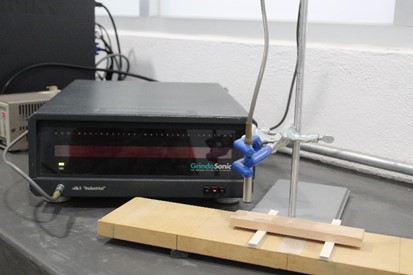
Wood used in the furniture and construction industries is a heterogeneous, hygroscopic, anisotropic and biodegradable substance. These natural properties limit its use as an architectural and engineering material and condition the rational use of timber species with mechanical characteristics that do not meet the design criteria stipulated in the regulations. The hypothesis of this research proposes that the transformation of Fagus crenata solid wood into a multi-material wood-mesh-adhesive increases its dynamic modulus and its material index. In addition, this technological improvement decreases its natural variability. The objective of the research was to determine the density, frequency, dynamic modulus and quality index in a statistically representative sample of F. crenata specimens and to contrast them with the same parameters, but determined in specimens of the multi-material made of the same species. Transverse vibration tests were carried out on small specimens of F. crenata and their moisture content, densities, frequencies, dynamic moduli and quality indexes were determined. The main results are: a decrease in the coefficient of variation in the density of the multi-material by 24,1% with respect to that of solid wood. Density is not a good predictor of dynamic modulus (R2 = 0,21), but frequency is (R2 = 0,94). The density of the multi-material increases 4,3% compared to that of solid wood. The dynamic modulus of the multi-material increases 8,5% with respect to that of solid wood. The multi-material reduces the variability of the dynamic modulus -54,7%. The magnitude of the material index of the multi-material increases 4,0% with respect to that of solid wood. These results are restricted by the experimentation of homogeneous and statistically representative samples of F. crenata wood and wood-mesh-adhesive multi-material and are valid for the particular conditions of the methodology used in this research.
References
[1] Richter, C. (2015). Wood Characteristics. Description, Causes, Prevention, Impact on Use and Technological Adaptation. Heidelberg: Springer. https://doi.org/10.1007/978-3-319-07422-1
[2] Ramage, M. H., Burridge, H., Busse-Wicher, M., Fereday, G., Reynolds, T., Shah, D. U. (…) y Scherman, O. (2017). The wood from the trees: The use of timber in construction. Renewable and Sustainable Energy Reviews, 68, 333-359. https://doi.org/10.1016/j.rser.2016.09.107
[3] Jacob, M., Harrington, J., y Robinson, B. (2018). The Structural Use of Timber Handbook for Eurocode 5: Part 1-1. Dublin: COFORD. Recuperado de http://www.coford.ie/media/coford/content/publications/TimberHandbook5Part130418.pdf
[4] American Institute of Timber Construction. (2012). Timber Construction Manual. Hoboken: John Wiley & Sons.
[5] Borgström, E. (Ed.). (2016a). Design of timber structures. Structural aspects of timber construction. Volumen 1. Stockholm: Swedish Forest Industries Federation. Recuperado de https://www.swedishwood.com/siteassets/5-publikationer/pdfer/design-of-timber-structures-1-2016.pdf
[6] Borgström, E. (Ed.). (2016b). Design of timber structures. Rules and formulas according to Eurocode 5 (Volume 2). Stockholm: Swedish Forest Industries Federation. Recuperado de https://www.swedishwood.com/siteassets/5-publikationer/pdfer/design-of-timber-structures-2-2016.pdf
[7] Borgström, E. (Ed.). (2016c). Design of timber structures. Examples. (Volume 3). Stockholm: Swedish Forest Industries Federation. Recuperado de https://www.swedishwood.com/siteassets/5-publikationer/pdfer/design-of-timber-structures-3-2016.pdf
[8] Sotomayor Castellanos, J. R., y Correa Jurado, S. (2016). Retención de sales de boro en la madera y su efecto en el módulo de elasticidad dinámico. Revista Científica. 24(1): 1-19. https://doi.org/10.14483/10.14483/udistrital.jour.RC.2016.24.a9
[9] Fink, G., Honfi, D., Kohler, J., y Dietsch, P. (Eds.). (2018). Basis of Design Principles for Timber Structures. A state-of-the-art report by COST Action FP1402 / WG 1. Germany: Shaker Verlag Aachen. Recuperado de https://www.cost.eu/wp-content/uploads/2018/11/Basis-of-Design-Principles-for-Timber-Structures.pdf
[10] Sandberg, D., Haller, P., y Navi, P. (2013). Thermo-hydro and thermo-hydro-mechanical wood processing: An opportunity for future environmentally friendly wood products, Wood Material Science & Engineering, 8(1), 64-88. http://dx.doi.org/10.1080/17480272.2012.751935
[11] Ormondroyd, G. A., Spear, M., y Curling, S. F. (2015). Modified wood: Review of efficacy and service life testing. Constructions Materials, Proceedings of the Institution of Civil Engineers, Paper 1400072. http://dx.doi.org/10.1680/coma.14.00072
[12] Song, J., Chen, C., Wang, C., Kuang, Y., Li, Y., Jiang, F., (…) y Hu, L. (2017). Super flexible Wood. ACS Applied Materials & Interfaces, 9(28), 23520-23527. https://doi.org/10.1021/acsami.7b06529
[13] Hill, C. A. S. (2006). Wood Modification, Chemical, Thermal and Other Processes. West Sussex: John Wiley & Sons.
[14] Sandberg, D., Kutnar, A., y Mantanis, G. (2017). Wood modification technologies - a review. iForest, 10, 895-908. http://dx.doi.org/10.3832/ifor2380-010
[15] Niederwestberg, J., Zhou, J., y Chui, Y.H. (2018). Mechanical Properties of Innovative, Multi-Layer Composite Laminated Panels. Buildings, 8, 142. https://doi.org/10.3390/buildings8100142
[16] Jorda, J., Kain, G., Barbu, M. C., Haupt, M., y Krišt’ák, L. (2020). Investigation of 3D-Moldability of Flax Fiber Reinforced Beech Plywood. Polymers, 12, 2852. https://doi.org/10.3390/polym12122852
[17] Icimoto, F. H., Calil Neto, C., Ferro, F. S., Borges de Macedo, L., Christoforo, A. L., Lahr, F. A. R., y Calil Júnior, C. (2016). Influence of Lamellar Thickness on Strength and Stiffness of Glued Laminated Timber Beams of Pinus oocarpa. International Journal of Materials Engineering, 6(2), 51-55. https://doi.org/10.5923/j.ijme.20160602.05
[18] Corigliano, P., Crupi, V., Epasto, G., Guglielmino, E., Maugeri, N., y Marin, A. (2017). Experimental and theoretical analyses of Iroko wood laminates. Composites Part B, 112, 251-264. http://dx.doi.org/10.1016/j.compositesb.2016.12.049
[19] Merk, V., Chanana, M., Gierlinger, N., Hirt, A. M., y Burgert, I. (2014). Hybrid Wood Materials with Magnetic Anisotropy Dictated by the Hierarchical Cell Structure. ACS Applied Materterials & Interfaces, 6, 9760-9767. http://dx.doi.org/10.1021/am5021793
[20] Marzi, T. (2015). Nanostructured materials for protection and reinforcement of timber structures: A review and future challenges. Construction and Building Materials, 97, 119-130. http://dx.doi.org/10.1016/j.conbuildmat.2015.07.016
[21] Wei, J., Rao, F., Zhang, Y., Yu, W., Hse, C., y Shupe, T. (2019). Laminating wood fiber mats into a densified material with high performance. Materials Letters, 253, 358-361. https://doi.org/10.1016/j.matlet.2019.06.097
[22] Raftery, G. M., y Rodd, P. D. (2015). FRP reinforcement of low-grade glulam timber bonded with wood adhesive. Construction and Building Materials, 91,116-125. http://dx.doi.org/10.1016/j.conbuildmat.2015.05.026
[23] Borri, A., Corradi, M., y Grazini, A. (2005). A method for flexural reinforcement of old wood beams with CFRP materials. Composites: Part B, 36, 143-153. http://dx.doi.org/10.1016/j.compositesb.2004.04.013
[24] Corradi, M., Righetti, L., y Borri, A. (2015). Bond Strength of Composite CFRP Reinforcing Bars in Timber. Materials, 8, 4034-4049. http://dx.doi.org/10.3390/ma8074034
[25] Reis, J. P., De Moura, M. F. S. F., Silva, F. G. A., y Dourado, N. (2018). Dimensional optimization of carbon-epoxy bars for reinforcement of wood beams. Composites Part B, 139, 163-170. https://doi.org/10.1016/j.compositesb.2017.11.046
[26] Byeon, J. W., Cho, Y. J., Lee, J. R., y Park, H. M. (2016). Static Bending Strength Performance of Domestic Wood-Concrete Hybrid Laminated Materials. Journal of the Korean Wood Science and Technology, 44(1), 48-56. http://dx.doi.org/10.5658/WOOD.2016.44.1.48
[27] De Lima, A. J. M., Iwakiri, S., y Trianoski, R. (2020). Determination of the physical and mechanical properties of wood-cement boards produced with Pinus spp and pozzolans waste. Maderas. Ciencia y tecnología, 22(4), 527-536. http://dx.doi.org/10.4067/S0718-221X2020005000411
[28] Clauß, S., Gabriel, J., Karbach, A., Matner, M., y Niemz, P. (2011). Influence of the adhesive formulation on the mechanical properties and bonding performance of polyurethane prepolymers. Holzforschung, 65, 835-844. http://dx.doi.org/10.1515/HF.2011.095
[29] Gáborik, J., Gaff, M., Ruman, D., Záborský, V., Kašíčková, V., y Sikora, A. (2016). Adhesive as a factor affecting the properties of laminated Wood. BioResources, 11(4), 10565-10574. http://dx.doi.org/10.15376/biores.11.4.10565-10574
[30] Jasieńko, J., y Nowak, T. P. (2014). Solid timber beams strengthened with steel plates – Experimental studies. Construction and Building Materials, 63, 81-88. http://dx.doi.org/10.1016/j.conbuildmat.2014.04.020
[31] Cañola, H. D., Echavarría, C., y Echavarría, B. (2018). Glulam beams reinforced with punched metal plates. DYNA, 85(204), 127-133. http://dx.doi.org/10.15446/dyna.v85n204.67847
[32] Jorge, F. C., Pereira, C., y Ferreira, J. M. F. (2004). Wood-cement composites: a review. Holz Roh Werkst, 62, 370-377. http://dx.doi.org/10.1007/s00107-004-0501-2
[33] Na, B., Wang, Z., Wang, H., y Lu, X. (2014). Wood-cement compatibility review. Wood Research, 59(5), 813-626. http://www.woodresearch.sk/wr/201405/10.pdf
[34] Saba, N., Jawaid, M., Alothman, O. Y., y Paridah. M. T. (2016). A review on dynamic mechanical properties of natural fibre reinforced polymer composites. Construction and Building Materials, 106, 149-159. http://dx.doi.org/10.1016/j.conbuildmat.2015.12.075
[35] Qi, Y., Xiong, W., Liu, W., Fang, H., y Lu, W. (2015). Experimental Study of the Flexural and Compression Performance of an Innovative Pultruded Glass-Fiber-Reinforced Polymer-Wood Composite Profile. PLoS ONE, 10(10), e0140893. http://dx.doi.org/10.1371/journal. pone.0140893
[36] Nadir, Y., Nagarajan, P., Ameen, M., y Arif, M. (2016). Flexural stiffness and strength enhancement of horizontally glued laminated wood beams with GFRP and CFRP composite sheets. Construction and Building Materials, 112, 547-555. http://dx.doi.org/10.1016/j.conbuildmat.2016.02.133
[37] Kusnindar., Dewi, S. M., Soehardjono, A., y Wisnumurti. (2018). Performance of glue laminated timber beams composed of sengon wood (Albizia falcatara) and coconut wood (Cocos nucifera) with nylon-threads reinforcement. MATEC Web of Conferences, 195, 02029. https://doi.org/10.1051/matecconf/201819502029
[38] Stoeckel, F., Konnerth, J., y Gindl-Altmutter, W. (2013). Mechanical properties of adhesives for bonding wood - A review. International Journal of Adhesion & Adhesives, 45, 32-41. http://dx.doi.org/10.1016/j.ijadhadh.2013.03.013
[39] Campilho, R. D. S. G., De Moura, M. F. S. F., Barreto, A. M. J. P., Morais, J. J. L., y Domingues, J. J. M. S. (2010). Experimental and numerical evaluation of composite repairs on wood beams damaged by cross-graining. Construction and Building Materials, 24, 531-537.http://dx.doi.org/ 10.1016/j.conbuildmat.2009.10.006
[40] Dietsch, P., y Brandner, R. (2015). Self-tapping screws and threaded rods as reinforcement for structural timber elements – A state-of-the-art report. Construction and Building Materials, 97, 78-89. http://dx.doi.org/10.1016/j.conbuildmat.2015.04.028
[41] Steiger, R., Serrano, E., Stepinac, M., Rajčić, V., O’Neill, C., McPolin, D., y Widmann, R. (2015). Strengthening of timber structures with glued-in rods. Construction and Building Materials, 97, 90-105. https://doi.org/10.1016/j.conbuildmat.2015.03.097
[42] Rangavar, H. (2017). Wood-Cement Board Reinforced with Steel Nets and Woven Hemp Yarns: Physical and Mechanical Properties. Drvna Industrija, 68(2), 121-128. http://dx.doi.org/10.5552/drind.2017.1631
[43] Toğay, A., Döngel, N., Söğütlü, C., Ergin, E., Uzel, M., y Güneş, S. (2017). Determination of the Modulus of Elasticity of Wooden Construction Elements Reinforced with Fiberglass Wire Mesh and Aluminum Wire Mesh. Bioresources, 12(2), 2466-2478. http://dx.doi.org/10.15376/BIORES.12.2.2466-2478
[44] Karampour, H., Bismire, A., Bourges, M., Bailleres, H., Gilbert, B. P., Gunalan, S., (…) y Guan, H. (2018). Experimental investigation on the structural performance of timber-filled tubular steel stub columns. 2018 World Conference on Timber Engineering, Seoul, Republic of Korea. Recuperado de https://www.researchgate.net/publication/327838307_experimental_investigation_on_the_structural_performance_of_timber-filled_tubular_steel_stub
[45] Qiao, Q., Yang, Z., y Mou, B. (2020). Experimental study on axial compressive behavior of CFRP confined square timber filled steel tube stub columns. Structures, 24, 823-834. https://doi.org/10.1016/j.istruc.2020.02.007
[46] Milner, H. R. (2009). Sustainability of engineered wood products in construction. En J. M. Khatib (Ed.). Sustainability of Construction Materials (pp. 184-212). Cambridge: Woodhead Publishing Series in Civil and Structural Engineering, https://doi.org/10.1533/9781845695842.184
[47] Asdrubali, F., Ferracuti, B., Lombardi, L., Guattari, C., Evangelisti, L., y Grazieschi, G. (2017). A review of structural, thermo-physical, acoustical, and environmental properties of wooden materials for building applications. Building and Environment, 114, 307-332. http://dx.doi.org/10.1016/j.buildenv.2016.12.033
[48] Caruso, M. C., Menna, C., Asprone, D., Prota, A., y Manfredi, G. (2017). Methodology for Life-Cycle Sustainability Assessment of Building Structures. ACI Structural Journal, 114(2), 323-336. http://dx.doi.org/10.14359/51689426
[49] Li, R., Natsuki, T., y Ni, Q. Q. (2015). A novel dynamic stress analysis in bimaterial composite with defect using ultrasonic wave propagation. Composite Structures, 132, 255-264. http://dx.doi.org/10.1016/j.compstruct.2015.04.046
[50] Kohl, D., Link, P., y Böhm, S. (2016). Wood as a Technical Material for Structural Vehicle Components. Procedia CIRP, 40, 557-561. https://doi.org/10.1016/j.procir.2016.01.133
[51] Kohl, D., Long, T. H. N., y Böhm, S. (2017). Wood-Based Multi-Material Systems for Technical Applications – Compatibility of Wood from Emerging and Developing Countries. Procedia Manufacturing, 8, 611-618. https://doi.org/10.1016/j.promfg.2017.02.078
[52] Kohl, D., Von Boyneburgk, C., Feldmann, M., Heim, H. P., y Böhm, S. (2018). Characterization of wood-based multi-material systems under dynamic impact stress. Wood Material Science & Engineering, 15(3), 130-139. https://doi.org/10.1080/17480272.2018.1501605
[53] Żmijewki, T., y Wojtowicz-Jankowska, D. (2017). Timber - Material of the Future - Examples of Small Wooden Architectural Structures. IOP Conf. Series: Materials Science and Engineering, 245(8), 082019. https://doi.org/10.1088/1757-899X/245/8/082019
[54] Papadopoulos, A. N. (2020a). Advances in Wood Composites. Polymers, 12, 1-8. https://doi.org/10.3390/polym12010048
[55] Papadopoulos, A. N. (2020b). Advances in Wood Composites II. Polymers, 20, 1-4. https://doi.org/10.3390/polym12071552
[56] American National Standards Institute [ANSI]. (2018). ANSI 405-2018: Standard for Adhesives for Use in Structural Glued Laminated Timber. Washington: American National Standards Institute.
[57] American National Standards Institute [ANSI]. (2020). ANSI 117-2020: Standard Specification for Structural Glued Laminated Timber of Softwood Species. Washington: American National Standards Institute.
[58] International Organization for Standardization [ISO]. (2014a). ISO 13061-1:2014. Physical and mechanical properties of wood. Test methods for small clear wood specimens. Part 1: Determination of moisture content for physical. Geneva: International Organization for Standardization.
[59] International Organization for Standardization [ISO]. (2014b). ISO 13061-2:2014. Physical and mechanical properties of wood. Test methods for small clear wood specimens. Part 2: Determination of density for physical and mechanical tests. Geneva: International Organization for Standardization.
[60] International Organization for Standardization [ISO]. (2020). ISO 16978:2003. Wood-based panels. Determination of modulus of elasticity in bending and of bending strength. Geneva: International Organization for Standardization.
[61] Kielmann, B. C., Militz, H., y Mai, C. (2013). Strength Changes in Ash, Beech and Maple Wood Modified with a N-Methylol Melamine Compound and a Metal-Complex Dye. Wood Research, 58(3), 343-350. Recuperado de http://www.woodresearch.sk/wr/201303/02.pdf
[62] Faydi, Y., Brancheriau, L., Pot, G., y Collet, R. (2017). Prediction of Oak Wood Mechanical Properties Based on the Statistical Exploitation of Vibrational Response. BioResources, 12(3), 5913-5927. https://doi.org/10.15376/biores.12.3.5913-5927
[63] Bardak, T. (2019). Effects of Different Advanced Engineering on Deformation Behaviour of Wood Structural Materials. Bioresources, 14(1), 180-192. http://dx.doi.org/10.15376/biores.14.1.180-192
[64] Wang, B., Bachtiar, E. V., Yan, L., Kasal, B., y Fiore, V. (2019). Flax, Basalt, E-Glass FRP and Their Hybrid FRP Strengthened Wood Beams: An Experimental Study. Polymers, 11(8), 1255-1270. http://dx.doi.org/10.3390/polym11081255
[65] Guan, C., Zhang, H., Hunt, J. F., Zhou, L., y Feng, D. (2016). Measurement of Dynamic Viscoelasticity of Full-Zise Wood Composites Panels Using a Vibration Testing Method. BioResources, 11(2), 4593-4604. Recuperado de https://bioresources.cnr.ncsu.edu/BioRes_11/BioRes_11_2_4593_Guan_ZHZF_Meas_Dynamic_Viscoelasticity_Wood_Comp_Vibration_Method_9199.pdf
[66] Dackermann, U., Elsener, R., Li, J., y Crews, K. (2016). A comparative study of using static and ultrasonic material testing methods to determine the anisotropic material properties of wood. Construction and Building Materials, 102, 963-976. http://dx.doi.org/10.1016/j.conbuildmat.2015.07.195
[67] De Cicco, D., y Taheri, F. (2018). Use of a Simple Non-Destructive Technique for Evaluation of the Elastic and Vibration Properties of Fiber-Reinforced and 3D Fiber-Metal Laminate Composites. Fibers, 6(1), 14-37. http://dx.doi.org/10.3390/fib6010014
[68] Alfredsen, G., y Larnøy, E. (2006). Dynamic MOE testing of wood: the influence of wood protecting agents and moisture content on ultrasonic pulse and resonant vibration. Wood Research, 51(1), 11-20. Recuperado de http://www.woodresearch.sk/wr/200601/02.pdf
[69] Ghosh, S. C., Militz, H., y Mai, C. (2008). Decay resistance of treated wood with functionalized commercial silicones. BioResources, 3(4), 1303-1314. Recuperado de https://bioresources.cnr.ncsu.edu/BioRes_03/BioRes_03_4_1303_Ghosh_MM_Decay_Resis_Treated_Wood_Silicones_313.pdf
[70] Baar, J., Tippner, J., y Gryc, V. (2016). Wood anatomy and acoustic properties of selected tropical hardwoods. IAWA Journal, 37(1), 69-83. https://doi.org/10.1163/22941932-20160121
[71] Ashby, M. F. (2011). Materials selection in mechanical design. London: Butterworth-Heinemann.
[72] Král, P., Klímek, P., Mishra, P. K., Wimmer, R., y Děcký, D. (2015). Specific modulus and density profile as characterization criteria of prefabricated wood composite materials. Acta Universitatis Agriculturae Et Silviculturae Mendelianae Brunensis, 63(2), 433-438. http://dx.doi.org/10.11118/actaun201563020433
[73] Dias, B. Z., y De Alvarez, C. E. (2017). Mechanical properties: wood lumber versus plastic lumber and thermoplastic composites. Ambiente Construído, 17(2), 201-219. http://dx.doi.org/10.1590/s1678-86212017000200153
[74] Konopka, D., Gebhardt, C., y Kaliske, M. (2017). Numerical modelling of wooden structures. Journal of Cultural Heritage, 27S, S93-S102. http://dx.doi.org/10.1016/j.culher.2015.09.008
[75] Darzi, S., Karampoura, H., Gilbert, B. P., y Bailleres, H. (2018). Numerical study on the flexural capacity of ultra-light composite timber sandwich panels. Composites Part B: Engineering, 155, 212-224. https://doi.org/10.1016/j.compositesb.2018.08.022
[76] Singh, N., Rana, A., y Badhotiya, G. K. (2021). Manufacturing processes for the development of engineered wood – A mini-review. Materials Today: Proceedings, 1-4. https://doi.org/10.1016/j.matpr.2021.02.612
[77] Song, J., Chen, C., Zhu, S., Zhu, M., Dai, J., Ray, U., (…) y Hu, L. (2018). Processing bulk natural wood into a high-performance structural material. Nature, 554, 224-239. https://doi.org/10.1038/nature25476
[78] Naruse, K. (2003). Estimation of shear moduli of wood by quasi-simple shear tests. Journal of Wood Science, 49(6), 479-484. http://dx.doi.org/10.1007/s10086-003-0515-0
[79] Sotomayor Castellanos, J. R., Macedo Alquicira, I., y Chávez García, H. L. (2020). Variabilidad en las densidades, las velocidades del ultrasonido y los módulos dinámicos en tres maderas mexicanas y tres maderas japonesas. Ingeniería y Desarrollo, 38(2), 282-299. https://doi.org/10.14482/inde.38.2.624.15
[80] Macedo Alquicira, I., Sotomayor Castellanos, J. R., y Castro Sánchez, F. J. (2019). Laminated wood and multimaterial wood – adhesive meshas replacements of solid wood in restoration of historical buildings, Int. Arch. Photogramm. Remote Sens. Spatial Inf. Sci., XLII-2/W15, 711-718. https://doi.org/10.5194/isprs-archives-XLII-2-W15-711-2019
[81] Yelle D. J., y Stirgus, A. M. (2016). Influence of Anatomical, Physical, and Mechanical Properties of Diffuse-Porous Hardwoods on Moisture Durability of Bonded Assemblies. General Technical Report FPL-GTR-244. Madison: U.S. Department of Agriculture, Forest Service, Forest Products Laboratory. https://doi.org/10.2737/FPL-GTR-244
[82] Pizzi, A., Papadopoulos, A. N., y Policardi, F. (2020). Wood Composites and Their Polymer Binders. Polymers, 12, 1115. https://doi.org/10.3390/polym12051115
[83] Weaver, W. Jr., Timoshenko, S. y Young, D. H. (1990). Vibration problems in engineering. New York: Wiley.
[84] Sotomayor Castellanos, J. R. (2019). Módulos de elasticidad e índices de calidad de maderas mexicanas. Síntesis de datos del Laboratorio de Mecánica de la Madera. Investigación e Ingeniería de la Madera, 15(1), 3-64. Recuperado de https://www.researchgate.net/publication/335665376_Modulos_de_elasticidad_e_indices_de_calidad_de_maderas_mexicanas_Sintesis_de_datos_del_Laboratorio_de_Mecanica_de_la_Madera
[85] Gutiérrez Pulido, H. y De La Vara Salazar, R. (2012). Análisis y diseño de experimentos. México: Mc Graw Hill.
[86] Jayne, B. A. (1959). Vibrational properties of wood as indices of quality. Forest Products Journal, 9(11), 413-416.
[87] Hanhijärvi, A., Ranta-Maunus, A., y Turk, G. (2005). Potential of strength grading of timber with combined measurement techniques. Report of the Combigrade-project, phase 1. Espoo, Finland: VTT Publications 568.
[88] Joint Committee on Structural Safety. (2006). Probabilistic model code. Part 3.5-Timber. Joint Committee on Structural Safety.
[89] Dietsch, P. y Köhler, J. (2010). Assessment of Timber Structures. Modelling of the Performance of Timber Structures. European Science Foundation. Herzogenrath: Shaker Verlag.
[90] Sousa, H. S., Sørensen J. D., Kirkegaard, P. H., Branco, J. M., y Lourenço, P. B. (2013). On the use of NDT data for reliability-based assessment of existing timber structures. Engineering Structures, 56, 298-311. https://doi.org/10.1016/j.engstruct.2013.05.014
[91] Kües, U. (Ed.). (2007). Wood Production, Wood Technology, and Biotechnological Impacts. Göttingen: Universitätsverlag Göttingen. https://doi.org/10.17875/gup2007-262
[92] Zhu, H., Luo, W., Ciesielski, P. N. Fang, Z., Zhu, J. Y., Henriksson, G., (…) y Hu, L. (2016). Wood-Derived Materials for Green Electronics, Biological Devices, and Energy Applications. Chemical Reviews, 116, 9305-9374. https://doi.org/10.1021/acs.chemrev.6b00225
[93] Mitchell G., Gaspar F., Mateus A., Mahendra V., y Sousa D. (2018). Advanced Materials from Forests. En L. Martínez, O. Kharissova, B. Kharisov (Eds). Handbook of Ecomaterials. Cham: Springer. https://doi.org/10.1007/978-3-319-48281-1_189-1
[94] Sun, W., Shen, H., y Cao, J. (2016). Modification of wood by glutaraldehyde and poly (vinyl alcohol). Materials and Design, 96, 392-400. http://dx.doi.org/10.1016/j.matdes.2016.02.044
[95] Labans, E., Kalnins, K., y Bisagni, C. (2019). Flexural behavior of sandwich panels with cellular wood, plywood stiffener/foam and thermoplastic composite core. Journal of Sandwich Structures and Materials, 21(2), 784-805. https://doi.org/10.1177/1099636217699587
[96] Sotomayor Castellanos, J. R. (2018). Índices materiales en flexión estática de maderas mexicanas con potencial para uso en la construcción. Ingeniería Mecánica. Tecnología y Desarrollo, 6(2), 45-52. Recuperado de http://www.revistas-conacyt.unam.mx/revistasomim/index.php/IMTyD/article/view/131/85