Influence of amaranth consumption on the anthropometric and hematological profile of school-age children with low height for age
Keywords:
Anthropometric parameters, amaranth, undernutrition, amaranth protein, low height.Abstract
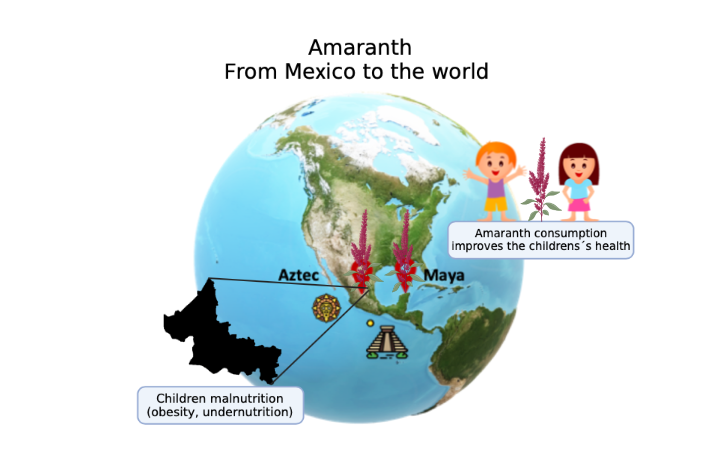
Malnutrition, especially in school-age children, is still a public health problem in Mexico. Particularly, in the state of San Luis Potosi, chronic undernutrition is given with higher prevalence in rural areas of the Huasteca Potosina. The supplementation of the children´s diets with nutritious and nutraceutical foods, such as amaranth, have been proposed as an alternative to improve the children´s health. Amaranth seed contains high quality proteins due to their good balance of essential amino acids, fulfilling the requirements for proper development of both children and adults. The objective of this work was to identify the rural area with the highest prevalence of chronic child undernutrition and to determine the effect of amaranth consumption on the anthropometric and hematological profile of school-age children with low height-for age. The selection of children was based on the reference growth standards for children defined by the World Health Organization. The participating children live in adobe houses with palm roofs, unpaved streets, basic services of electricity and drinking water, walk long distances to attend school and only the support of a basic food basket to eat. All participating children took an oral antiparasitic medication at the beginning of the study, and the diet was supplemented with flour and popped amaranth grain for a period of 90 days. At the beginning and end of the study, anthropometric parameters were measured and blood and stool samples were taken. At the end of the study, no significant increase in the children´s height was observed; however, an increased hemoglobin levels in the blood was noted. The presence of parasites in the stool, especially Blastocytis spp., which is related to intestinal inflammation and diarrheal episodes, was observed at the end of the study. Improvements in the environmental conditions of the children´s habitat should be considered in order to improve intestinal health and therefore the overall health of the children.
References
1. WHO, “Double burden of malnutrition”, World Health Organization, 2017, https://www.who.int/publications/i/item/WHO-NMH-NHD-17.3. Revisada mayo 2022.
2. WHO, “Malnutrition” World Health Organization, 2021. https://www.who.int/news-room/fact-sheets/detail/malnutrition. Revisado mayo 2022.
3. Iddrisu, I., Monteagudo-Mera, A., Poveda, C., Pyle, S., Shahzad, M., Andrews, S., Walton, G.E., “Malnutrition and gut microbiota in children”, Nutrients, 13, 2021, 2727. https://doi.org/10.3390/nu13082727.
4. WHO, “Child Growth Standards: Length/Height-for-Age, Weight-for-Age, Weight-for-Length, Weight-for-HEIGHT and body Mass Index-for-Age: Methods and Development”, 2006. https://www.who.int/publications/i/item/924154693X. Revisado mayo 2022.
5. Fernández, A., Martínez, R., Carrasco, I., Palma, A, “Impacto social y económico de la doble carga de la malnutrición. Modelo de análisis y estudio piloto en Chile, el Ecuador y México. 2017. Publicación de las Naciones Unidas. https://www.cepal.org/es/publicaciones/42535-impacto-social-economico-la-doble-carga-la-malnutricion-modelo-analisis-estudio
6. UNICEF. Salud y nutrición. 2022. https://www.unicef.org/mexico/salud-y-nutrición. Revisado mayo 2022.
7. Rivera-Dommarco, J.A, Cuevas-Nasu L, González de Cosio, T., Shamah-Levy, T., García-Feregrino, R., “Desnutrición crónica en México en el último cuarto de siglo: análisis de cuatro encuestas nacionales”, Salud Pública de México, 55, 2013, S161-S169. https://www.scielosp.org/article/ssm/content/raw/?resource_ssm_path=/media/assets/spm/v55s2/v55s2a13.pdf.
8. Barba de la Rosa, A.P., Gueguen, J., Paredes-López, O., Viroben, G., “Fractionation procedures, electrophoretic characterization, and amino acid composition of amaranth seed proteins”, Journal of Agricultural and Food Chemistry, 40(6), 1992, 931-936. https://doi.org/10.1021/jf00018a002.
9. Barba de la Rosa, A.P., Barba-Montoya, A., Martínez-Cuevas, P., Hernández-Ledesma, B., De León-Rodríguez, A., González, C., “Tryptic amaranth glutelin digests induce endothelial nitric oxide production through inhibition of ACE: antihypertensive role of amaranth peptides”, Nitric Oxide-Biology and Chemistry Journal, 23, 2010, 106-111. https://doi.org/10.1016/j.niox.2010.04.006.
10. Motta, C., Castanheira, I., Gonzalez, G.B., Delgado I., Torres, D., Santos, M., Matos A.S., “Impact of cooking methods and malting on amino acids content in amaranth, buckwheat and quinoa”, Journal of Food Composition and Analysis, 76, 2019, 58-65. https://doi.org/10.1016/j.jfca.2018.10.001.
11. Velarde-Salcedo, A.J., Barrera-Pacheco, A., Lara-González, S., Montero-Morán, G.M., Díaz-Gois, A., González de Mejia, E., Barba de la Rosa, A.P., “In vitro inhibition of dipeptidyl peptidase IV by peptides derived from the hydrolysis of amaranth (Amaranthus hypochondriacus L.) proteins”, Food Chemistry 136(2), 2013, 758–764. https://doi.org/10.1016/j.foodchem.2012.08-032.
12. Maldonado-Cervantes, E., Jeong, H.J., León-Galván, F, González de Mejía, E., deLumen, B.O., Barba de la Rosa, A.P., “Amaranth lunasin-like peptide internalizes into the cell nucleus and inhibits chemical carcinogen-induced transformation of NIH-3T3 cells”, Peptides, 31(9), 2010, 1635-1642. https://doi.org/10.1016/j.peptides.2010.06.014.
13. Barba de la Rosa, A.P., Fomsgaard, I.S., Laursen, B., Mortensen, A.G., Olvera-Martínez, L., Silva-Sánchez, C., Mendoza-Herrera, A., González-Castañeda, J., De León-Rodríguez, A., “Amaranth (Amaranthus hypochondriacus) as an alternative crop for sustainable food production: Phenolic acids and flavonoids with potential impact on its nutraceutical quality”, Journal of Cereal Science, 49, 2009, 117-121. https://doi.org/10.1016/j.jcs.2008.07.012.
14. Morales-Guerrero, J.C., Vázquez-Mata, N., Bressani-Castignoli, R., “El amaranto: características físicas, químicas, toxicológicas y funcionales y aporte nutricio”, Instituto Nacional de Ciencias Médicas y Nutrición Salvador Zubirán, 2009, 53-89. ISBN:978-607-7797-00-5.
15. Dus-Zuchowska, M., Walkowiak, J., Morawska, A., Kryzanowka-Jankowska, P., Miskiewicz-Chotnicka, A., Przyslawski, J., Lisowska, A., “Amaranth oil increases total and LDL colesterol levels without influencing early markers of atherosclerosis in an overweight and obese population: A randomized double-blind cross-over study in comparison with rapeseed oil supplementation”, Nutrients, 11(12), 2019, 3069. https://doi.org/10.3390/nu11123069.
16. Czerwiński, J., Bartnikowska, E., Leontowicz, H., Lange, E., Leontowicz, M., Katrich, E., Trakhtenberg, S., Gorinstein, Sh., “Oat (Avena sativa L.) and amaranth (Amaranthus hypochondriacus) meals positively affect plasma lipid profile in rats fed cholesterol-containing diets”, Journal of Nutritional Biochemistry, 15, 2004, 622-629. https://doi.org/10.1016/j.jnutbio.2004.06.002.
17. Martirosoyan, D.M., Miroshnichenko, L.A., Kulakova, S.N., Pogojeva, A.V., Zoloedov, V.I., “Amaranth oil application for coronary heart disease and hypertension”, Lipids in Health and Disease 6(1), 2007, 6, 1. https://doi.org/10.1186/1476-511X-6-1.
18. Kim, S.K., Karadeniz, F., “Biological importance and applications of squalene and squalane”. En: Advances in Food and Nutrition Research, 65, 2012, 224-233. https://doi.org/10.1016/B978-0-12-416003-3.00014-7.
19. Moszak, M., Zawada, A., Juchacz, A., Grzymislawski, M., Bogdanski, P., “Comparison of the effect of rapeseed oil or amaranth seed oil supplementation on weight loss, body composition, and changes in the metabolic profile of obese patients following 3-week body mass reduction program: a randomized clinical trial”, Lipids in Health and Disease 19, 2020, 143. https://doi.org/10.1186/s12944-020-01330-7.
20. ENSANUT. Encuesta Nacional de Salud y Nutirición, 2012. https://ensanut.insp.mx/encuestas/ensanut2012/informes.php.
21. NMX-FF-116-SCFI-2010, Productos agrícolas destinados para consumo humano. Grano reventado de amaranto (Amaranthus spp.) para uso y consumo humano-Especificaciones y método de ensayo. http://sitios.dif.gob.mx/alimentacion/docs/normas/origen_vegetal/NMX-FF-116-SCFI-2010_amaranto.pdf.
22. Kane, A.Vc, Dinh, D.M., Ward, H.D., “Childhood malnutrition and the intestinal microbiome”, International Pediatric Research Foundation, Inc, 77(1), 2015, https://doi.org/10.1038/pr.2014.179.
23. Gómez-Gallego, C., García-Mantrana, I., Martínez-Costa, C., Salminen, S., Isolauri, E., Collado, M.C., “The microbiota and malnutrition: Impact of nutritional status during early life”, Annual Reviews, 39, 2019, 267-290.
24. Jaramillo, M., Sánchez, A., “Impacto del programa Juntos sobre nutrición temprana”, Documento de Investigación: salud y desarrollo humano, N°2012-001, 2012. ISBN:978-9972-615-59-7.
25. Jain, P., Virk, A., Khan, Z.A., Mittal, A., Singh, H., Nazir, M., “A Study of Environmental Factors Affecting Nutritional Status of under 5 Children in Rural Area of North India”, Indian Journal of Public Health Research and Development, 9(9), 2018, 94–99. https://doi.org/10.5958/0976-5506.2018.00975.0.
26. García-Cruz, L.M., “Factores asociados a la desnutrición crónica infantil en Mozambique”, Thesis Doctoral, 2018. http://hdl.handle.net/10553/55200
27. Paredes-Mamani, R.P., “Efecto de factores ambientales y socioeconómicas del hogar sobre la desnutrición crónica de niños menores de 5 años en el Perú”, Revista de Investigaciones Altoandinas - Journal of High Andean Research, 22(3), 2020, 226–237. https://doi.org/10.18271/ria.2020.657.
28. Del Coco, V.F., Molina, N.B., Basualdo, J.A., Córdoba, M.A., “Blastocytis spp.: avances, controversias y desafíos futuros”, Revista Argentina de Microbiología, 49, 2017, 110-118. https://doi.org/10.1016/j.ram.2016.08.004.
29. Muzzo, S., “Crecimiento normal y patológico del niño y del adolescente. Revista Chilena de Nutrición, 30(2), 2003, 92–100. https://doi.org/10.4067/s0717-75182003000200003 http://www.grade.org.pe/upload/publicaciones/archivo/download/pubs/ddt61.pdf.
30. Devera, R., Soares, A., Rayarán, D., Rayarán, D., Amaya, I., Blanco, Y., “Enteroparasitosis en escolares: importancia de los parásitos asociados”, Revista Venezolana de Salud Pública, 8(1), 2020, 49–64. https://revistas.uclave.org/index.php/rvsp/article/view/2877/1798.
31. Monárrez-Espino, J., Pérez-Espejo, R., Vázquez-Mendoza, G., Balleza-Carreón, A., Caballero-Hoyos, R., “Intervention to prevent intestinal parasitic reinfections among Tarahumara indigenous schoolchildren in northern Mexico”, Revista Panamerica de Salud Pública, 30(3), 2011, 196-203. https://www.scielosp.org/pdf/rpsp/2011.v30n3/196-203/en.
32. Koukounari, A., Estambale, B.B.A., Kiambo Njagi, J., Cundill, B., Ajanga, A., Crudder, C., Otido, J., Jukes, M.C.H., Clarke, S.E., Brooker, S., “Relationships between anaemia and parasitic infections in Kenyan schoolchildren: A Bayesian hierarchical modelling approach”, International Journal for Parasitology, 38(14), 2008, 1663–1671. https://doi.org/10.1016/j.ijpara.2008.05.013.
33. Soriano-García, M., Ilnamiqui Arias-Olguín, I., Pablo Carrillo Montes, J., Genaro Rosas Ramírez, D., Silvestre Mendoza Figueroa, J., Flores-Valverde, E., Rita Valladares-Rodríguez, M., “Nutritional functional value and therapeutic utilization of Amaranth”, Journal of Analytical & Pharmaceutical Research, 7(5), 2018, https://doi.org/10.15406/japlr.2018.07.00288.
34. Macharia-Mutie, C.W., Moretti, D., Van den Briel, N., Omusundi, A.M., Mwangi, A.M., Kok, F.J., Zimmermann, M.B., Brouwer, I.D., “Maize porridge enriched with a micronutrient powder containing low-dose iron as NaFeEDTA but not amaranth grain flour reduces anemia and iron deficiency in kenyan preschool children”, Journal of Nutrition, 142(9), 2012, 1756–1763. https://doi.org/10.3945/jn.112.157578.
35. Iftikhar, M., Khan, M., “Amaranth”, En: Bioactive Factors and Processing Technology for Cereal Foods, 2019, 217–232. Springer, Singapore. https://doi.org/10.1007/978-981-13-6167-8_13.
36. Wu, S., Bhat, Z.F., Goudner, R.S., Ahmed, I.A.M., Al-Juhaimi, F., Ding, Y., Bekhit, A.E.-D.A., “Effect of dietary protein and processing on gut microbiota- A systematic review”, Nutrients 14, 2022, 453. https://doi.org/10.3390/nu14030453.
37. Ramírez-Carrillo, E., Gaona, O., Nieto, J., Sánchez-Quinto, A., Cerqueda-García, D., Falcón, L. I., Rojas-Ramos, O.A., González-Santoyo, I., “Disturbance in human gut microbiota networks by parasites and its implications in the incidence of depression”, Scientific Reports, 10(1), 2020. 1-12. https://doi.org/10.1038/s41598-020-60562.w.