Comparative study of polyphenol extraction from grapefruit (Citrus paradisi) peel using solid fermentation
Keywords:
A. niger, hongos-filamentosos, HPLC-MS, polifenoles, residuos-toronja.Abstract
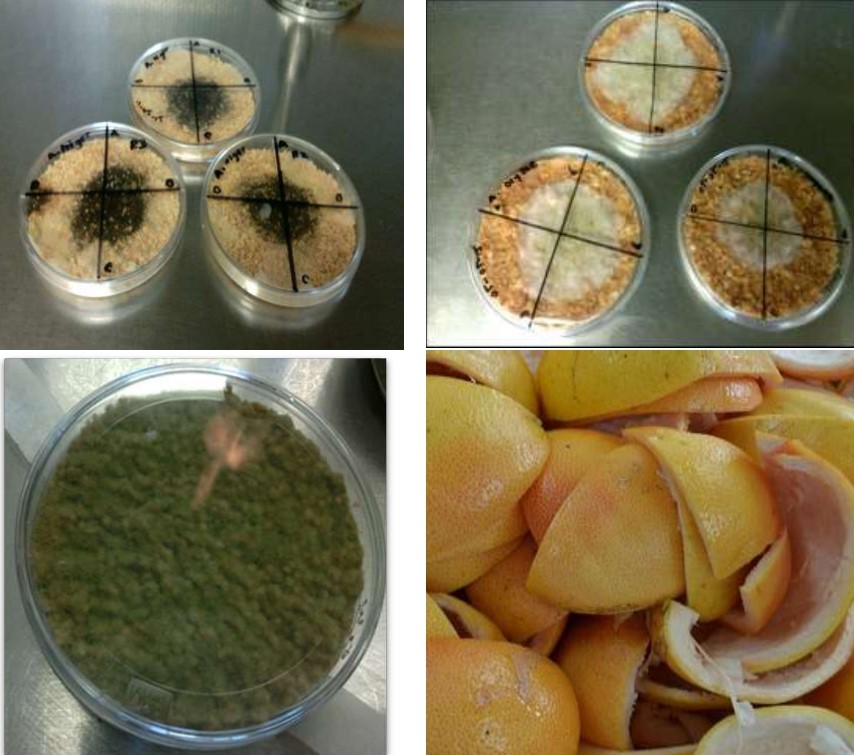
Three fungal strains were used to release polyphenols from grapefruit peel using Solid-State Fermentation (SSF). The bioprocess was carried out in bioreactors in triplicate at 30 ± 2 °C for 5 days under static conditions. Quantification of total polyphenols was done with the Folin-Ciocalteu and n-Butanol/HCl/Fe3+ assays. The characterization of fermented extracts was by HPLC-MS. In the results, better yields of polyphenols released at 96 h were obtained using the fermentation with A. niger, around 518 ± 22 mg/g of sample. A lower yield was obtained with A. oryzae, 196 ± 22 mg/g, while Penicillium digitatum did not show adaptation to the substrate at the time of evaluation. In addition, eight flavonoids compounds were identified, being naringin and hesperidin the major molecules in fermented extracts. Our comparative study, evidenced that Solid-State Fermentation using A. niger allows higher phenolic content to be obtained than the unfermented control, in contrast, fermentation with A. oryzae allowed less release during the whole extraction process. The results show that A. niger is a better fermentative strain for the recovery of important metabolites applicable in pharmaceutical and food industry using grapefruit residues. The use of A. Oryzae in solid fermentations is not discarded, but it is recommended to study its growth and adaptation using other agro-industrial substrates.
References
1. Aguilar, C. N., Aguilera-Carbo, A., Robledo, A., Ventura, J., Belmares, R., Martínez, D., Rodríguez-Herrera, R., & Contreras, J. (2008). Production of antioxidants nutraceuticals by solid-state cultures of pomegranate (Punica granatum) peel and creosote bush (Larrea tridentata) leaves. Food Technol Biotechnol, 46:218-222.
2. Duhan, J. S., Mehta, K., Sadh, P. K., Saharan, P., & Surekha, C. (2016). Bio-enrichment of phenolics and free radicals scavenging activity of wheat (WH-711) fractions by solid state fermentation with Aspergillus oryzae. African Journal of. Biochemistry Research, 1(2): 2-19. https://doi.org/10.5897/AJBR2015.0854
3. Koyani, R. D. & Rajput, K. S. (2015). “Solid State Fermentation: Comprehensive Tool for Utilization of Lignocellulosic through Biotechnology. Journal of Bioprocessing and Biotechniques, 5(10).doi:10.4172/2155-9821.1000258.
4. Buenrostro-Figueroa, J. J., Velázquez, M., Flores-Ortega O., Ascacio-Valdés, J. A., Huerta-Ochoa, S., Aguilar, C. N., & Prado-Barragán, L. A. (2017). “Solid state fermentation of fig (Ficus carica L.) by-products using fungi to obtain phenolic compounds with antioxidant activity and qualitative evaluation of phenolics obtained “. Process Biochemistry, 62, 16-23.
5. Meena, L., Sengar, A.S., Neog, R. et al. (2021). Pineapple processing waste (PPW): bioactive compounds, their extraction, and utilisation: a review. J Food Sci Technol. https://doi.org/10.1007/s13197-021-05271-6
6. Sepúlveda, L., de la Cruz, R., Buenrostro, J. J., Ascacio-Valdés, J. A., Aguilera-Carbó, A. F., Pradoc, A., Rodríguez-Herrera, R., & Aguilar, C. (2016). “Efecto de las diferentes fuentes de polifenoles sobre la eficiencia de liberación de ácido elágico por Aspergillus niger “. Revista Argentina de microbiología 48(1):71-77.
7. El-Sayed, E., Ahmed, A. and Al-Hagar, O. (2020), Agro-industrial wastes for production of paclitaxel by irradiated Aspergillus fumigatus under solid-state fermentation. J Appl Microbiol, 128: 1427-1439. https://doi.org/10.1111/jam.14574
8. Sindhu, R., Pandey, A., & Binod, P. (2015). Solid-state “Fermentation to produce Poly (hydroxyalkanoates). Chemical and Biochemical Engineering Quarterly, 29(2): 173-181.
9. Ahmed, I., Zia-Anjum, M., Azhar-Hussain, M., Akram, Z., Naveed, M. & Nowrouz, I. (2015). A Bioprocessing of citrus waste peel for induced pectinase production by Aspergillus niger; its purification and characterization. Journal of Radiation Research and Applied Sciences, 9(2). https://doi.org/10.1016/j.jrras.2015.11.003.
10. de la Rosa, O., Flores-Gallegos A. C., Muñíz-Marquez, D., Nobre, C., Contreras-Esquivel, J. C., Cristobal, N. A. (2019). Fructooligosaccharides production from agro-wastes as alternative low-cost source. Trends in Food Science & Technology, 91, 139-146, https://doi.org/10.1016/j.tifs.2019.06.013.
11. Zhang, B., Cai, J., Duan, C., Reeves, J. M., & He, F. (2015). Review of Polyphenolics in Oak Woods. International Journal of Molecular Sciences, 16(4). doi:10.3390/ijms16046978.
12. Arfaoui, L. (2021). Dietary Plant Polyphenols: Effects of Food Processing on Their Content and Bioavailability. Molecules, 26(10), 2959. https://doi.org/10.3390/molecules26102959
13. Agudelo, C., Barros, L., Santos-Buelga, C., Martínez-Navarrete, N., & Ferreira, I. C. (2017). Phytochemical content and antioxidant activity of grapefruit (Star Ruby): A comparison between fresh freeze-dried fruits and different powder formulations. LWT-Food Science and Technology, 80, 106-112.
14. Ahmed, W., Azmat, R., Mehmood, A. et al. (2021). Comparison of storability and seasonal changes on new flavonoids, polyphenolic acids and terepene compounds of Citrus paradisi (grapefruit) cv. shamber through advance methods. Food Measure, 15, 2915–2921. https://doi.org/10.1007/s11694-021-00815-y
15. Zou, Z., Xi, W., Hu, Y., Nie, C., & Zhou, Z. (2015). Antioxidant activity of Citrus fruits. Food Chemestry. 196; pp.885–896.
16. Lin, X., Cao, S., Sun, J., Lu, D., Zhong, B., & Chun, J. (2021). The Chemical Compositions, and Antibacterial and Antioxidant Activities of Four Types of Citrus Essential Oils. Molecules (Basel, Switzerland), 26(11), 3412. https://doi.org/10.3390/molecules26113412
17. Saini, R. K., Ranjit, A., Sharma, K., Prasad, P., Shang, X., Gowda, K., & Keum, Y. S. (2022). Bioactive Compounds of Citrus Fruits: A Review of Composition and Health Benefits of Carotenoids, Flavonoids, Limonoids, and Terpenes. Antioxidants (Basel, Switzerland), 11(2), 239. https://doi.org/10.3390/antiox11020239
18. Londoño, J., Sierra, J., Álvarez, R., Restrepo, A. M., & Passaro, C. (2012). Aprovechamiento de los subproductos citrícolas en Cítricos: cultivo, poscosecha e industrialización. Artes y Letras.
19. Larios-Cruz, R., Buenrostro-Figueroa, J., Prado-Barragán, A. et al. (2019). Valorization of Grapefruit By-Products as Solid Support for Solid-State Fermentation to Produce Antioxidant Bioactive Extracts. Waste Biomass Valor 10, 763–769. https://doi.org/10.1007/s12649-017-0156-y.
20. FAO/IAEA. (2000). Quantification of Tannins in Tree Foliage, A laboratory manual for the FAO/IAEA, Working Document, IAEA, Vienna, Austria Sec. 3.05-4.09.
21. Porter, L. J., Hrstich, L. N., & Chan, B. G. (1986). The conversion of procyanidins to cyanidin and delphinidin. Phytochem, 25(1): 223-230.
22. Paulussen, C., Hallsworth, J. E., Álvarez-Pérez, S., Nierman, W. C., Hamill, P. G., Blain, D., Rediers, H., & Lievens, B. (2017). Ecology of aspergillosis: insights into the pathogenic potency of Aspergillus fumigatus and some other Aspergillus species. Microbial biotechnology, 10(2), 296–322. https://doi.org/10.1111/1751-7915.12367
23. Li, Y., Xia, M., He, P., Yang, Q., Wu, Y., He, P., Ahmed, A., et al. (2022). Developing Penicillium digitatum Management Strategies on Post-Harvest Citrus Fruits with Metabolic Components and Colonization of Bacillus subtilis L1-21. Journal of Fungi, 8(1), 80. MDPI AG. Retrieved from http://dx.doi.org/10.3390/jof8010080
24. Chen, J., Shen, Y., Chen, C., & Wan, C. (2019). Inhibition of Key Citrus Postharvest Fungal Strains by Plant Extracts In Vitro and In Vivo: A Review. Plants, 8(2), 26. MDPI AG. Retrieved from http://dx.doi.org/10.3390/plants8020026
25. Šelo, G., Planinić, M., Tišma, M., Grgić, J., Perković, G., Koceva Komlenić, D., & Bucić-Kojić, A. (2022). A Comparative Study of the Influence of Various Fungal-Based Pretreatments of Grape Pomace on Phenolic Compounds Recovery. Foods, 11(11), 1665. MDPI AG. Retrieved from http://dx.doi.org/10.3390/foods11111665
26. Martins, S., Mussatto, S. I., Martínez-Avila, G., Montañez-Saenz J., Aguilar, C. N., & Teixeira, J. A. (2011). Bioactive phenolic compounds: Production and extraction by solid-state fermentation. A review. Biotechnology Advances, 29, 365-373.
27. Ooi C. K., Rasit N., Rafizah W., Abdullah W. (2021). Optimization of Protease from Aspergillus Niger under Solid-State Fermentation Utilizing Shrimp Shell Substrate. Biointerface Research in Applied Chemistry, 11 (6), 14809 – 14824. https://doi.org/10.33263/BRIAC116.1480914824
28. Persad, A. & Bisaria, S. V. (2014). Bioprocessing of Renewable Resources to Commodity Bioproducts. First Edition. Bisaria S. V. and Kondo A. Editors; John Wiley & Sons.
29. Dias, L., dos Santos, B., Albuquerque, C., Baeta, B., Pasquini, D. and Baffi, M. (2018), Biomass sorghum as a novel substrate in solid-state fermentation for the production of hemicellulases and cellulases by Aspergillus niger and A. fumigatus. Journal of Applied Microbiology, 124, 708-718. https://doi.org/10.1111/jam.13672.
30. Ottenheim, C., Verdejo, C., Zimmermann, W., & Wu, J. C. (2014). Hemicellulase production by Aspergillus niger DSM 26641 in hydrothermal palm oil empty fruit bunch hydrolysate and transcriptome analysis. Journal of Bioscience and Bioengineering, 118(6). http://dx.doi.org/10.1016/j.jbiosc.2014.05.014.
31. Upadhyaya, J., Joshi, D. R., Lekhak, B., Kumar Chaudhary, D., Raj Pant, B., Raj Bajgai, T., et al. (2020). Production, Characterization, and Industrial Application of Pectinase Enzyme Isolated from Fungal Strains. Fermentation, 6(2), 59. MDPI AG. Retrieved from http://dx.doi.org/10.3390/fermentation6020059
32. Li Q., Ray C., Callow N., Loman A., Islam A., Ju LK. (2020). Aspergillus niger production of pectinase and α-galactosidase for enzymatic soy processing. Enzyme and Microbial Technology, 134(1). https://doi.org/10.1016/j.enzmictec.2019.109476.
33. Scurria, A., Sciortino, M., Presentato, A., Lino, C., Piacenza, E., Albanese, L., Zabini, F., et al. (2020). Volatile Compounds of Lemon and Grapefruit IntegroPectin. Molecules, 26(1), 51. MDPI AG. Retrieved from http://dx.doi.org/10.3390/molecules26010051
34. Rojas, P., Perea, A., & Ortíz, C. (2007). Determinación por HPLC de flavanonas en jugos cítricos de variedades cultivadas en Santander. Scientia Et Technica, 13(33).
35. Yun, D. & Liu, J. (2022). Recent advances on the development of food packaging films based on citrus processing wastes: A review. Journal of Agriculture and Food Research, 9. https://doi.org/10.1016/j.jafr.2022.100316.
36. Zehra, M., Syed, M. N., & Sohail, M. (2020). Banana Peels: A Promising Substrate for the Coproduction of Pectinase and Xylanase from Aspergillus fumigatus MS16. Polish journal of microbiology, 69(1), 19–26. https://doi.org/10.33073/pjm-2020-002
37. Larios-Cruz, R., Buenrostro-Figueroa, J., Prado-Barragán, A., Rodríguez-Jasso, R., & Aguilar, C. 2016. Perfil respirométrico de Aspergillus niger GH1 por fermentación en estado sólido sobre residuos de toronja. Agronomía. Colombiana, 34(1): S1232-S1235.
38. Abdel-Nabey, M. A., Sherief, A. A., & EL-Tanash, A.B. (2011). Tannin Biodegradation and Some Factors Affecting Tannase Production by Two Aspergillus sp. Biotecnology. 10(2):149-158. http://dx.doi.org/10.3923/biotech.2011.149.158.
39. Al-Manhel, A. & Al-fekaiki, D. (2019). Purification and characterization of tannase from the local isolate of Aspergillus niger. 7. 29-34. http://dx.doi.org/10.7324/JABB.2019.70106.
40. Jiménez, N., Esteban-Torres, M., Mancheño, J. M., de las Rivas, B., & Muñoz, R. (2014). Tannin Degradation by a Novel Tannase Enzyme Present in Some Lactobacillus plantarum Strains. Applied and Environmental Microbiology Journal, 80 (10):2991-2997
41. Reges de Sena A., Morgana de Melo-Lopes L., Jamesse-Gouveia M., Gouveia M., C., Rodrigues M., Campos-Leite T., Souza-Lima K., Aparecida-Moreira K. & Aparecida K. (2021) Tannin biodegradation by tannase from Serratia marcescens: optimization of production by response surface methodology and its partial characterization. Chemical Engineering Communications, 208:10, 1369-1384.
42. Sepúlveda, L., De la Cruz, R., Buenrostro-Figueroa, J., Ascacio-Valdés, J. & Aguilera-Carbó, A., Prado, L., Rodriguez, R. & Aguilar, C. (2016). Effect of different polyphenol sources on the efficiency of ellagic acid release by Aspergillus Niger. Revista Argentina de microbiología. 48. 1-7. http://dx.doi.org/10.1016/j.ram.2015.08.008.
43. Huynh N. T., Camp, J., Smagghe, G., & Raes, K. (2014). Improved Release and Metabolism of Flavonoids by Steered Fermentation Processes: A Review. International Journal of Molecular Sciences, 15: 19369-19388. http://dx.doi.org/10.3390/ijms151119369.
44. Wen, Q., Cao, X., Chen, Z., Xiong, Z., Liu, J., Cheng, Z., Zheng, Z., Long, C., Zheng, B. & Huang, Z. (2020). An overview of Monascus fermentation processes for monacolin K production. Open Chemistry, 18(1), 10-21. https://doi.org/10.1515/chem-2020-0006
45. Chuenjit-Chancharoonpong, P., Chuan H., & Shyang-Chwen S. (2012). Enzyme Production and Growth of Aspergillus oryzae S. on Soybean Koji Fermentation. International Journal of Bioscience, Biochemistry and Bioinformatics, 2(4). http://dx.doi.org/10.7763/IJBBB. 2012.V2.106
46. Adebo, O. A., & Medina-Meza, I. (2020). Impact of Fermentation on the Phenolic Compounds and Antioxidant Activity of Whole Cereal Grains: A Mini Review. Molecules (Basel, Switzerland), 25(4), 927. https://doi.org/10.3390/molecules25040927
47. Stabrauskiene, J., Marksa, M., Ivanauskas, L., Bernatoniene, J. (2022). Optimization of Naringin and Naringenin Extraction from Citrus × paradisi L. Using Hydrolysis and Excipients as Adsorbent. Pharmaceutics, 14, 890. https://doi.org/10.3390/ pharmaceutics14050890 Academic Editors: Donatell
48. Xi, W., Zhang, G., Jiang, D. & Zhou, Z. (2015). Phenolic compositions and antioxidant activities of grapefruit (Citrus paradisi Macfadyen) varieties cultivated in China. International Journal of Food Sciences and Nutrition, 66(8). http://dx.doi.org/10.3109/09637486.2015.1095864
49. Ntana, F., Sarazin, C., Figge, R. & Mortensen, U. (2020). Aspergillus: A Powerful Protein Production Platform. Catalysts. 10. http://dx.doi.org/10.3390/catal10091064.
50. Francisc, D., Vodnar, D. & Socaciu, C. (2016). Effects of solid-state fermentation with two filamentous fungi on the total phenolic contents, flavonoids, antioxidant activities and lipid fractions of plum fruit (Prunus domestica L.) by-products. Food Chemistry. 209. http://dx.doi.org/10.1016/j.foodchem.2016.04.016.