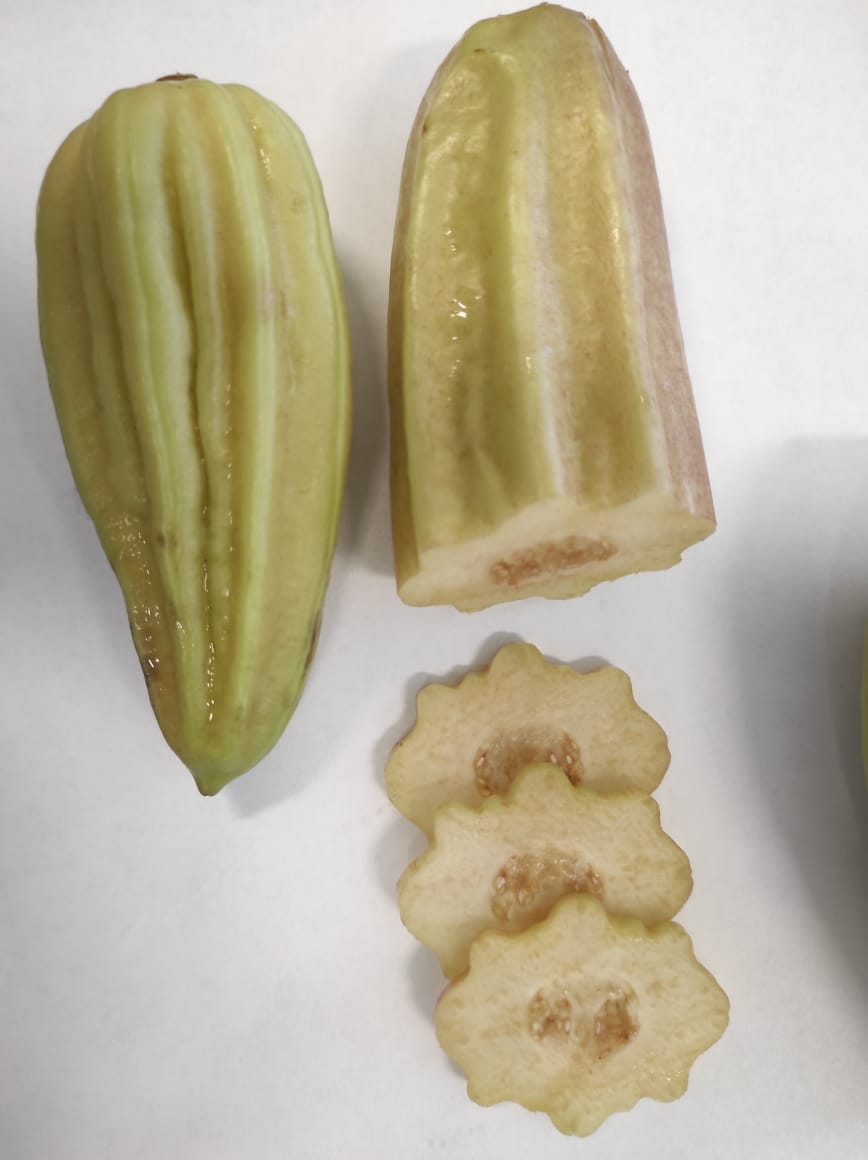
Valorization of the fruit of Parmentiera aculeata in animal nutrition: its use as substrate for the growth of two probiotic strains
Keywords:
Chote, Solid state fermentation, Probiotics, Taguchi.Abstract
In Mexico, there are fruits with low biotechnological exploitation, such as the fruit of Parmentiera aculeata, whose uses are timber, medicinal and edible for humans and animals. In this sense, it is important to use ingredients that nourish, promote digestive health and improve growth of livestock production systems. Precisely, probiotics are microorganisms that confer health to the host and there is interest in the search for new sources of substrates for them. Therefore, the objective of the present work was to use the fruit of P. aculeata as a substrate for the growth of probiotic bacteria in solid-state fermentation (SSF). A chemical-proximal analysis of the fruit was carried out according to AOAC methodology. Two probiotic strains (Lactobacillus paracasei subsp. paracasei ATCC25302 and Lactobacillus plantarum subsp. plantarum ATCC 14917) were used for the development of SSFs using an experimental design with L9 (3^3) orthogonal arrangement proposed by Taguchi. Three parameters were evaluated: pH, humidity and inoculum concentration at three levels: 4.0, 5.0 and 6.0; 50, 60 and 70%; and 5, 10 and 15%, respectively. Incubation was carried out at 37°C for 120 hours. Growth was reported as cells/g dry bagasse (cel/gbs). From the chemical-proximal composition of the fruit, moisture and ash values are similar to those reported; fat and protein values are higher and carbohydrate values are lower than reported. The differences can be attributed to the geographical area and time of fruit harvesting. The optimum growth conditions for both strains was treatment 3: levels 1, 3 and 3 (pH 4.0, 70% moisture and 15% inoculum). The maximum growth value was 1.42 x 10⁹ cells/gbs for the L. plantarum subsp. plantarum ATCC14917 strain, which exceeded 2.34 times the growth of the L. paracasei subsp. paracasei ATCC25302 strain. After validation, we observed a value of 3.8 times higher than the value predicted by the Taguchi model. These results provide interesting information for the area of animal nutrition, particularly for the design of feedstuffs that improve growth in livestock production systems.
References
1. Rodríguez R, Ontivero Y, García Y, Gómez D, Sosa G. Use of the sweet potato tuber (Ipomoea batatas L.) and the Lactobacillus pentosus LB-31 strain as additives to mixed silages for ruminants. Livest Res Rural Dev [Internet]. 2020 [cited 2022 May 25];23(7):Artículo 117. Available from: https://www.lrrd.cipav.org.co/lrrd32/7/rodri32117.html
2. Flórez-Delgadoa DF, Rosales-Asensio E. Vista de Uso del ensilaje de pulpa de café en alimentación animal. Mundo Fesc [Internet]. 2018 [cited 2022 May 26];15(1):73–82. Available from: https://www.fesc.edu.co/Revistas/OJS/index.php/mundofesc/article/view/254/385
3. Molina A. Probiotics and their mechanism of action in animal feed. Agron Mesoam. 2019;30(2):601–11.
4. Núñez-Torres OP. Los costos de la alimentación en la producción pecuaria. J Selva Andin Anim Sci. 2017;4(2):93–4.
5. Sainz-Ramírez A, Botana A, Pereira-Crespo S, González-González L, Veiga M, Resch C, et al. Efecto de la fecha de corte y del uso de aditivos en la composición química y calidad fermentativa de ensilado de girasol. Rev Mex Ciencias Pecu [Internet]. 2020 [cited 2022 May 26];11(3):620–37. Available from: http://www.scielo.org.mx/scielo.php?script=sci_arttext&pid=S2007-11242020000300620&lng=es&nrm=iso&tlng=es
6. Bernal Castro CA, Díaz-Moreno C, Gutiérrez-Cortés C. Probióticos y prebióticos en matrices de origen vegetal: avances en el desarrollo de bebidas de frutas. Rev Chil Nutr [Internet]. 2017 [cited 2018 Nov 29];44(4):383–92. Available from: http://www.scielo.cl/scielo.php?script=sci_arttext&pid=S0717-75182017000400383&lng=en&nrm=iso&tlng=en
7. Mariño G, Núñez V, Barreto P. Microbiota, probióticos, prebióticos y simbióticos. Acta Médica Cuba [Internet]. 2016 Oct 31 [cited 2018 Dec 5];17(1). Available from: http://www.medigraphic.com/cgi-bin/new/resumen.cgi?IDARTICULO=68527
8. Davani-Davari D, Negahdaripour M, Karimzadeh I, Seifan M, Mohkam M, Masoumi SJ, et al. Prebiotics: Definition, Types, Sources, Mechanisms, and Clinical Applications. Foods. 2019;8(3):92.
9. Guarner F, Sanders M, Eliakim R, Fedorak R, Gangl A, Garisch J, et al. Probióticos y prebióticos. World Gastroenterol Organ. 2017;35.
10. Nataraj BH, Ali SA, Behare P V., Yadav H. Postbiotics-parabiotics: The new horizons in microbial biotherapy and functional foods. Microb Cell Fact [Internet]. 2020;19:168. Available from: https://doi.org/10.1186/s12934-020-01426-w
11. Flores L, Usca J, Peñafiel S, Tello L. Probióticos Como Aditivos Dietéticos Para Cerdos. Una Revisión/Probiotics as Dietetic Additives for Pigs. A Review. KnE Eng [Internet]. 2020 Jan 26 [cited 2022 Apr 26];2020:477–499–477–499. Available from: http://3.65.204.3/index.php/KnE-Engineering/article/view/6267
12. Vera-Mejía RR, Vega-Cañizares E, Sánchez-Miranda L. Efecto de Lactobacillus plantarum como probiótico en cerdos al destete. Rev Salud Anim [Internet]. 2018 [cited 2022 Apr 26];40(3):2224–4700. Available from: http://opn.to/a/kqa3R
13. Gutiérrez-Castro L, Güecha-Castillo A. Uso de probióticos en alimentación animal. Rev Sist Prod uctivos Agroecol. 2016;7(2):43–55.
14. Lecarnaque Dioses EN. Efecto de tres porcentajes de inóculo de Lactobacillus cases y tres concentraciones de arroz sobre la acidez del ensilado de residuos de pescado. Universidad Nacional de Tumbes; 2019.
15. Zimmermann J. Aplicación de diferentes matrices transportadoras de probióticos destinadas a cerdos en producción primaria. Universidad Nacional del Litoral; 2020.
16. Angón-Galván P. Caracterización parcial del fruto Parmentiera edulis. Universidad Tecnológica de la Mixteca; 2006.
17. García-Castillo CG, Martínez-Tinajero JJ, Montañez-Valdez OD, Sánchez-Orozco L, Posada-Cruz S, Izaguirre-Flores F, et al. Degradación ruminal de la materia seca del fruto cuajilote (Parmentiera edulis). Zootec Trop. 2008;26(1):1–8.
18. AOAC. Official Methods of Analysis of AOAC International. 18th ed. Horwirtz W, editor. AOAC International. Marylanda, USA: AOAC International; 2005.
19. AOAC. Official Methods of Analysis of AOAC International of AOAC International. 20 th. Latimer GW, editor. AOAC International. Maryland, USA: AOAC International; 2016. 3172 p.
20. Aguilar-Zarate P, Cruz-Hernandez MA, Montañez JC, Belmares-Cerda RE, Aguilar CN. Enhancement of tannase production by Lactobacillus plantarum CIR1: Validation in gas-lift bioreactor. Bioprocess Biosyst Eng. 2014;37(11):2305–16.
21. Villar-Herrera S. Evaluación nutrimental del fruto Parmentiera edulis para su posible utilización en la industria alimentaria. Universidad Autónoma Agraria Antonio Narro; 2011.
22. Kader AA, Pelayo-Zaldivar C. Tecnología postcosecha de cultivos hortofrutícola [Internet]. UCANR Publications; 2011 [cited 2022 Aug 18]. 584 p. Available from: https://books.google.com.mx/books?id=x62K8WywAt4C&pg=PA321&dq=factores+que+influyen+en+la+calidad+de+las+frutas&hl=es&sa=X&ved=2ahUKEwjHs-X2iNL5AhVJnGoFHbOhC20Q6AF6BAgLEAI#v=onepage&q=factores que influyen en la calidad de las frutas&f=false
23. Negroni M. Microbiología Estomatológica, Fundamentos y guía práctica [Internet]. Segunda. Buenos Aires: Médica Panamericana; 2009 [cited 2022 Aug 19]. 656 p. Available from: https://books.google.com.mx/books?id=Gxmui-vjZBgC&pg=PA45&dq=factores+que+afectan+el+crecimiento+bacteriano&hl=es&sa=X&ved=2ahUKEwjb_uzTjtL5AhW3hIkEHU14CNwQ6AF6BAgHEAI#v=onepage&q=humedad&f=false
24. Díaz-Fernández JM. Ingeniería de Bioprocesos [Internet]. Tercera ed. ESpaña: Ediciones Paraninfo, S. A.; [cited 2022 Aug 19]. Available from: https://books.google.com.mx/books?id=eHA-EAAAQBAJ&pg=PA340&dq=actividad+de+agua+para+crecimiento+microbiano&hl=es&sa=X&ved=2ahUKEwjy2_eOh9P5AhWGIUQIHWTwCzkQ6AF6BAgHEAI#v=onepage&q=actividad de agua para crecimiento microbiano&f=false
25. Lora Cahuas de Robles CE del R. Efecto de diferentes concentraciones de inóculo de Pseudomonas aeruginosa en la degradación de aceite lubricante en laboratorio [Internet]. Biblioteca Digital-Dirección de Sistemas de Informática y Comunicación. Universidad Nacional de Trujillo; 2021. Available from: http://dspace.unitru.edu.pe/bitstream/handle/UNITRU/14465/Aguilar Ramos Cesar Hilton.pdf?sequence=1&isAllowed=y
26. Fuenmayor CA, Quicazán MC, Figueroa J. Desarrollo de un suplemento mnutricional mediante la fermentación en fase sólida de polen de abejas empleando bacterias ácido lácticas rpobióticas. Aliment Hoy [Internet]. 2010 [cited 2022 May 30];20(23):18–40. Available from: https://acta.org.co/acta_sites/alimentoshoy/index.php/hoy/article/view/24/24
27. Agropecuarias C, Ramírez-díaz R, Pinto-ruiz R, Medina-jonapá F, Guevara-hernández F. Efecto de inoculantes y aditivos sobre fracciones de fermentación ruminal y degradación in vitro en ensilaje de sorgo ( Sorghum sp ) Effect of inoculants and additives on fractions of ruminal fermenta- tion and in vitro degradation in sorghum silage ( Sor. Cienc UAT. 2020;15(1):172–9.
28. Vera Mendoza AJ, Zambrano Zambrano BA. Inoculación de Lactobacillus plantarum para la fermentación y conservación del ensilaje de maíz (Zea mays)SILAJE DE MAÍZ (Zea mays). Escuela Superior Politécnica Agropecuaria Manuel Félix López; 2019.
29. Holguín VA, Cuchillo-Hilario M, Mazabel J, Quintero S, Mora-Delgado J. sobre la fermentación ruminal in vitro y su emisión de metano en el sistema RUSITEC. Rev Mex Ciencias Pecu. 2020;11(1):19–37.