Obtaining and evaluation of natural hair dye based on the green husk of Juglans sp.
Keywords:
Aloe vera, Euphorbia antisyphilitica, Fisher-saller, mordants, synthetic dye.Abstract
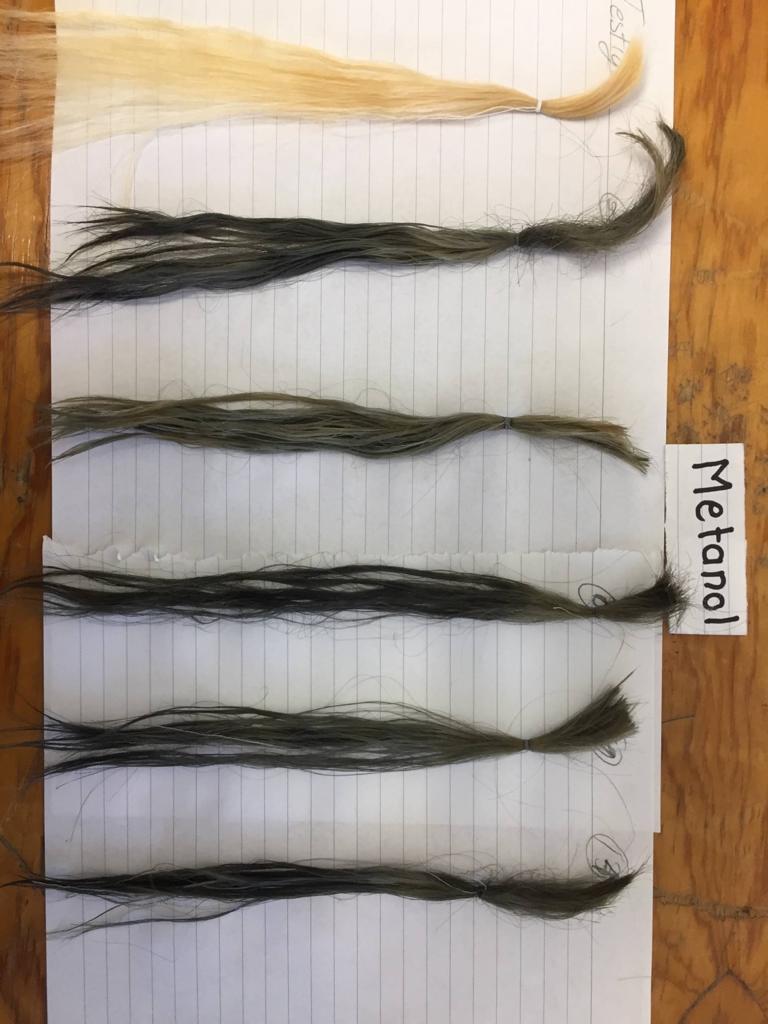
The green husk of Juglans sp., is an agricultural waste with a source of organic compounds that provide naturally coloring agents. Natural pigments represent an alternative to beauty products most of which contain allergens and carcinogens. The objective of this study was to evaluate the effectiveness and color loss of a dye using extracts from the pericarp of Juglans sp. in strands of bleached hair. Dried and ground pericarp extracts (10% w/v) based on water, ethanol, and methanol, were obtained and evaluated on bleached hair strands using hydrogen peroxide. Color change was assessed using the Fisher-Saller scale by assigning a number instead of a letter to each treated hair strand. The results of the modified scale were evaluated by analysis of variance and color loss was recorded by washing each strand 30 times. As results, no significant color loss was found after 30 washes with detergent; both ethanolic and methanolic extracts developed dark colors (U-Y on the Fisher-Saller scale, 21-25), while aqueous extracts developed ashy colors (M-O on the Fisher-Saller scale, 13-15). There is no commercial green peel-based hair dye on the market. This research shows a semi-permanent formulation as an ecological option to synthetic dyes.
References
[1] Huncharek, M.; Kupelnick, B. Personal use of hair dyes and the risk of bladder cancer: results of a meta-analysis. Public Health Rep. 2005, 120, 31–38. DOI: 10.1177/003335490512000107.
[2] AlGhamdi, K. M.; Moussa, N. A. Knowledge and practices of, and attitudes towards, the use of hair dyes among females visiting a teaching hospital in Riyadh, Saudi Arabia. Ann. Saudi Med. 2011, 31, 613–619. DOI: 10.4103/0256-4947.87099.
[3] Kim, K. H.; Kabir, E.; Jahan, S. A. The use of personal hair dye and its implications for human health. Environ. Int. 2016, 89-90, 222–227. DOI:10.1016/j.envint.2016.01.018.
[4] Zhang, Y.; Birmann, B. M.; Han, J.; Giovannucci, E.; Speizer, F. E.; Stampfer, M. J.; Rosner, B. E.; Schernhammer, E. S. Personal use of permanent hair dyes and cancer risk and mortality in US women: prospective cohort study. BMJ. 2020, 370. DOI:10.1136/bmj.m29422.
[5] Beiki, T.; Najafpour, G. D.; Hosseini, M. Evaluation of antimicrobial and dyeing properties of walnut (Juglans regia L.) green husk extract for cosmetics. Color. Technol. 2018, 134, 71–81. https://doi.org/10.1111/cote.12322
[6] Patel, D.; Narayana, S.; Krishnaswamy, B. Trends in use of hair dye: A cross-sectional study. Int. J. Trichology. 2013, 5, 140. DOI: 10.4103/0974-7753.125610.
[7] Abe, F. R.; Mendonça, J. N.; Moraes, L. A. B.; de Oliveira, G. A. R.; Gravato, C.; Soares, A. M. V.; Oliveira, D. P. Toxicological and behavioral responses as a tool to assess the effects of natural and synthetic dyes on zebrafish early life. Chemosphere. 2017, 178, 282–290. DOI:10.1016/j.chemosphere.2017.03.030.
[8] Lind, M. L.; Boman, A.; Sollenberg, J.; Johnsson, S.; Hagelthorn, G.; Meding, B. Occupational dermal exposure to permanent hair dyes among hairdressers. Ann Occup Hyg. 2005, 49, 473-480. DOI: 10.1093/annhyg/mei030.
[9] Carvalho, M.; Ferreira, P. J.; Mendes, V. S.; Silva, R.; Pereira, A.; Jerónimo, C.; Silva, B. M. Human cancer cell antiproliferative and antioxidant activities of Juglans regia L. Food Chem. Toxicol. 2010, 48, 441-447. DOI:10.1016/j.fct.2009.10.043.
[10] Mendelsohn, J. B.; Ji, Q. Z.; Li, B. T.; Shu, X. O.; Yang, G.; Li, H. L.; Zheng, W. Personal use of hair dye and cancer risk in a prospective cohort of Chinese women. Cancer Sci. 2009, 100, 1088-1091. https://doi.org/10.1111/j.1349-7006.2009.01149.x.
[11] Bolt, H. M.; Golka, K. The debate on carcinogenicity of permanent hair dyes: new insights. Crit. Rev. Toxicol. 2007, 37, 521–536. DOI: 10.1080/10408440701385671.
[12] Harling, M.; Schablon, A.; Schedlbauer, G.; Dulon, M.; Nienhaus, A. Bladder cancer among hairdressers: a meta-analysis. Occup. Environ. Med. 2010, 67, 351–358. DOI: 10.1136/oem.2009.050195.
[13] IARC. International Agency for Research on Cancer. Monographs on the Evaluation of Carcinogenic of some aromatic amines and related compounds. 2020. Retrieved from: 127. https://www.iarc.who.int/wp-content/uploads/2020/06/QA_Monographs_Volume-127.pdf (Accesed on April 5, 2022).
[14] IARC, International Agency for Research on Cancer. Overall evaluations of carcinogenicity: an updating of IARC monographs. 1987, 42, 53. (p. 53). Lyon, France: IARC.
[15] Ali, A.; Shaziya-Allarakha, M., Shamila, F.; Amaan, S.; Habib, S. Risk of Carcinogenicity Associated with Synthetic Hair Dyeing Formulations: A Biochemical View on Action Mechanisms, Genetic Variation and Prevention. Ind J Clin Biochem. 2022. 37, 399–409. https://doi.org/10.1007/s12291-022-01051-x
[16] Boonsong, P.; Laohakunjit, N.; Kerdchoechuen, O. Natural pigments from six species of Thai plants extracted by water for hair dyeing product application. J. Clean. Prod. 2012, 37, 93–106. DOI:10.1016/j.jclepro.2012.06.013.
[17] Adeel, S.; Abrar, S.; Kiran, S.; Farooq, T.; Gulzar, T.; Jamal, M. Sustainable Application of Natural Dyes in Cosmetic Industry. Handbook of Renewable Materials for Coloration and Finishing, Scrivener publishing. 2018, 189-190. DOI: 10.1002/9781119407850. ISBN:9781119407850.
[18] Diarsa, M.; Gupte, A. Optimization and Extraction of Natural Dye from Tagetes Erecta and Dyeing of Cotton and Silk Fabric Using Banana (Musa sp.) Pseudo Stem Sap. J. Nat. Fibers. 1–13. DOI:10.1080/15440478.2020.1863291.
[19] Jahanban-Esfahlan, A.; Ostadrahimi, A.; Tabibiazar, M.; Amarowicz, R. A comprehensive review on the chemical constituents and functional uses of walnut (Juglans spp.) husk. Int. J. Mol. Sci. 2019, 3920. https://doi.org/10.3390/ijms20163920.
[20] Fernández-Agulló, A., E. Pereira, M.S. Freire, P. Valentão, P.B. Andrade, J. González-Álvarez and J.A. Pereira. 2013. Influence of solvent on the antioxidant and antimicrobial properties of walnut (Juglans regia L.) green husk extracts. Ind Crops Prod. 42: 126–132. DOI:10.1016/j.indcrop.2012.05.021
[21] Sánchez-Mirón, B. W.; Roux-Gutiérrez, R. S.; Molar-Orozco, M. E. Alternative material for load-bearing wall with addition of walnut shell. Waste Reduction. In: Proceedings of the 3rd International Congress on Sustainable Construction and Eco-Efficient Solutions. 2017, 1023-1034. Universidad de Sevilla. Escuela Técnica Superior de Arquitectura.
[22] Cosmulescu, S. N.; Trandafir, I.; Achim, G.; Baciu, A. Juglone content in leaf and green husk of five walnut (Juglans regia L.) cultivars. Not. Bot. Horti Agrobot. Cluj-Napoca. 2011, 39, 237–240.
[23] Akbari, V.; Jamei, R.; Heidari, R.; Esfahlan, A. J. Antiradical activity of different parts of Walnut (Juglans regia L.) fruit as a function of genotype. Food Chem. 2012, 135, 2404–2410. DOI: 10.1016/j.foodchem.2012.07.030.
[24] Sadeghi-Kiakhani, M.; Tehrani-Bagha, A. R; Gharanjig, K.; Hashemi, E. Use of pomegranate peels and walnut green husks as the green antimicrobial agents to reduce the consumption of inorganic nanoparticles on wool yarns. J. Clean. Prod. 2019, 231, 1463–1473. DOI: 10.1016/j.jclepro.2019.05.283.
[25] Wenzel, J.; Storer-Samaniego, C.; Wang, L.; Burrows, L.; Tucker, E.; Dwarshuis, N.; Zand, A. Antioxidant potential of Juglans nigra, black walnut, husks extracted using supercritical carbon dioxide with an ethanol modifier. Food Sci. Nutr. 2017, 5, 223–232. DOI:10.1002/fsn3.385.
[26] Shaukat, A.; Munazza, M.; Muhammad, T. H. Efficacy of Some Plants Extracts for Natural Dyeing of Human Hair. J. Nat. Fibers. 2020, 1-15. DOI:10.1080/15440478.2020.1821280.
[27] Vieira, V.; Pereira, C.; Abreu, R. M.; Calhelha, R.; Alves, M. J.; Coutinho, J. A.; Ferreira, C. Hydroethanolic extract of Juglans regia L. green husks: A source of bioactive phytochemicals. Food Chem. Toxicol. 2020, 137, 111189. https://doi.org/10.1016/j.fct.2020.111189.
[28] Birngruber, C.; Verhoff, M. A. The color of human hair. In: Preedy, V. R. ed. Handbook of Hair in Health and Disease. Wageningen Academic Publishers. 2012, 30–49. DOI:10.3920/978-90-8686-728-8_2.
[29] Evayanti, L.G.; Artaria, M. D. 2019. Understanding the Characteristics of Physical Color in Human–an Article Review. Proceedings of the 1st international conference of social science. ICOSS 2018. Universitas Warmadewa, Denpasar, Bali-Indonesia. pp. 227. Doi:10.4108/eai.21-9-2018.2281158.
[30] R Core Team. R: A language and environment for statistical computing. R Foundation for Statistical Computing, Vienna, Austria. 2020, https://www.R-project.org/. (Accesed on March 25, 2022).
[31] Arifeen, W.; Rehman, F. U.; Adeel, S.; Zuber, M.; Ahmad, M. N.; Ahmad, T. Environmental friendly extraction of walnut bark-based juglone natural colorant for dyeing studies of wool fabric. Environ. Sci. Pollut. Res., 2021, 28, 49958–49966. doi:10.1007/s11356-021-14277-8
[32] van Wyk, B. E.; van Rheed, M. C.; van Oudtshoorn, G. F.; Smith, G. F. 1995. Geographical variation in the major compounds of Aloe ferox leaf exudate. Planta medica. 61, 250–3. DOI: 10.1055/s-2006-958066.
[33] Yagi, A.; Tsunoda, M.; Egusa, E.; Akasaki, A.; Tsuji, H. Immunochemical distinction of Aloe vera, A. Arborescens and A. Chinensis gel. Planta Medica, 1998, 64, 277–278. DOI: 10.1055/s-2006-957427. PMID: 9581527.
[34] Lee, K.C. Nature and occurrence of juglone in Juglans nigra L. A Master's thesis dissertation.1967, Kansas State University.
[35] Ali, S.; Maqbool, M.; Hussain, M. T. Efficacy of Some Plants Extracts for Natural Dyeing of Human Hair. J. Nat. Fibers. 2020, 1–15. DOI:10.1080/15440478.2020.1821280.
[36] Burkinshaw, S.M.; Kumar, N. The mordant dyeing of wool using tannic acid and FeSO4, Part 1: Initial findings. Dyes Pigm. 2009, 80, 53–60. doi:10.1016/j.dyepig.2008.05.008.
[37] Chairat, M.; Darumas, U.; Bremner, J. B.; Bangrak, P. Dyeing of cotton yarn with the aqueous extract of the leaves of Eupatorium odoratum L. in Thailand and associated extract toxicity studies. Color. Tech. 127(5): 346–353. DOI:10.1111/j.1478-4408.2011.00321.x.
[38] de Sanjosé S.; Benavente, Y.; Nieters, A.; Foretova, L.; Maynadié, M.; Cocco, P. L.; Stainers, A.; Vornanen, M., Boffetta, P.; Becker, N.; Alvaro, T.; Brennan, P. Association between personal use of hair dyes and lymphoid neoplasms in Europe. Am J. Epidemiol. 2006, 164, 147–55.
[39] Caraballo-Arias, Y.; Rodríguez, A. R.; Rivero, A. J.; Rangel, R. G.; Barrios-Covaro, M. Riesgos laborales en trabajadores de barberías y peluquerías de economía informal: Caracas, Venezuela. Ciencia y Trabajo, 2013, 15(46), 18–23. https://dx.doi.org/10.4067/S0718-24492013000100005
[40] Bañuelos-Revilla, J. E.; Palacio-Núñez, J.; Martínez-Montoya, J. F.; Olmos-Oropeza, G.; Flores-Cano, J. A. Distribución potencial y abundancia de candelilla (Euphorbia antisyphilitica) en el norte de Zacatecas, México. Madera y bosques, 2019, 25(1), e2511657. https://doi.org/10.21829/myb.2019.2511657