Impact of a gamified educational video game on academic performance in Object-Oriented Programming
Keywords:
academic performance, educational video game, gamification, higher education, object-oriented programming.Abstract
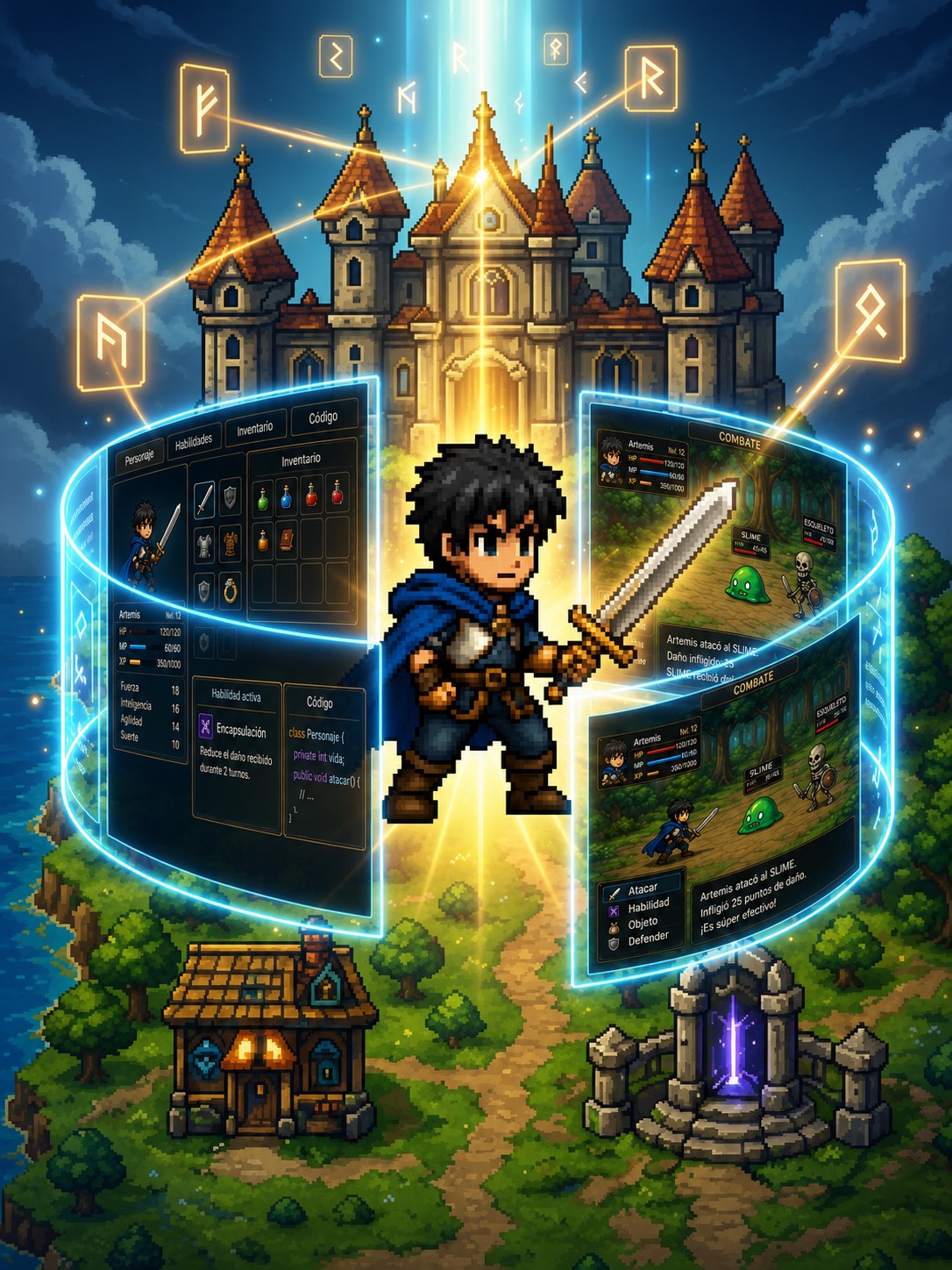
Video games are rarely used in academic contexts and are commonly associated with leisure. This study analyzes the impact of a video game as a gamification tool on the academic performance of second-semester students enrolled in the Object-Oriented Programming (OOP) course at the Tecnológico Nacional de México, Campeche campus. A quantitative methodology with a quasi-experimental design was applied, comprising a control group (n=22) and an experimental group (n=31), totaling 53 students—20 women and 33 men, aged 18 to 23. The educational video game Tales from the South II, developed in RPG Maker MV, served as the gamification tool. Pre- and post-tests with dichotomous items were administered to both groups; instrument reliability was validated using the Kuder-Richardson coefficient (KR-20 = 0.799). Due to heterogeneous variances confirmed by Levene's test (F=7.719, p=0.008), Welch's t-test was applied (α=0.05). Results showed a statistically significant difference favoring the experimental group (t=3.535, df=43.92, p=0.001), with a large effect size (Cohen's d=0.99). These results suggest favorable evidence that the use of a video game as a gamification strategy positively impacts OOP academic performance and contributes to the design of innovative pedagogical strategies for engineering programs in higher education.
References
[1] UNESCO. (2021). Reimagining our futures together: A new social contract for education. UNESCO Publishing.
[2] Medeiros, R.P., Ramalho, G.L. y Falcão, T.P. (2019). A systematic literature review on teaching and learning introductory programming in higher education. IEEE Transactions on Education, 62(2), 77-90. https://doi.org/10.1109/TE.2018.2864133
[3] Torres-Zapata, Á.E., Pérez-Jaimes, A.K., Lara-Gamboa, C.C. y Estrada-Reyes, C.U. (2022). Caracterización de los factores docentes en torno al índice de reprobación en universitarios. RIDE Revista Iberoamericana para la Investigación y el Desarrollo Educativo, 12(24), e310. https://doi.org/10.23913/ride.v12i24.1123
[4] Deterding, S., Dixon, D., Khaled, R. y Nacke, L. (2011). From game design elements to gamefulness: Defining gamification. Proceedings of the 15th International Academic MindTrek Conference, 9-15. https://doi.org/10.1145/2181037.2181040
[5] Almarales-Sarasola, M. y García-Fernández, O. (2019). Tutorial interactivo para la enseñanza de la Programación Orientada a Objetos. Revista de Investigación, Formación y Desarrollo: Generando Productividad Institucional, 7(3), 65-72. https://doi.org/10.34070/rif.v7i3
[6] Pegalajar Palomino, M.C. (2021). Implicaciones de la gamificación en Educación Superior: una revisión sistemática sobre la percepción del estudiante. Revista de Investigación Educativa, 39(1), 169-188. https://doi.org/10.6018/rie.419481
[7] Deci, E.L. y Ryan, R.M. (2000). The "what" and "why" of goal pursuits: Human needs and the self-determination of behavior. Psychological Inquiry, 11(4), 227-268. https://doi.org/10.1207/S15327965PLI1104_01
[8] Csikszentmihalyi, M. (1990). Flow: The Psychology of Optimal Experience. Harper & Row.
[9] Corchuelo-Rodríguez, C.A. (2018). Gamificación en educación superior: experiencia innovadora para motivar estudiantes y dinamizar contenidos en el aula. EDUTEC. Revista Electrónica de Tecnología Educativa, 63, 29-41. https://doi.org/10.21556/edutec.2018.63.927
[10] Werbach, K. y Hunter, D. (2012). For the Win: How Game Thinking Can Revolutionize Your Business. Wharton Digital Press.
[11] Parra-González, M.E. y Segura-Robles, A. (2019). Producción científica sobre gamificación en educación: un análisis cienciométrico. Revista de Educación, 386, 113-135. https://doi.org/10.4438/1988-592X-RE-2019-386-429
[12] Sedeño, A.M. (2002). Videojuegos como dispositivos culturales: las competencias espaciales en educación. Comunicar, 18, 183-189.
[13] Barr, M. (2016). Video games can develop graduate skills in higher education students: A randomised trial. Computers & Education, 113, 86-97. https://doi.org/10.1016/j.compedu.2016.09.002
[14] Seaborn, K. y Fels, D. (2015). Gamification in theory and action: A survey. International Journal of Human-Computer Studies, 74(1), 14-31. https://doi.org/10.1016/j.ijhcs.2014.09.006
[15] Simões, J., Díaz, R. y Fernández, A. (2013). A social gamification framework for a K-6 learning platform. Computers in Human Behavior, 29(2), 345-353. https://doi.org/10.1016/j.chb.2012.06.007
[16] Lee, J. y Hammer, J. (2011). Gamification in education: What, how, why bother? Academic Exchange Quarterly, 15(2), 146.
[17] Subhash, S. y Cudney, E.A. (2018). Gamified learning in higher education: A systematic review of the literature. Computers in Human Behavior, 87, 192-206. https://doi.org/10.1016/j.chb.2018.05.028
[18] Montenegro-Rueda, M., Luque-de la Rosa, A., Sarasola Sánchez-Serrano, J.L. y Fernández-Cerero, J. (2023). Gamification in higher education: A systematic review. Education Sciences, 13(1), 63. https://doi.org/10.3390/educsci13010063
[19] Marín, B., Frez, J., Cruz, J. y Genero, M. (2019). An empirical investigation on the benefits of gamification in programming courses. ACM Transactions on Computing Education, 19(1), 1-22. https://doi.org/10.1145/3231709
[20] García Lázaro, I. (2019). Escape Room como propuesta de gamificación en educación. Revista Educativa Hekademos, 27, 71-79.
[21] Kapp, K.M. (2012). The Gamification of Learning and Instruction: Game-Based Methods and Strategies for Training and Education. John Wiley & Sons.
[22] Bodnar, C.A., Anastasio, D., Enszer, J.A. y Burkey, D.D. (2016). Engineers at play: Games as teaching tools for undergraduate engineering students. Journal of Engineering Education, 105(1), 147-200. https://doi.org/10.1002/jee.20106
[23] Laura-Ochoa, L., Bedregal-Alpaca, N., Delgado-Barra, L. y Guevara, K. (2023). Aprendizaje activo y aprendizaje cooperativo para la enseñanza de un curso de fundamentos de programación. RISTI - Revista Ibérica de Sistemas e Tecnologias de Informação, E59, 64-77.
[24] Hernández, R., Fernández, C. y Baptista, M.P. (2018). Metodología de la investigación (7ª ed.). McGraw-Hill.
[25] Cohen, J. (1988). Statistical power analysis for the behavioral sciences (2ª ed.). Lawrence Erlbaum Associates.