Multicriteria analysis computer program using classical techniques and Unified Model
Keywords:
Computer program, MCDM, WSM, WPM, WASPAS, PROMETHEE, VIKOR, TOPSIS, unified methodology.Abstract
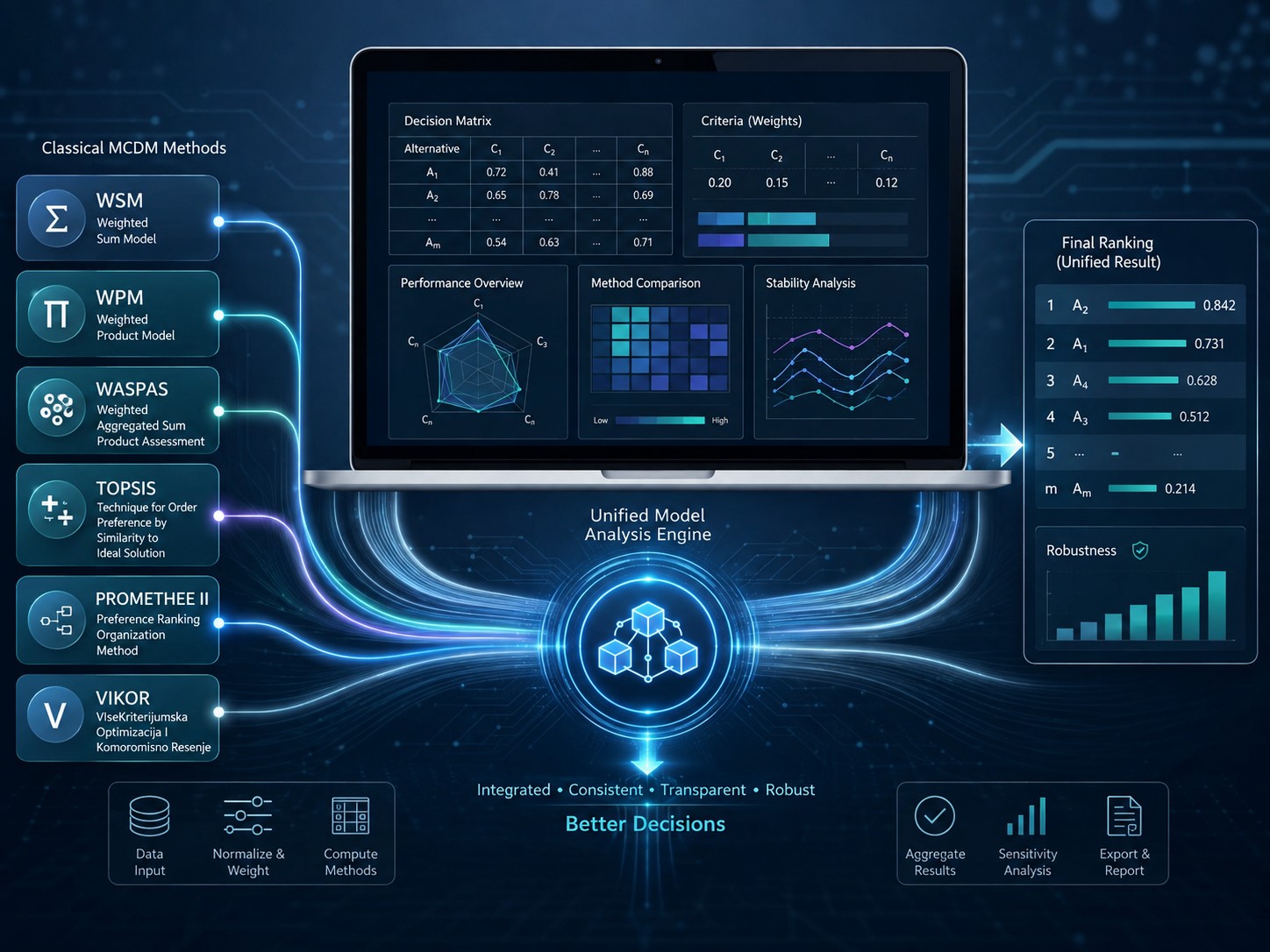
Over recent decades, research on decision making has expanded significantly, becoming a key area within computer science, particularly in fields concerned with data‑driven methods, intelligent computational systems, and algorithmic optimization. Within this context, this article introduces a computational tool designed to support the analysis of decision problems involving multiple criteria. The system brings together several well‑established multicriteria decision‑making approaches within a single framework, allowing these problems to be examined from a broader and more methodologically consistent standpoint.
The study incorporates a set of widely recognized multicriteria decision‑making methods, including the Weighted Sum Model (WSM), the Weighted Product Model (WPM), the Weighted Aggregated Sum Product Assessment (WASPAS), the Preference Ranking Organization Method for Enrichment Evaluations (PROMETHEE II), the Technique for Order of Preference by Similarity to the Ideal Solution (TOPSIS), and the Multicriteria Optimization and Compromise Solution (VIKOR). The integration of these approaches aims to enhance and support structured decision‑making processes. Additionally, this document details the fundamental operating principles of each method and provides their corresponding programming implementations. These implementations are made available through QR codes to improve accessibility, comprehension, and ease of use. The proposed tool contributes directly to academic, scientific and technological domains.
The developed software successfully integrates these six classic multi-criteria decision-making (MCDM) techniques into a single computational environment, along with the proposed Unified Methodology. The system allows for generating rankings, storing intermediate results, and exporting final solutions in a CSV format. Experimental implementation demonstrated the correct execution of all incorporated algorithms, providing a unified environment for multi-criteria analysis in academic and industrial applications.
References
1. Zhang, Q., Li, H., Wan, X., Skitmore, M., & Sun, H. (2020). An intelligent waste removal system for smarter communities. Sustainability, 12(17), 6829. https://doi.org/10.3390/su12176829
2. Wu, J., Zhang, Y., & Li, X. (2022). Advances in decision support systems for multicriteria analysis. Computers & Industrial Engineering, 165, 107927.
3. Belton, V., & Stewart, T. J. (2002). Multiple criteria decision analysis: An integrated approach. Springer. https://doi.org/10.1007/978-1-4615-1495-4
4. Haider, A., Khan, M. A., & Ahmed, R. (2023). Integrating multicriteria decision-making models in industrial management. Industrial Management Review, 19(2), 88–104.
5. Jalil, R., Hamid, S., & Rahman, K. (2023). Supplier selection using multicriteria decision analysis: Case studies and frameworks. International Journal of Supply Chain Management, 12(4), 32–49.
6. González, A. G., & Ríos, R. G. (2003). Aplicación de las técnicas multicriteriales en la evaluación y selección de proveedores. Ingeniería Industrial, 24(2), 2.
7. Ho, W. (2008). Integrated analytic hierarchy process and its applications: A literature review. European Journal of Operational Research, 186(1), 211–228. https://doi.org/10.1016/j.ejor.2007.01.004
8. Zarghami, M., & Szidarovszky, F. (2011). Multicriteria analysis: Applications to water and environment management. Springer. https://doi.org/10.1007/978-3-642-17937-2.
9. Budiharjo, Windarto, A. P., & Muhammad, A. (2017). Comparison of weighted sum model and multi attribute decision making weighted product methods in selecting the best elementary school in Indonesia. International Journal of Software Engineering and Its Applications, 11(4), 69–90. https://doi.org/10.14257/ijseia.2017.11.4.06
10. Rao, C. M., & Venkatasubbaiah, K. (2016). Application of MCDM approach-TOPSIS for the multi-objective optimization problem. International Journal of Grid and Distributed Computing, 9(10), 17–32. https://doi.org/10.14257/ijgdc.2016.9.10.02.
11. Chourabi, Z., Khedher, F., Babay, A., & Cheikhrouhou, M. (2019). Multi-criteria decision making in workforce choice using AHP, WSM and WPM. The Journal of the Textile Institute, 110(7), 1092–1101. https://doi.org/10.1080/00405000.2018.1541434.
12. Triantaphyllou, E., & Mann, S. H. (1989). An examination of the effectiveness of multi-dimensional decision-making methods: A decision-making paradox. Decision Support Systems, 5(3), 303–312. https://doi.org/10.1016/0167-9236(89)90037-7
13. Atmojo, R. N. P., Cahyani, A. D., & Lie, Y. (2014). Simulation modeling of tablet PCs selection using weighted-product algorithm. Applied Mathematical Sciences, 8(115), 5705–5719. https://doi.org/10.12988/ams.2014.47531
14. Adriyendi. (2015). Multi-attribute decision making using simple additive weighting and weighted product in food choice. International Journal of Information Engineering and Electronic Business, 7(6), 8–14. https://doi.org/10.5815/ijieeb.2015.06.02
15. Chakraborty, S., Zavadskas, E. K., & Antucheviciene, J. (2015). Applications of WASPAS method as a multi-criteria decision-making tool. Economic Computation and Economic Cybernetics Studies and Research, 49(1), 5–22.
16. Chakraborty, S., & Zavadskas, E. K. (2014). Applications of WASPAS method in manufacturing decision making. Informatica, 25(1), 1–20. https://doi.org/10.15388/Informatica.2014.01
17. Tuzkaya, G., Gülsün, B., Kahraman, C., & Özgen, D. (2010). An integrated fuzzy multi-criteria decision making methodology for material handling equipment selection problem and an application. Expert Systems with Applications, 37(4), 2853–2863. https://doi.org/10.1016/j.eswa.2009.09.004
18. Dağdeviren, M. (2008). Decision making in equipment selection: An integrated approach with AHP and PROMETHEE. Journal of Intelligent Manufacturing, 19(4), 397–406. https://doi.org/10.1007/s10845-008-0091-7
19. Mousavi, M. M., & Lin, J. (2020). The application of PROMETHEE multi-criteria decision aid in financial decision making: Case of distress prediction models evaluation. Expert Systems with Applications, 159, Article 113438. https://doi.org/10.1016/j.eswa.2020.113438
20. Taillandier, P., & Stinckwich, S. (2011). Using the PROMETHEE multi-criteria decision-making method to define new exploration strategies for rescue robots. In 2011 IEEE International Symposium on Safety, Security, and Rescue Robotics (pp. 321–326). IEEE. https://doi.org/10.1109/SSRR.2011.6106747
21. Shen, K.-Y., Zavadskas, E. K., & Tzeng, G.-H. (2018). Updated discussions on “Hybrid multiple criteria decision-making methods: A review of applications for sustainability issues.” Economic Research-Ekonomska Istraživanja, 31(1), 1437–1452. https://doi.org/10.1080/1331677X.2018.1483836
22. Kelemenis, A., & Askounis, D. (2010). A new TOPSIS-based multi-criteria approach to personnel selection. Expert Systems with Applications, 37(7), 4999–5008. https://doi.org/10.1016/j.eswa.2009.12.013
23. Łatuszyńska, A. (2014). Multiple-criteria decision analysis using TOPSIS method for interval data in research into the level of information society development. Folia Oeconomica Stetinensia, 13(2), 63–76. https://doi.org/10.2478/foli-2013-0015
24. Radhika, S., Kumar, D. S., & Swapna, D. (2013). VIKOR method for multi criteria decision making in academic staff selection. Journal of Production Research & Management, 3(2), 30–35. https://doi.org/10.37591/joprm.v3i2.7145
25. Ghareb, M. I., & Ahmed, A. M. (2016). The use of programming language Java and C-Sharp in academic institutes of Kurdistan Region Government. International Journal of Research in Engineering, IT and Social Sciences, 6(8), 1–9.
26. Dhanalakshmi, C. S., Madhu, P., Karthick, A., Mathew, M., & Kumar, R. V. (2022). A comprehensive MCDM-based approach using TOPSIS and EDAS as an auxiliary tool for pyrolysis material selection and its application. Biomass Conversion and Biorefinery, 12(12), 5845–5860. https://doi.org/10.1007/s13399-020-01009-0