Microplásticos (MP): clasificación, aplicación y remoción
Palabras clave:
microplásticos, agua de desecho, tratamientoResumen
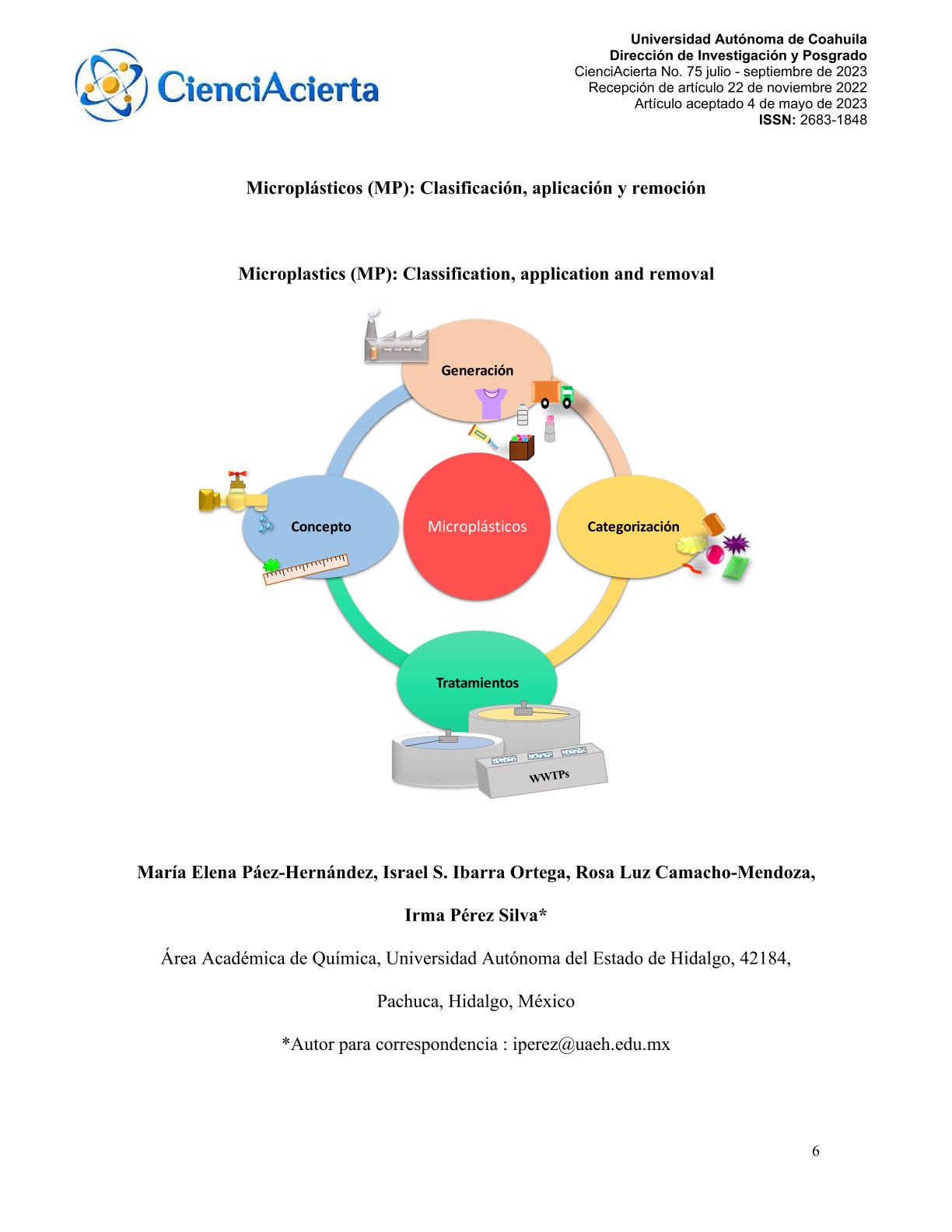
La presente revisión tiene por objeto dar a conocer información general sobre los microplásticos (MP) tal como su concepto, clasificación y formas de remoción implementadas en las plantas de tratamiento de aguas residuales. Un MP es un polímero sintético cuyas dimensiones no exceden los 5mm, dentro de sus propiedades se encuentra la baja biodegradabilidad y su capacidad de adsorber compuestos tóxicos, los cuales al entrar en contacto con un cuerpo de agua pueden ser liberados, por esta razón se encuentran entre los 10 principales problemas de contaminación ambiental. Los MP pueden ser primarios (fabricados para formar parte de un producto como cremas, cosméticos, pastas dentales, jabones, etc.) o secundarios (provienen de la fragmentación de un plástico) lo cual genera que su morfología y composición sea muy diversa lo cual trae como consecuencia que no todas las etapas que se tienen en una planta de tratamiento de aguas residuales tengan la misma eficiencia por lo que es necesario contar con nuevas técnicas de tratamiento como es la electrocoagulación.
Referencias
Aguirrezabal, I. (2019). Plásticos en México. Oficina Económica y Comercial de España en Ciudad de México (ICEX) DOC2019826983.pdf
Bui, X.T., Vo, T.D.H., Nguyen, P.T., Nguyen, V.T., Dao, T.S. & Nguyen, P.D. (2020). Microplastics pollution in wastewater: Characteristics, occurrence and removal technologies. Environmental Technology & Innovation. 19, 101013. DOI:10.1016/j.eti.2020.101013
Chang, X., Fang, Y., Wang, Y., Wang, F., Shang, L., Zhong, R. (2022). Microplastic pollution in soils, plants, and animals: A review of distributions, effects and potential mechanisms. Science of the Total Environment. 850, 157857. DOI: 10.1016/j.scitotenv.2022.157857
Fortunato, A., Cuccolini, G., Ascari, A., Campana, G. & Tani. G. (2010). Hybrid metal- plastic joining by means of laser. International Journal of Material Forming. 3, 1131- 1134. DOI: 10.1007/s12289-010-0971-1
Hidalgo-Ruz, V., Gutow L., Thompson R.C. & Thiel, M. (2012) Microplastics in the Marine Environment: A Review of the Methods Used for Identification and Quantification. Environmental Science Technology. 46, 3060-3075. DOI: 10.1021/es2031505
Jang, M., Shim, W.J., Han, G.M., Song, Y.K. & Hong, S.H. (2018). Formation of microplastics by polychaetes (Marphysa sanguinea) inhabiting expanded polystyrene marine debris. Marine Pollution Bulletin. 131, 365–369. DOI: 10.1016/j.marpolbul.2018.04.017
Kavya, A.N.V.L., Sundarrajan, S. & Ramakrishna, S. (2020). Identification and characterization of micro-plastics in the marine environment: A mini review. Marine Pollution Bulletin. 160, 111704. DOI:10.1016/j.marpolbul.2020.111704
Kooi, M. & Koelmans, A.A. (2019). Simplifying Microplastic via Continuous Probability Distributions for Size, Shape, and Density. Environmental Science Technology Letters. 6, 551−557. DOI: 10.1021/acs.estlett.9b00379
Lechthaler, S., Waldscläger, K., Stauch G., Schüttrumpf, H. (2020). The Way of Macroplastic through the Environment. Environments. 7, 73. DOI: 10.3390/environments7100073
Magni, S., Binelli, A., Pittura, L., Avio, C.G., Della Torre, C., Parenti, C.C., Gorbi, S. & Regoli, F. (2019). The fate of microplastics in an Italian Wastewater Treatment Plant. Science of the Total Environment. 652:602-610. DOI: 10.1016/j.scitotenv.2018.10.269
Napper, I.E. & Thompson, R.C. (2016). Release of synthetic microplastic plastic fibers from domestic washing machines: effects of fabric type and washing conditions. Marine Pollution Bulletin. 112:39–45. DOI: 10.1016/j.marpolbul.2016.09.025
Ngô, P.L., Pramanik, B.K., Shah, K. & Roychand, R. (2019). Pathway, classification and removal efficiency of microplastics in wastewater treatment plants. Environmental Pollution. 225, (113326). DOI: 10.1016/j.envpol.2019.113326
Ou, H. & Zeng, E.Y. (2018). Occurrence and Fate of Microplastics in Wastewater Treatment Plants. In: Zeng, E.Y. (Ed.), Microplastic Contamination in Aquatic Environments, An Emerging Matter of Environmental Urgency. Elsevier, Amsterdam, Netherlands, Ch. 10,
pp. 317-338
Perren, W., Wojtasik, A. & Cai, Q., (2018). Removal of Microbeads from Wastewater Using Electrocoagulation. ACS Omega. 3, 3357–3364. DOI: 10.1021/acsomega.7b02037
Plastics– the Facts (2022). [En línea]. Disponible en: https://www.plasticseurope.org. Fecha de consulta: 19 de Noviembre del 2022.
Ramírez-Álvarez, N., Mendoza, L. M. R., Macías-Zamora, J. V., Oregel-Vázquez, L., Álvarez-Aguilar, A., Hernández-Guzmán, F. A., Sánchez-Osorio J. L., Moore C. J., Silva-Jiménez, H. & Navarro-Olache, L. F. (2020). Microplastics: Sources and Distribution in Surface Waters and Sediments of Todos Santos Bay, Mexico. Science of The Total Environment. 703, 134838. doi:10.1016/j.scitotenv.2019.1348
Reddy, A.S., Nair, A.T. (2022). The fate of microplastics in wastewater treatment plants: An overview of source and remediation technologies. Environmental Technology & Innovation, 28, 102815. DOI: 10.1016/j.eti.2022.102815
Ríos-Mendoza, L. M., Ontiveros-Cuadras, J. F., León-Vargas, D., Ruiz-Fernández, A. C., Rangel-García, M., Pérez-Bernal, L. H., & Sánchez-Cabeza, J.-A. (2021). Microplastic contamination and fluxes in a touristic area at the SE Gulf of California. Marine Pollution Bulletin, 170, 112638.
Rochman, C.M., (2015). The Complex Mixture, Fate and Toxicity of Chemicals Associated with Plastic Debris in the Marine Environment. In: Bergmann M, Gutow L, Klages M. (eds) Marine Anthropogenic Litter. Springer, Cham, pp. 117-140
Shen, M., Zhang, Y., Almatrafi, E., Hu, T., Zhou, C., Song, B., Zeng, Z., Zeng, G. (2022). Efficient removal of microplastics from wastewater by an electrocoagulation process. Chemical Engineering Journal, 428, 1311161. DOI: 10.1016/j.cej.2021.131161
Singh, S., Kalyanasundaram, M., Diwan, V. (2021). Removal of microplastics from wastewater: available techniques and way forward. Water Science & Technology. 84 (12), 3689. DOI: 10.2166/wst.2021.472
Su, L., Xue, Y., Li, L., Yang, D., Kolandhasamy, P., Li, D. & Shi, H. (2016). Microplastics in Taihu Lake, China. Environmental Pollution. 216, 711–719. DOI: 10.1016/j.envpol.2016.06.036
Ungureanu, N., Vlăduț, V. & Paraschiv, G., (2019). Electrocoagulation in Wastewater Treatment. Annals of the University of Craiova - Agriculture, Montanology, Cadastre Series, 49, 206-216
Vuori, L.., Ollikainen, M. (2022). How to remove microplastics in wastewater? A cost- effectiveness analysis. Ecological Economics, 192, 107246. DOI: 10.1016/j.ecolecon.2021.107246
Yang, S., Zhou, M., Chen, X., Hu, L., Xu, Y., Fu, W., Li, C. (2022). A comparative review of microplastics in lake systems from different countries and regions. Chemosphere, 286, 131806. DOI:10.1016/j.chemosphere.2021.131806
Zhou, Y., He, G., Jiang, X., Yao, L., Ouyang, L., Liu, X., Liu, W. & Liu, Y. (2021). Microplastic contamination is ubiquitous in riparian soils and strongly related to elevation, precipitation and population density. Journal of Hazardous Materials, 411, 125178. DOI:10.1016/j.jhazmat.2021.125178.