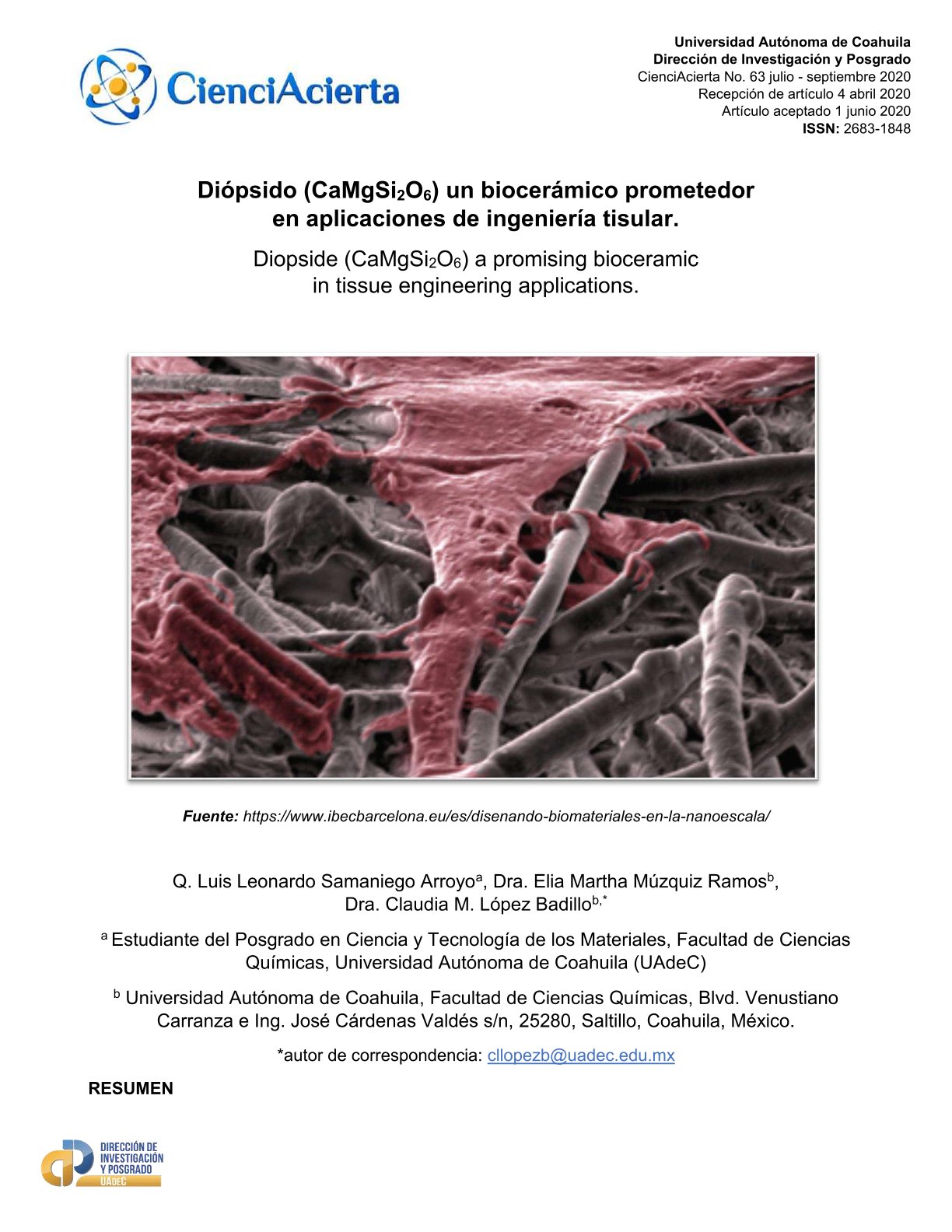
Diópsido (CaMgSi2O6) un biocerámico prometedor en aplicaciones de ingeniería tisular
Palabras clave:
biocerámico, diópsido, ingeniería tisularResumen
Los biocerámicos, comúnmente óxidos o silicatos, han ganado un gran interés en el área médica ya que son capaces de estimular y ayudar al crecimiento del hueso humano siendo excelentes candidatos para la ingeniería tisular (Valerio y col., 2004; Wu y col., 2004). El diópsido (CaO-MgO-2SiO2) representa uno de estos biocerámicos gracias a que se comporta como un material bioactivo, bioabsorbible y biocompatible en los tejidos tisulares (Baghjeghaz y Salahinejad, 2017; Rahmani y Salahinejad, 2018; Sadeghzade y col., 2019; Tsigkou y col., 2009), esto gracias a que es capaz de formar una composición similar a la del hueso y ayuda al crecimiento de células para mejorar tanto sus propiedades mecánicas como biológicas, por ello tiene una amplia aplicación en la ingeniería tisular (Ba y col., 2018; Baghjeghaz y Salahinejad, 2017; Kheradmandfard y col., 2018). En este documento se abordarán diversas investigaciones que tratan al diópsido como futuro candidato promisorio en el área de ingeniería tisular, además de las ventajas que presenta, debido a sus propiedades mecánicas, físicas y biológicas.
Referencias
Abdellahi, M., Najafinezhad, A., Ghayour, H., Saber-Samandari, S., & Khandan, A. (2017). Preparing diopside nanoparticle scaffolds via space holder method: Simulation of the compressive strength and porosity. Journal of the Mechanical Behavior of Biomedical Materials, 72, 171-181.
Ba, Z., Chen, Z., Huang, Y., Feng, D., Zhao, Q., Zhu, J., & Wu, D. (2018). Nanoporous diopside modulates biocompatibility, degradability and osteogenesis of bioactive scaffolds of gliadin-based composites for new bone formation. International Journal of Nanomedicine, 13, 3883-3896.
Baghjeghaz, M. J., & Salahinejad, E. (2017). Enhanced sinterability and in vitro bioactivity of diopside through fluoride doping. Ceramics International, 43, 4680-4686.
Chen, C.-C., Ho, C.-C., Lin, S.-Y., & Ding, S.-J. (2015). Green synthesis of calcium silicate bioceramic powders. Ceramics International, 41, 5445-5453.
Choudhary, R., Vecstaudza, J., Krishnamurithy, G., Raghavendran, H. R. B., Murali, M. R., Kamarul, T., Locs, J. (2016). In-vitro bioactivity, biocompatibility and dissolution studies of diopside prepared from biowaste by using sol–gel combustion method. Materials Science and Engineering: C, 68, 89-100.
Choudhary, R., Venkatraman, S. K., Chatterjee, A., Vecstaudza, J., Yáñez-Gascón, M. J., Sánchez, H. P., Swamiappan, S. (2019). Biomineralization, antibacterial activity and mechanical properties of biowaste derived diopside nanopowders. Advanced Powder Technology, 30, 1950-1964.
Eslami, M., Hamnabard, Z., & Ali, N. (2013). Synthesis and spectral properties of Nd-doped glass- ceramics in SiO2-CaO-MgO system prepared by sol-gel method. Journal of Rare Earths, 31, 595-599.
Esmati, N., Khodaei, T., Salahinejad, E., & Sharifi, E. (2018). Fluoride doping into SiO2-MgO-CaO bioactive glass nanoparticles: bioactivity, biodegradation and biocompatibility assessments. Ceramics International, 44, 17506-17513.
Fiocco, L., Agnoli, S., Pedron, D., Secco, M., Tamburini, S., Ferroni, L., Bernardo, E. (2017). Wollastonite-diopside-carbon composite foams from a silicone resin and inorganic fillers. Ceramics International, 44, 931-937.
Gajek, M., Rapacz-Kmita, A., Leśniak, M., Stodolak-Zych, E., Dudek, M., & Sitarz, M. (2019). Influence of SrO content on microstructure and crystallization of glazes in the SiO2–Al2O3–CaO–MgO–K2O system. Journal of Thermal Analysis and Calorimetry, 1,1-10
García-Páez, I. H., Pena, P., Baudin, C., Rodríguez, M. A., Cordoba, E., & De Aza, A. H. (2016). Processing and in vitro bioactivity of a β-Ca3(PO4)2–CaMg(SiO3)2 ceramic with the eutectic composition. Boletín de la Sociedad Española de Cerámica y Vidrio, 55, 1-12.
Ghomi, H., Emadi, R., & Javanmard, S. H. (2016). Fabrication and characterization of nanostructure diopside scaffolds using the space holder method: Effect of different space holders and compaction pressures. Materials & Design, 91, 193-200.
Ghorbanian, L., Emadi, R., Razavi, M., Shin, H., & Teimouri, A. (2012). Synthesis and characterization of novel nanodiopsidebioceramic powder. Journal of nanostructures, 2, 357-361.
Iwata, N. Y., Lee, G.-H., Tokuoka, Y., & Kawashima, N. (2004a). Sintering behavior and apatite formation of diopside prepared by coprecipitation process. Colloids and Surfaces B: Biointerfaces, 34, 239-245.
Iwata, N. Y., Lee, G.-H., Tsunakawa, S., Tokuoka, Y., & Kawashima, N. (2004b). Preparation of diopside with apatite-forming ability by sol–gel process using metal alkoxide and metal salts. Colloids and Surfaces B: Biointerfaces, 33, 1-6.
Jandt, K. D. (2007). Evolutions, revolutions and trends in biomaterials science–a perspective. Advanced Engineering Materials, 9, 1035-1050.
Juraski, A. D. C., Rodas, A. C. D., Elsayed, H., Bernardo, E., Soares, V. O., & Daguano, J. (2017). The in vitro bioactivity, degradation, and cytotoxicity of polymer-derived wollastonite-diopside glass- ceramics. Materials, 10, 425.
Kaur, P., Singh, K., Yadav, A. K., Sood, H., Kaur, S., Kaur, R., Kaur, S. (2018). Preliminary investigation of the effect of doping of copper oxide in CaO-SiO2-P2O5-MgO bioactive composition for bone repair applications. Materials Science and Engineering: C, 83, 177-186.
Kazemi, A., Abdellahi, M., Khajeh-Sharafabadi, A., Khandan, A., & Ozada, N. (2017). Study of in vitro bioactivity and mechanical properties of diopside nano-bioceramic synthesized by a facile method using eggshell as raw material. Materials Science and Engineering: C, 71, 604-610.
Kheradmandfard, M., Noori-Alfesharaki, A. H., Zargar-Kharazi, A., Kheradmandfard, M., & Kashani- Bozorg, S. F. (2018). Ultra-fast microwave-assisted synthesis of diopside nanopowder for biomedical applications. Ceramics International, 44, 18752-18758.
Lugo, G. J., Mazón, P., & Piedad, N. (2016). Material processing of a new calcium silicophosphate ceramic. Ceramics International, 42, 673-680.
Misrar, W., Loutou, M., Saadi, L., Mansori, M., Waqif, M., & Favotto, C. (2017). Cordierite containing ceramic membranes from smectetic clay using natural organic wastes as pore-forming agents. Journal of Asian Ceramic Societies, 5, 199-208.
Moatary, A., Teimouri, A., Bagherzadeh, M., Chermahini, A. N., & Razavizadeh, R. (2017). Design and fabrication of novel chitin hydrogel/chitosan/nano diopside composite scaffolds for tissue engineering. Ceramics International, 43, 1657-1668.
Naga, S. M., El-Maghraby, H. F., Mahmoud, E. M., Killinger, A., & Gadow, R. (2019). Hydroxyapatite/Diopside Porous Scaffolds: Preparation and In Vitro Study. Interceram - International Ceramic Review, 68, 22-29.
Najafinezhad, A., Abdellahi, M., Ghayour, H., Soheily, A., Chami, A., & Khandan, A. (2017). A comparative study on the synthesis mechanism, bioactivity and mechanical properties of three silicate bioceramics. Materials Science and Engineering: C, 72, 259-267.
Rahmani, H., & Salahinejad, E. (2018). Incorporation of monovalent cations into diopside to improve biomineralization and cytocompatibility. Ceramics International, 44, 19200-19206.
Razavi, M., Fathi, M., Savabi, O., Razavi, S. M., Heidari, F., Manshaei, M., Tayebi, L. (2014). In vivo study of nanostructured diopside (CaMgSi2O6) coating on magnesium alloy as biodegradable orthopedic implants. Applied Surface Science, 313, 60-66.
Sadeghzade, S., Emadi, R., Ahmadi, T., & Tavangarian, F. (2019). Synthesis, characterization and strengthening mechanism of modified and unmodified porous diopside/baghdadite scaffolds. Materials Chemistry and Physics, 228, 89-97.
Sadeghzade, S., Emadi, R., Tavangarian, F., & Naderi, M. (2017). Fabrication and evaluation of silica- based ceramic scaffolds for hard tissue engineering applications. Materials Science and Engineering: C, 71, 431-438.
Shahrouzifar, M. R., Salahinejad, E., & Sharifi, E. (2019). Co-incorporation of strontium and fluorine into diopside scaffolds: Bioactivity, biodegradation and cytocompatibility evaluations. Materials Science and Engineering: C, 103, 109752.
Shuai, C., Liu, T., Gao, C., Feng, P., Xiao, T., Yu, K., & Peng, S. (2016). Mechanical and structural characterization of diopside scaffolds reinforced with graphene. Journal of Alloys and Compounds, 655, 86-92.
Teimouri, A., Roohafza, S., Azadi, M., & Chermahini, A. N. (2018). Fabrication and characterization of chitosan/gelatin/nanodiopside composite scaffolds for tissue engineering application. Polymer Bulletin, 75, 1487-1504.
Tsigkou, O., Jones, J. R., Polak, J. M., & Stevens, M. M. (2009). Differentiation of fetal osteoblasts and formation of mineralized bone nodules by 45S5 Bioglass® conditioned medium in the absence of osteogenic supplements. Biomaterials, 30, 3542-3550.
Valerio, P., Pereira, M. M., Goes, A. M., & Leite, M. F. (2004). The effect of ionic products from bioactive glass dissolution on osteoblast proliferation and collagen production. Biomaterials, 25, 2941-2948.
Wu, C., Chang, J., Ni, S., & Wang, J. (2006). In vitro bioactivity of akermanite ceramics. Journal of Biomedical Materials Research Part A, 76A, 73-80.
Wu, C., Ramaswamy, Y., & Zreiqat, H. (2010). Porous diopside (CaMgSi2O6) scaffold: a promising bioactive material for bone tissue engineering. Acta Biomaterialia, 6, 2237-2245.
Yamamoto, S., Nonami, T., Hase, H., & Kawamura, N. (2012). Fundamental study on apatite precipitate ability of CaO-MgO-SiO2 compounders employed pseudo body solution of application for biomaterials. Journal of the Australian Ceramic Society, 48, 180-184.
Zhang, S., Zhang, Y., & Wu, T. (2018). Effect of Cr2O3 on the crystallization behavior of synthetic diopside and characterization of Cr-doped diopside glass ceramics. Ceramics International, 44, 10119- 10129.
Zhai, W., Lu, H., Chen, L., Lin, X., Huang, Y., Dai, K., Chang, J. (2012). Silicate bioceramics induce angiogenesis during bone regeneration. Acta Biomaterialia, 8, 341-349.