
Impact of the integrative course on professional training
DOI:
https://doi.org/10.68038/xfzsyg33Keywords:
Project-based learning, Integrative course, Professional competences, Educative innovation, EmployabilityAbstract
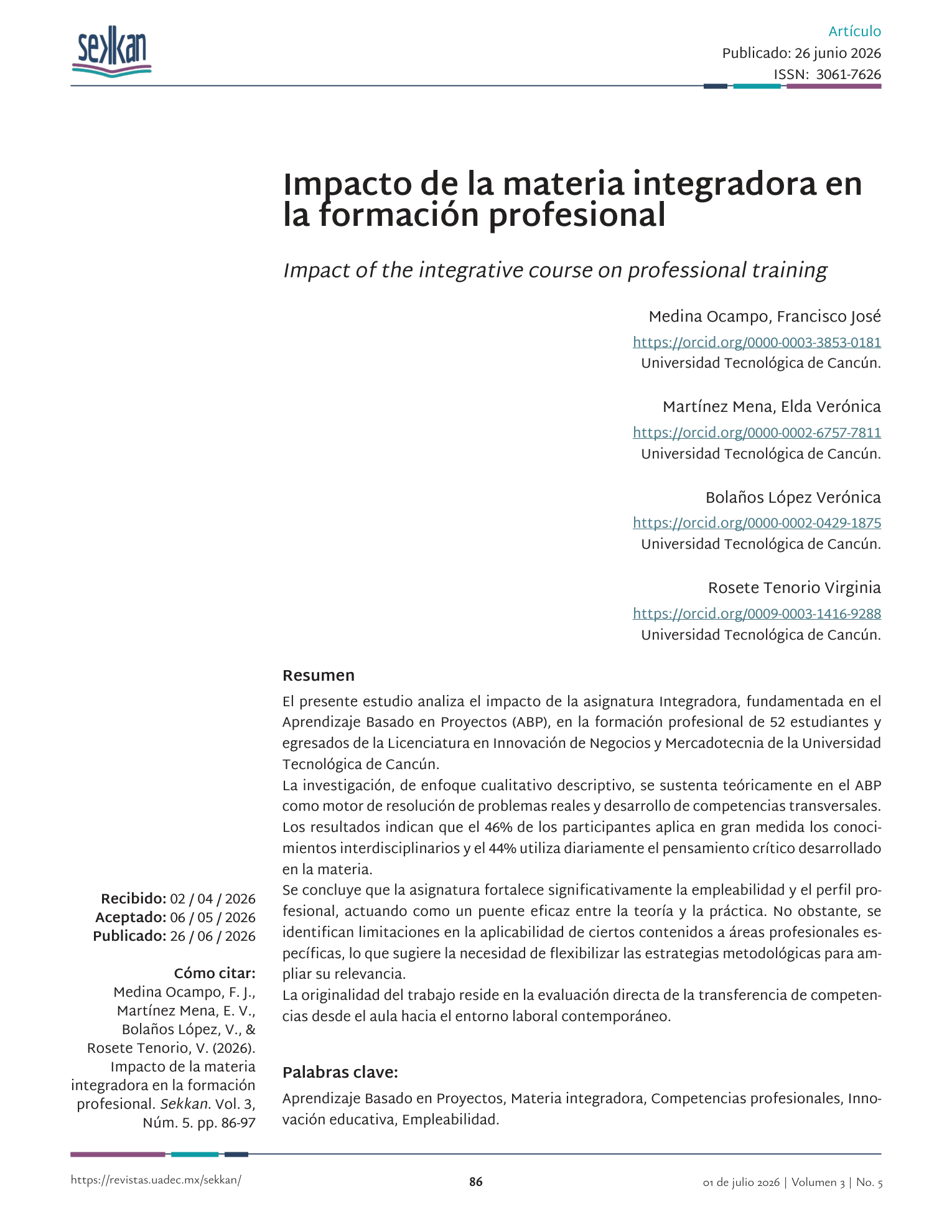
This research examines the impact of the Integrative Course, based on Project-Based Learning (PBL), on the professional training of 52 students and graduates from the Business Innovation and Marketing program at the Universidad Tecnológica de Cancún. Adopting a qualitative descriptive approach, the study is theoretically grounded in PBL as a driver for real-world problem-solving and transversal competency development.
Findings reveal that 46 % of participants apply interdisciplinary knowledge to a great extent, and 44 % utilize critical thinking skills daily in their professional environments. The study concludes that the course significantly enhances employability and professional profiles, serving as an effective bridge between theory and practice. However, limitations regarding the applicability of specific content to certain professional domains suggest a need for more flexible methodological strategies.
The originality of this work lies in the direct evaluation of competency transfer from the classroom to the contemporary labor market.
References
Benassini, C. (2009). Investigación de mercados. México: Pearson Educación. Delgado-
Gastélum, J., et al. (2022). El aprendizaje basado en proyectos como estrategia de integración curricular, Revista de Innovación Educativa , 10 (2), 45–62. https://clea.edu.mx/biblioteca/files/original/89fd306f47a32a187ffcd3fa1f116370.pdf
Dirección General @prende.mx (2021). Guía metodológica para proyectos interdisciplinarios. México: Secretaría de Educación Pública. https://www.gob.mx/aprendemx/es/articulos/el-aprendizaje-basado-en-proyectos-como-oportunidad-para-transformar-la-escuela?idiom=es
Hernández, R. y Baptista, P. (2014). Metodología de la investigación. México: McGraw-Hill.
Instituto Federal de Telecomunicaciones [IFT] (2022). Metodología para la elaboración de estudios de mercado en materia de competencia económica. México: IFT. https://www.ift.org.mx/sites/default/files/metodologiaestudiosdemercadoenmateriadecompetenciaeconomica.pdf
Instituto Universitario del Norte [INSUNTE] (2022). Aprendizaje basado en proyectos en educación superior. México: INSUNTE. https://insunte.edu.mx/es/proyecto-integrador-que-es-y-como-se-implementa-2/
Martínez, M. (2022). Aprendizaje basado en proyectos como estrategia de formación profesional. Revista Iberoamericana para la investigación y el desarrollo educativo, 12 (23). https://www.scielo.org.mx/scielo.php?script=sci_arttext&pid=S2007-74672021000200153
Rodríguez, H. (2024). Aprendizaje basado en proyectos: Innovación educativa, Universidad Loyola de América. https://universidadloyola.edu.mx/aprendizaje-basado-en-proyectos-innovacion-educativa/
Secretaría de Educación Pública, [SEP] (2022). Metodología del aprendizaje basada en proyectos ABP. https://educacionbasica.sep.gob.mx/wpcontent/uploads/2022/06/Metodologia-ABP-Final.pdf
Thomas, J. (2000). A review of research on project-based learning. California: Autodesk Foundation. https://tecfa.unige.ch/proj/eteach-net/Thomas_researchreview_PBL.pdf
Gobierno de Canarias, Área de Tecnología Educativa [ATE] (s.f.). Kit de pedagogía y TIC. https://www.uaeh.edu.mx/division_academica/educacion-media/repositorio/estrategias-ensenanza-aprendizaje/docs/aprendizaje-basado-proyectos-1.pd
Universidad Tecnológica de Jalisco (2021) Plan curricular de la Licenciatura en Innovación de Negocios y Mercadotecnia. México: UTJ. https://www.utj.edu.mx/wp-content/uploads/2021/10/37.-INTEGRADORA-II.pdf
Downloads
Published
Issue
Section
License

This work is licensed under a Creative Commons Attribution-NonCommercial-NoDerivatives 4.0 International License.
Authors who publish in Sekkan retain copyright of their work and agree to the terms of publication under a Creative Commons license. Upon submission and acceptance, authors grant the Universidad Autónoma de Coahuila the right to publish their article in open access, including reproduction, distribution, and public communication, provided that proper attribution is given and the original publication in this journal is acknowledged.
