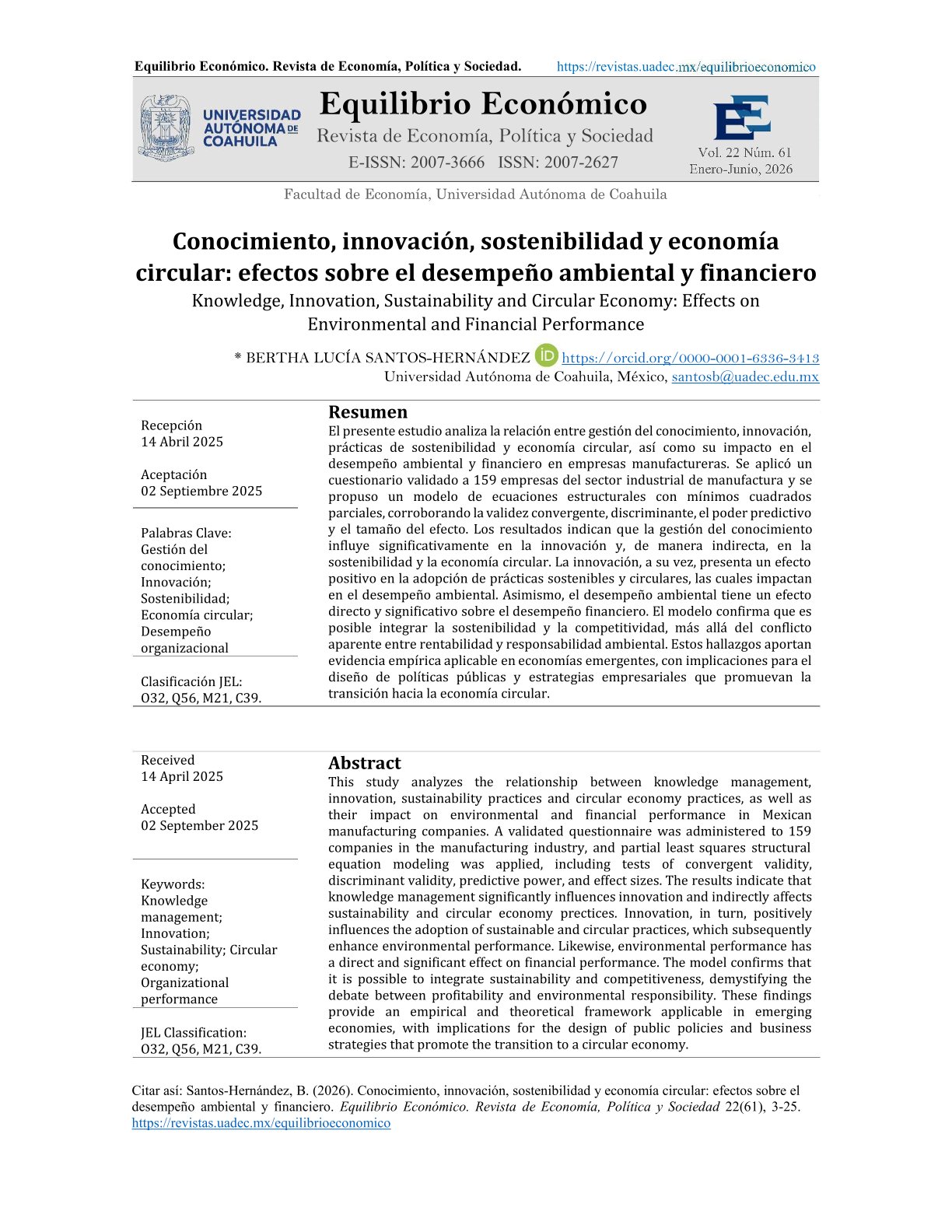
Knowledge, Innovation, Sustainability and Circular Economy: Effects on Environmental and Financial Performance
DOI:
https://doi.org/10.68038/j3p4m324Keywords:
Knowledge management; Innovation; Sustainability; Circular economy; Organizational performanceAbstract
This study analyzes the relationship between knowledge management, innovation, sustainability practices and circular economy practices, as well as their impact on environmental and financial performance in Mexican manufacturing companies. A validated questionnaire was administered to 159 companies in the manufacturing industry, and partial least squares structural equation modeling was applied, including tests of convergent validity, discriminant validity, predictive power, and effect sizes. The results indicate that knowledge management significantly influences innovation and indirectly affects sustainability and circular economy prectices. Innovation, in turn, positively influences the adoption of sustainable and circular practices, which subsequently enhance environmental performance. Likewise, environmental performance has a direct and significant effect on financial performance. The model confirms that it is possible to integrate sustainability and competitiveness, demystifying the debate between profitability and environmental responsibility. These findings provide an empirical and theoretical framework applicable in emerging economies, with implications for the design of public policies and business strategies that promote the transition to a circular economy.
Downloads
References
Ahmad, N.; Ullah, Z.; Arshad, M.; Waqas, M.; Tariq, A., y Sharif, W. (2022). Role of knowledge management on the sustainable environment: Assessing the moderating effect of innovative culture. Frontiers in Psychology, 13, 861813. https://doi.org/10.3389/fpsyg.2022.861813
Alkathiri, N.; Said, F.; Meyer, N. y Soliman, M. (2024). Knowledge management and sustainable entrepreneurship: A bibliometric overview and research agenda. Journal of Innovation and Entrepreneurship, 13(1), 38.
Awan, U., Sroufe, R., y Shahbaz, M. (2022). Achieving green innovation and sustainable development goals through green knowledge management: Moderating role of organizational green culture. Journal of Innovation & Knowledge, 7(4), 100272.
Belaid, M., y Oubaa, W. (2024). How can industrial SMEs achieve sustainability through cleaner production? Green marketing's role as a mediator. Sustainability, 16(19), 8629. https://doi.org/10.3390/su16198629
Bozbura, F. (2007). Knowledge management practices in Turkish SMEs. Journal of Enterprise Information Management, 20(2), 209–221.
https://doi.org/10.1108/17410390710725788
Castro-Lopez, A., Entrialgo, M., Liao, C., y Santos-Vijande, M. (2025). Towards circular economy through innovation: the role of entrepreneurial orientation and human resource management. International Entrepreneurship and Management Journal, 21(1), 1-35. https://doi.org/10.1007/s11365-024-01032-x
Cainelli, G., D'Amato, A., y Mazzanti, M. (2020). Resource-efficient eco-innovations for a circular economy: Evidence from EU firms. Research Policy, 49(1), 103827. https://doi.org/10.1016/j.respol.2019.103827
Centobelli, P., Cerchione, R., Chiaroni, D., Del Vecchio, P., y Urbinati, A. (2020). Designing business models in circular economy: A systematic literature review and research agenda. Business Strategy and the Environment, 29(4), 1734-1749. https://doi.org/10.1002/bse.2466
Circle Economy. (2025). Circularity Gap Report 2025. Circle Economy Foundation. https://www.circularity-gap.world/2025
Comisión Económica para América Latina y el Caribe (CEPAL) (2021). Economía circular en América Latina y el Caribe: Oportunidad para un desarrollo sostenible. Comisión Económica para América Latina y el Caribe.
Comisión Económica para América Latina y el Caribe. (2023). Promoviendo la economía circular en América Latina y el Caribe. CEPAL.
https://www.cepal.org/es/proyectos/promoviendo-la-economia-circular-america-latina-caribe
Cohen, J. (1988). Statistical power analysis for the behavioral sciences. Lawrence Erlbaum Associates.
Chin, W. (1998). The partial least squares approach to structural equation modeling. En A. Marcoulides (Ed.), Modern methods for business research (295-336). Lawrence Erlbaum Associates.
Chopra, M., Saini, N., Kumar, S., Varma, A., Mangla, S. y Lim, W. (2021). Past, present, and future of knowledge management for business sustainability. Journal of Cleaner Production, 328, 129592.
https://doi.org/10.1016/j.jclepro.2021.129592
Chouaibi, J. (2021). Innovation and financial performance in manufacturing companies: An empirical study Tunisian. Journal of the Knowledge Economy, 12(4), 1870–1890. https://doi.org/10.1007/s13132-020-00692-8
Das, D. (2017). Desarrollo y validación de una escala para medir las prácticas y el desempeño de la Gestión Sostenible de la Cadena de Suministro. Revista de Producción Más Limpia, 164, 1344–1362.
Díez-Vial, I., Belso-Martínez, J. y Martín-de-Castro, G. (2022). Extending green innovations across clusters: How can firms benefit most? Business Strategy and the Environment, 32(4), 1412-1429.
Dong, H., Wang, B., Li, J., Li, Z., Li, F. y Wang, C. (2022). Circular economy implementation and business performance: The mediating role of environmental performance in the Chinese energy production enterprises. Frontiers in Environmental Science, 10, 982994. https://doi.org/10.3389/fenvs.2022.982994
Dzhengiz, T. y Niesten, E. (2020). Competences for environmental sustainability: A systematic review on the impact of absorptive capacity and capabilities. Journal of Business Ethics, 162(4), 881-906.
https://doi.org/10.1007/s10551-019-04360-z
ECOCE (2024). Cifras y estadísticas. https://www.ecoce.mx/cifras_y_estadisticas
Environmental Protection Agency (EPA). (2024). Sustainable manufacturing. U.S. Environmental Protection Agency.
https://www.epa.gov/sustainability/sustainable-manufacturing
Esposito, B., Sica, D., Supino, S. y Malandrino, O. (2024). Measuring the impact of circular economy performance on financial performance: The moderating role of stakeholder engagement. Business Strategy and the Environment, 33(6), 5109–5126. https://doi.org/10.1002/bse.3744
Feng, X.; Goli, A. (2023). Enhancing Business Performance through Circular Economy: A Comprehensive Mathematical Model and Statistical Analysis. Sustainability, 15, 12631. https://doi.org/ 10.3390/su151612631
Gaceta Oficial de la Ciudad de México. (2019). Ley para la gestión integral de residuos de la Ciudad de México. Gobierno de la Ciudad de México.
Geissdoerfer, M., Savaget, P., Bocken, N. y Hultink, E. (2017). The Circular Economy – A new sustainability paradigm? Journal of Cleaner Production, 143, 757–768. https://doi.org/10.1016/j.jclepro.2016.12.048
Ghisellini, P., Cialani, C. y Ulgiati, S. (2016). A review on circular economy: The expected transition to a balanced interplay of environmental and economic systems. Journal of Cleaner Production, 114, 11-32.
https://doi.org/10.1016/j.jclepro.2015.09.007
Gobierno de México. (2019). Estrategia Nacional para la Implementación de la Agenda 2030 en México. https://www.gob.mx/agenda2030/documentos/estrategia-nacional-de-la-implementacion-de-la-agenda-2030-para-el-desarrollo-sostenible-en-mexico
Green, K., Zelbst, P., Meacham, J. y Bhadauria, V. (2012). Green supply chain management practices: Impact on performance. Supply Chain Management 17(3), 290-305. https://doi.org/10.1108/13598541211227126
Hair, J., Hult, G., Ringle, C., Sarstedt, M., Danks, N. y Ray, S. (2022). Partial least squares structural equation modeling (PLS-SEM) using R: A workbook. Springer. https://doi.org/10.1007/978-3-030-80519-7
Hermawan, A., Masudin, I., Zulfikarijah, F., Restuputri, D. y Shariff, S. (2024). The effect of sustainable manufacturing on environmental performance through government regulation and eco-innovation. International Journal of Industrial Engineering and Operations Management, 6(4), 299–325.
https://doi.org/10.1108/ijieom-04-2023-0039
Instituto Nacional de Estadística y Geografía (INEGI). (2025). Estadísticas a propósito del Día Mundial del Medio Ambiente (5 de junio). Comunicado de Prensa Núm. 65/25.
International Organization for Standardization. (2015). ISO 14001:2015 Environmental management systems. Requirements with guidance for use. ISO. https://www.iso.org/standard/60857.html
Kirchherr, J., Piscicelli, L., Bour, R., Kostense-Smit, E., Muller, J., Huibrechtse-Truijens, A. y Hekkert, M. (2018). Barriers to the circular economy: Evidence from the European Union. Ecological Economics, 150, 264-272.
Kumar, A., Sharma, M. y Jain, V. (2025). Investigation of green supply chain management practices and sustainability in Indian manufacturing enterprises using a structural equation modelling approach. Scientific Reports, 15(1), 2156. https://doi.org/10.1038/s41598-025-95940-9.
Leonidou, L., Leonidou, C., Fotiadis, T. y Zeriti, A. (2013). Resources and capabilities as drivers of hotel environmental marketing strategy: Implications for competitive advantage and performance. Tourism Management, 35, 94–110. https://doi.org/10.1016/j.tourman.2012.06.003
López-Torres, G., Garza-Reyes, J., Maldonado-Guzmán, G., Kumar, A., Rocha-Lona, L. y Cherrafi, A. (2019). Knowledge management for sustainability in operations. Production Planning & Control, 30(10-12), 813-826.
Loutfi, F., Flores, A., González-Marín, M. y Alarcón Montero, P. (2024). Situación de las políticas sobre economía circular en México. World Resources Institute. https://doi.org/10.46830/wriwp.20.00153
Magaña-Lemus, D., Islas-Samperio, J., Manzini, F. y García-Barrientos, A. (2019). Circular economy in the electronic products sector: Material flow analysis and economic impact of cellphone e-waste in Mexico. Sustainability, 11(5), Article 1361. https://doi.org/10.3390/su11051361
Mondal, M., Akter, N. y Ibrahim, A. (2024). Nexus of environmental accounting, sustainable production and financial performance: An integrated analysis using PLS-SEM, fsQCA, and NCA. Environmental Challenges , 15, 100878.
https://doi.org/10.1016/j.envc.2024.100878
Nonaka, I. y Takeuchi, H. (1995). The knowledge-creating company: How Japanese companies create the dynamics of innovation. Oxford University Press.
Padilla-Rivera, A., Morales Brizard, M., Merveille, N. y Güereca-Hernandez, L. P. (2024). Barriers, challenges, and opportunities in the adoption of the circular economy in Mexico: An analysis through social perception. Recycling, 9(5), 71. https://doi.org/10.3390/recycling9050071
Perotti, F., Troise, C., Ferraris, A. y Hirwani Wan Hussain, W. (2025). Bridging innovation management and circular economy: An empirical assessment of green innovation and open innovation. Creativity and Innovation Management, 34(2), 466–485. https://doi.org/10.1111/caim.12647.
Pinzón, S. (2009). Impacto de la Orientación a Mercado en la innovación en empresas de Aguascalientes. Tesis Doctoral. San Luis Potosí, México.
Quintana-García, C., Marchante-Lara, M. y Benavides-Chicón, C. (2022). Towards sustainable development: Environmental innovation, cleaner production performance, and reputation. Corporate Social Responsibility and Environmental Management, 29(5), 1330–1340.
https://doi.org/10.1002/csr.2272
Rubio, K., Martínez, E. y Cruz, A. (2024). Efecto de la innovación ambiental sobre la sustentabilidad en el sector hotelero. RAE, 64(2).
https://doi.org/10.1590/s0034-759020240201
Saari, L., Valkokari, K., Martins, J. y Acerbi, F. (2024). Matriz de Economía Circular: Guía a las empresas de la industria manufacturera hacia la circularidad: Una perspectiva de estudio de casos múltiples. Circular Economy and Sustainability, 4 , 2505–2530. https://doi.org/10.1007/s43615-024-00385
Sarstedt, M., Ringle, C. y Hair, J. (2022). Modelado de ecuaciones estructurales por mínimos cuadrados parciales. En: Homburg, C., Klarmann, M., Vomberg, A. (Eds.) Manual de investigación de mercados. Springer, Cham.
https://doi.org/10.1007/978-3-319-57413-4_15
Secretaría de Medio Ambiente y Recursos Naturales (SEMARNAT) (2023). Trabaja SEMARNAT en Estrategia Nacional de Economía Circular [Comunicado de prensa]. Gobierno de México. https://www.gob.mx/semarnat/prensa/trabaja-semarnat-en-estrategia-nacional-de-economia-circular.
Semlali, Y.; Elrayah, M.; Sabri, M.; Rahma, Z.; Bengana, I. (2024). How Can Industrial SMEs Achieve Sustainability through Cleaner Production? Green Marketing’s Role as a Mediator. Sustainability 16, 8629.
https://doi.org/10.3390/ su16198629
Suchek, N., Fernandes, C. I., Kraus, S., Filser, M. y Sjögrén, H. (2021). Innovation and the circular economy: A systematic literature review. Business Strategy and the Environment, 30(8), 3686–3702. https://doi.org/10.1002/bse.2834
Van-Keulen, M. y Kirchherr, J. (2021). The implementation of the Circular Economy: Barriers and enablers in the coffee value chain. Journal of Cleaner Production, 281(125033), 125033. https://doi.org/10.1016/j.jclepro.2020.125033
Xu, Z., Frankwick, G. y Ramirez, E. (2016). Effects of big data analytics and traditional marketing analytics on new product success: A knowledge fusion perspective. Journal of Business Research, 69(5), 1562-1566
Zhang, F. y Zhu, L. (2019). Enhancing corporate sustainable development: Stakeholder pressures, organizational learning, and green innovation. Business Strategy and the Environment, 28(6), 1012-1026. https://doi.org/10.1002/bse.2298
Zapata-Cantu, L. y González, F. (2021). Challenges for Innovation and Sustainable Development in Latin America: The Significance of Institutions and Human Capital. Sustainability, 13, 4077. https://doi.org/10.3390/ su13074077
Zhu, Q., Geng, Y. y Lai, K. (2010). Circular economy practices among Chinese manufacturers varying in environmental-oriented supply chain cooperation and the performance implications. Journal Of Environmental Management, 91(6), 1324-1331. https://doi.org/10.1016/j.jenvman.2010.02.013