
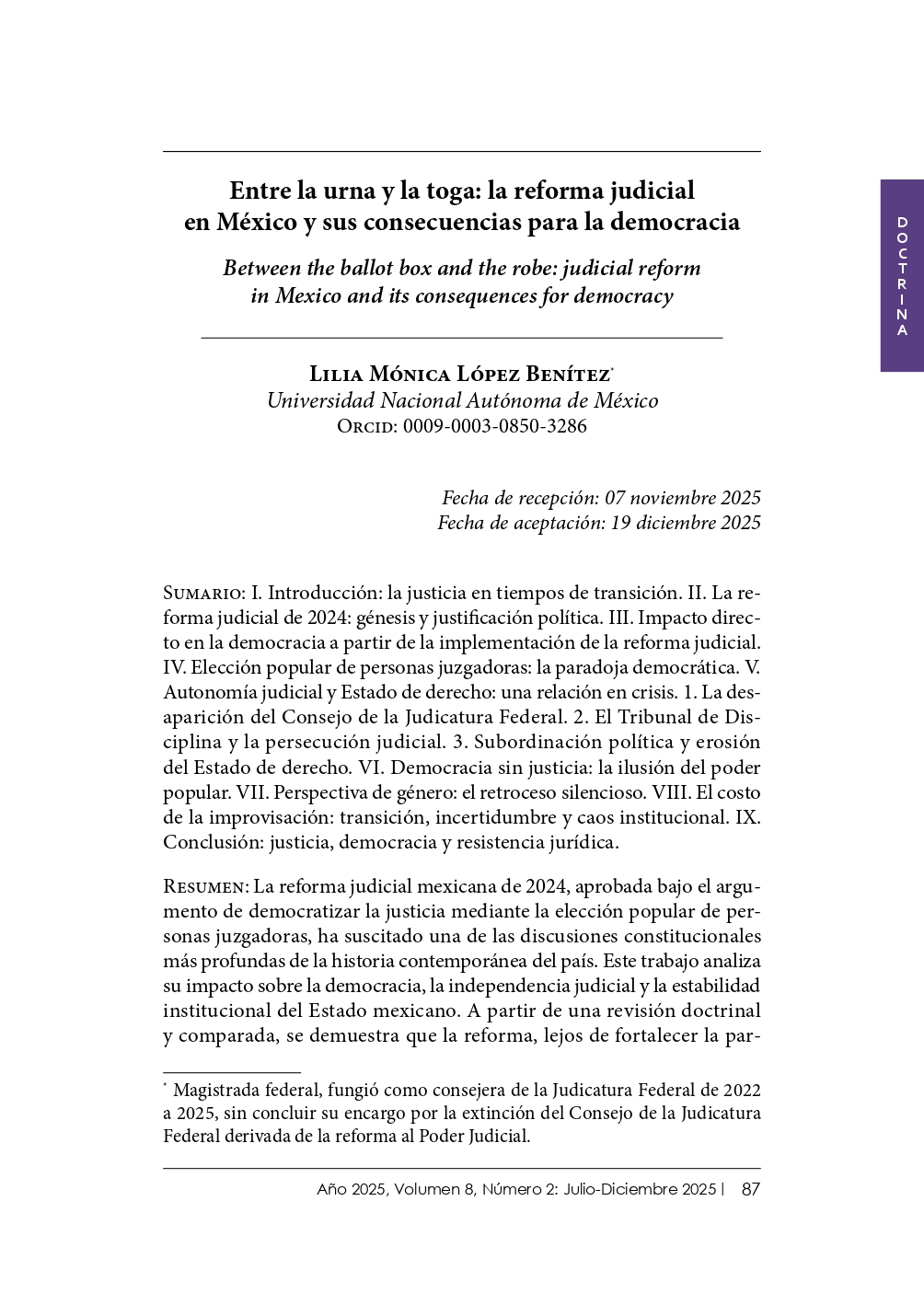
Between the ballot box and the robe: judicial reform in Mexico and its consequences for democracy
Keywords:
Judicial overhaul, democracy, judicial autonomy, judicial independence, judiciary, popular election, rule of law, separation of powersAbstract
The 2024 Mexican judicial reform, approved under the argument of democratizing justice through the popular election of judges, has triggered one of the most profound constitutional debates in the country’s contemporary history. This study examines its impact on democracy, judicial independence, and the institutional stability of the Mexican State. Based on a doctrinal and comparative review, it demonstrates that the reform, far from strengthening citizen participation, constitutes a setback in terms of the separation of powers and the protection of fundamental rights, thereby eroding Mexican democracy. It is argued that the popular election of judges distorts the counter-majoritarian principle of constitutional justice and opens the door to the political, economic, and criminal capture of judicial bodies. Likewise, the operational crisis of the Federal Judiciary during and after the institutional transition is analyzed, highlighting the risks it poses to the rule of law. The article concludes that judicial independence is not a corporate privilege but a structural requirement for the validity of constitutional democracy.
Downloads
References
Barak, Aharon (2006): The Judge in a Democracy, Princeton University Press.
Bobbio, N. (1989): El futuro de la democracia, Fondo de Cultura Económica.
Bonneau, C. W., & Hall, M. G. (2009): In Defense of Judicial Elections, Routledge.
CIDH (2013): Garantías para la independencia de las y los operadores de justicia, OEA/Ser.L/V/II.
Dworkin, R. (1986): Law’s Empire, Harvard University Press.
Dworkin, R. (1990): A Bill of Rights for Britain, University of Michigan.
Ferrajoli, Luigi (2011): Poderes salvajes: la crisis de la democracia constitucional, Trotta.
Ferrajoli, Luigi. (2025): “La reforma judicial mexicana: cómo se destruye el estado de derecho”, en Jueces para la democracia, núm.113, 103-108.
Gargarella, R. (2020): La derrota del derecho en América Latina: Siete tesis, Siglo XXI Editores, Buenos Aires.
Huchín Sosa, Eduardo (2025): “La reforma y la elección judicial en perspectiva histórica, entrevista a Pablo Mijangos y González”, en Letras Libres. Disponible en: «https://letraslibres.com/revista/revista-reforma-eleccion-judicial-perspectiva-historica-entrevista-pablo-mijangos-y-gonzalez/01/07/2025/» [Consultado el 19 de diciembre de 2025].
Montesquieu, C. (2005): El espíritu de las leyes, F. González Vicén (trad.), Gredos.
Morelos y Pavón, José María (1813): Sentimientos de la Nación, Congreso de Chilpancingo.
IDEA Internacional (2021): The Global State of Democracy Report 2021, International IDEA.
Levitsky, S., & Ziblatt, D. (2018): Cómo mueren las democracias, Ariel.
Observatorio Electoral Judicial (2025): “Resultados anticipados en la elección judicial: la inequidad en la contienda electoral”, en Observatorio Electoral Judicial. Disponible en: « https://oej.mx/report/informe-especial-inequidad» [Consultado el 19 de diciembre de 2025].
O’Donnell, G. (1999): Democracia, agencia y Estado: teoría con intención comparativa, PNUD.
ONU (1985): “Principios básicos relativos a la independencia de la judicatura”, en Naciones Unidas. Disponible en: « https://www.ohchr.org/es/instruments-mechanisms/instruments/basic-principles-independence-judiciary» [Consultado el 19 de diciembre de 2025].
OEA (2025): “Informe preliminar de la Misión de Observación Electoral (MOE) de la OEA para las elecciones del Poder Judicial de México”, en OEA. Disponible en: « https://www.oas.org/fpdb/press/2025_MEXICO_MOE_Elecciones_Judiciales_-Informe_Preliminart_ESP.pdf» [Consultado el 19 de diciembre de 2025].
Wolff, Jonathan (2018): “The lure of fascism. Fascism promised radical national renewal and supreme power to the people. Are we in danger of a fascist revival today”, en AEON. Disponible en: «https://aeon.co/essays/what-1930s-political-ideologies-can-teach-us-about-the-2020s?utm_source=Aeon+Newsletter&utm_campaign=48bb00ede7-EMAIL_CAMPAIGN_2020_04_14_04_38&utm_medium=email&utm_term=0_411a82e59d-48bb00ede7-70647345» [Consultado el 19 de diciembre de 2025].
World Justice Project (2024): Rule of Law Index 2024, Bolivia. Disponible en: «https://worldjusticeproject.org/rule-of-law-index/downloads/WJPIndex2024.pdf» [Consultado el 19 de diciembre de 2025].
Downloads
Published
Issue
Section
License
Copyright (c) 2026 RRevista Internacional y Comparada de Derechos Humanos

This work is licensed under a Creative Commons Attribution-NonCommercial-ShareAlike 4.0 International License.
This means that anyone may read, download, copy, distribute, print, link to, and reuse the content, provided that proper credit is given to the authors and the journal.
