
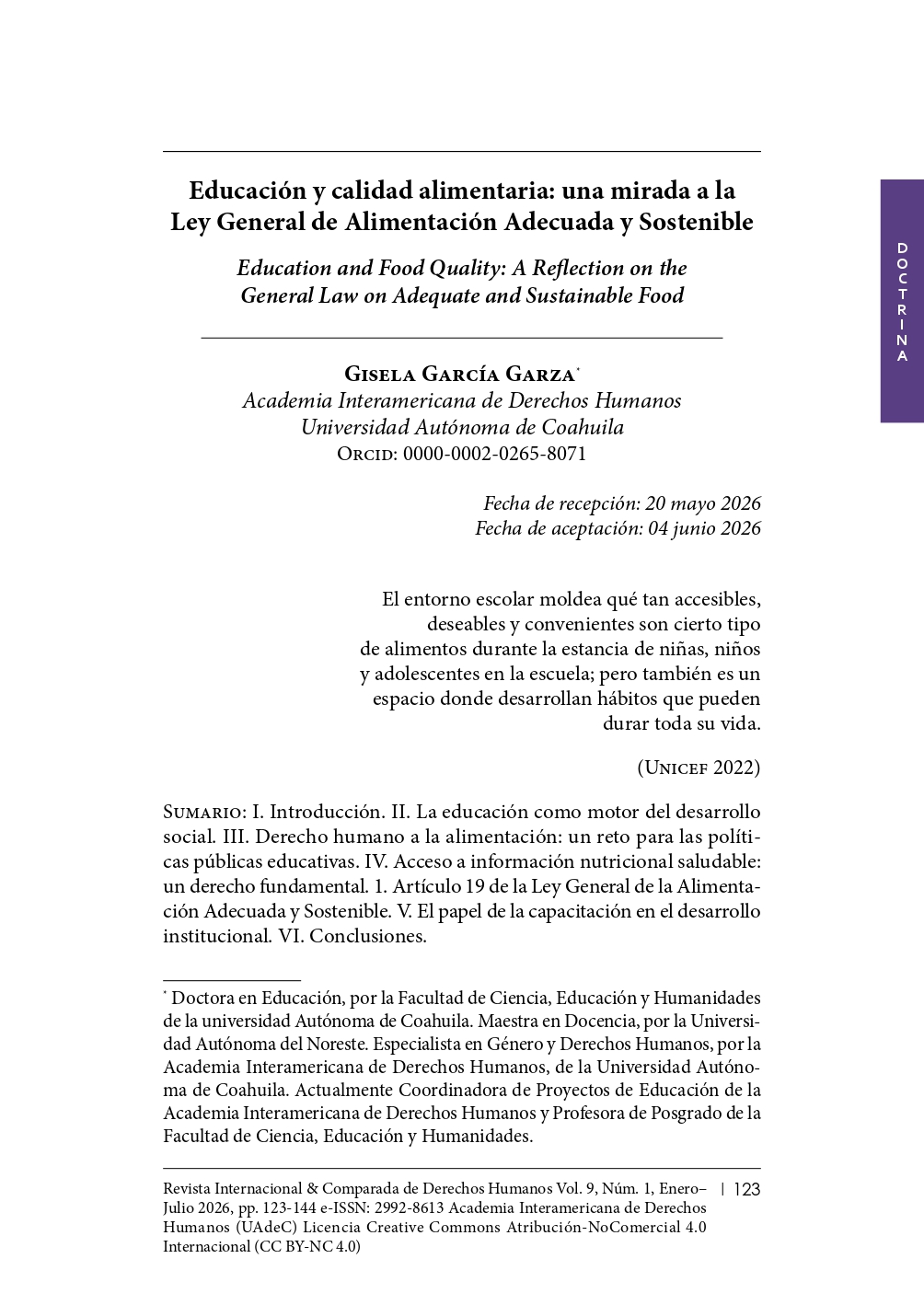
Education and Food Quality: A Reflection on the General Law on Adequate and Sustainable Food
Keywords:
human rights education, right to food, nutritional education, eating habitsAbstract
This article highlights the importance of training people in topics related to nutrition as an essential component of the educational field. It also analyzes how education is not only necessary, but, following the enactment of the General Law of Adequate and Sustainable Food (Lgaas), it is established as an unavoidable obligation for educational institutions, as it constitutes one of the most effective means to provide, from an early age, the information and knowledge that allow making appropriate decisions about nutritional habits that contribute to a dignified life. In the same way, the constitutional recognition of the right to food in Mexico is addressed, which was incorporated until October 2011 in Article 4 of the Constitution as the right of every person to nutritious, sufficient, and quality food, establishing the obligation of the State to guarantee it. Likewise, the article emphasizes how, from this point, various legal provisions and public policies have been developed to strengthen this right and transform food education, leaving behind the merely biological approach to promote practices that raise awareness among students and encourage new lifestyles. From the analysis carried out, it is noted that these initiatives have proven insufficient in the face of eating practices deeply rooted in the national culture. Therefore, transferring these programs to the classrooms requires overcoming the exclusively theoretical approach and promoting critical and reasoned reflections that allow genuine and sustainable changes. In this context, the Lgaas, published on April 17, 2024, acknowledges the need to ensure food requirements for a dignified life. Consequently, the present analysis highlights the importance of integrating nutritional content into the curricula and training teachers as the main agents of change.
Downloads
References
Díaz, S. (2017): Laicidad. Concepto, origen y perspectivas histórica y contemporánea en México, Tirant, México.
Fernández, M. (2011): “El derecho a la alimentación. Una nueva perspectiva tras el cambio constitucional” en Derecho a la alimentación, O. Restrepo y C. Molina (coords.), Universidad de Medellín y Fondo Editorial, 69-94.
Fuentes, S. y Estrada, B. (2023): “Alimentación escolar y educación alimentaria: tendencias recientes en la investigación en América Latina entre 2005 y 2021 en Revista Educación, vol.47, núm. 1, 588-604.
González-Jaramillo et al (2021): “Nutrición en el ser humano: evaluación de una propuesta didáctica multidisciplinar basada en la indagación y el aprendizaje colaborativo” en Investigações em Ensino de Ciências, vol. 26, núm. 1, 188-212.
Leyva, D. y Sandoval, E. (2022): “La garantía alimentaria en visión de derechos humanos en México” en Biolex, vol. 14, núm. 25, 1-24.
Morales, J. (2020): “Educación y desarrollo humano: dimensiones para la elaboración de políticas públicas en tiempos de complejidad” en Conrado, vol.16, núm.75, 372-383.
Priego, A. et al (2023): “Percepción de los docentes sobre las estrategias para mejorar la alimentación de estudiantes de educación básica en tiempos de Covid-19” en Estudios sociales. Revista de alimentación contemporánea y desarrollo regional, vol. 33, núm. 61, 2-24.
Sánchez, G. et al (2023): “Evolución de los conocimientos sobre alimentación y nutrición en ESO y bachillerato en Retos: nuevas tendencias en educación física, deporte y recreación, núm. 48, 312-326.
SEP (2024): “Boletín 19. Presenta SEP nuevos lineamientos y acciones de Vida Saludable en las escuelas” en SEP. Disponible en: «https://www.gob.mx/sep/prensa/boletin-19-presenta-sep-nuevos-lineamientos-y-acciones-de-vida-saludable-en-las-escuelas» [Consultado el 18 de junio de 2026].
UNICEF (2022): “La importancia del entorno escolar en la alimentación de niñas, niños y adolescentes. Las horas que están en la escuela cuentan para su nutrición”, en UNICEF. Disponible en: «https://www.unicef.org/mexico/historias/la-importancia-del-entorno-escolar-en-la-alimentación-de-niñas-niños-y-adolescentes» [Consultado el 18 de junio de 2026].
Downloads
Published
Issue
Section
License
Copyright (c) 2026 Gisela García Garza (Autor/a)

This work is licensed under a Creative Commons Attribution-NonCommercial-ShareAlike 4.0 International License.
This means that anyone may read, download, copy, distribute, print, link to, and reuse the content, provided that proper credit is given to the authors and the journal.
