
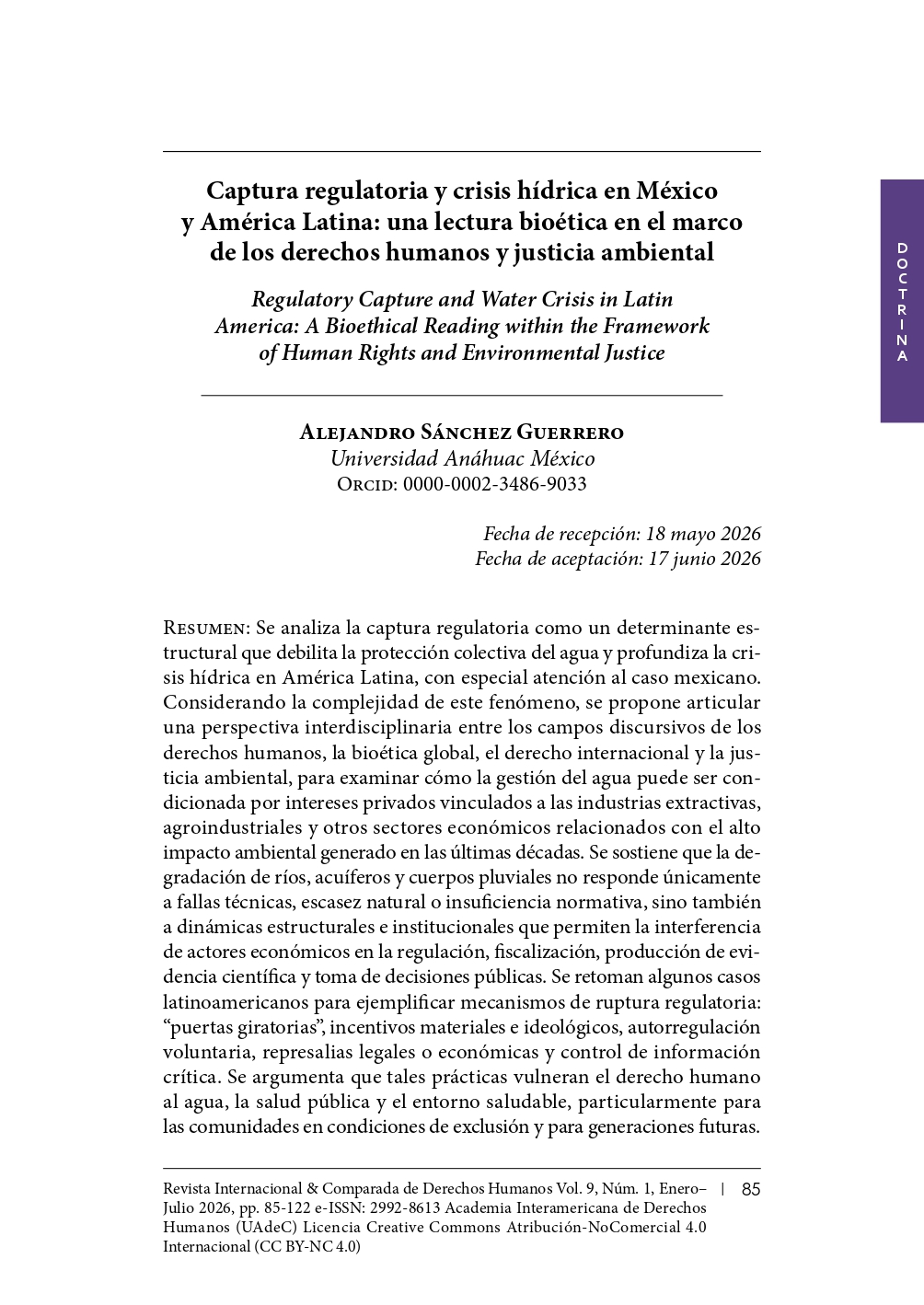
Regulatory Capture and Water Crisis in Latin America: A Bioethical Reading within the Framework of Human Rights and Environmental Justice
Keywords:
regulatory capture, water, human rights, global bioethics, environmental justice, water governanceAbstract
This article analyzes regulatory capture as a structural determinant that weakens the collective protection of water and deepens the water crisis in Latin America, with particular attention to the Mexican case. Considering the complexity of this phenomenon, it proposes an interdisciplinary perspective that brings together the discursive fields of human rights, global bioethics, international law, and environmental justice in order to examine how water governance may be shaped by private interests linked to extractive industries, agro-industrial activities, and other economic sectors associated with the high environmental impact generated in recent decades. The article argues that the degradation of rivers, aquifers, and rainwater bodies does not respond solely to technical failures, natural scarcity, or regulatory insufficiency, but also to structural and institutional dynamics that allow economic actors to interfere in regulation, oversight, the production of scientific evidence, and public decision-making. Several Latin American cases are used to illustrate mechanisms of regulatory disruption, including revolving doors, material and ideological incentives, voluntary self-regulation, legal or economic retaliation, and the control of critical information. The article argues that these practices violate the human right to water, public health, and a healthy environment, particularly for communities living under conditions of exclusion and for future generations. Finally, it proposes a regulatory governance framework grounded in bioethics, guided by the precautionary principle, the principle of responsibility, and the comprehensive reparation of water-related, environmental, and health damages.
Downloads
References
Alcántara Zapata, D. E. y Mazzei Pimental, M. (2018): “Bioética y justicia ambiental en la salud de los pobladores andinos de Perú” en Revista Latinoamericana de Bioética, vol.18, núm.1, 36-50.
Alemán-Contreras, U. A. et al. (2022): “Riesgos de la fractura hidráulica: Casos de las cuencas de Burgos, México y Neuquina, Argentina” en Investigación y Ciencia de la Universidad Autónoma de Aguascalientes, vol. 30. núm. 87, Universidad Autónoma de Aguascalientes.
Alianza Mexicana Contra el Fracking (2024): “¿Qué es el fracking o fractura hidráulica?” en Alianza Mexicana Contra el Fracking. Disponible en: «https://www.nofrackingmexico.mx/» [consultado el 11 de mayo de 2026].
Alves de Lima, I., y Massard da Fonseca, E. (2021): “Analytical perspectives in the study of regulatory policies” en Brazilian Journal of Public Administration, vol. 55, núm. 3, 625-643.
Barrero Tíscar, A., y Giménez Delgado, I. (2024): “La criminalización de las personas defensoras ambientales en América Latina” en Papeles de Relaciones Ecosociales y Cambio Global, núm. 165), 79–89.
Brand, J. A. et al. (2026): “Cocaine pollution alters the movement and space use of Atlantic salmon (Salmo salar) in a large natural lake” en Current Biology, vol. 36, núm. 8, 2018-2027.
Cabrales Salazar, O. y Márquez, F. (2016): “El buen vivir y el no consumo como modelos de desarrollo desde la perspectiva de la bioética global” en Revista Latinoamericana de Bioética, vol. 17, núm. 1, 168-183.
Camacho, G. (2021): “Agua y corrupción en América Latina” en Transparency International. Disponible en: «https://knowledgehub.transparencycdn.org/helpdesk/ES-Water-and-corruption-in-Latin-America_2021_PR-ES.pdf» [consultado el 14 de mayo de 2026].
Castrejón, M., y Pineda, E. (2021): Conceptualizing state capture in Latin America and assessing its impacts on the extractive sector, Project on Organizing, Development, Education and Research (PODER).
Comisión Nacional de los Derechos Humanos y Universidad Nacional Autónoma de México. (2019): Estudio sobre la protección de ríos, lagos y acuíferos desde la perspectiva de los derechos humanos: Síntesis ejecutiva. Ciudad de México.
Cortez Lara, Alfonso Andrés (2020): “Elementos de conflicto socioambiental: la cervecera Constellation Brands y el agua de Mexicali” en Frontera norte, núm. 32. Enero-diciembre.
Crespo, C. et al. (2005): “La Guerra del Agua en Cochabamba, Bolivia: dos lecturas” en Cuadernos del Cendes, vol. 22, núm. 59, 185-188.
Cuéllar Saavedra, J. E. (2018): “Agricultura transgénica. Una valoración bioética del caso colombiano” en Revista Latinoamericana de Bioética, vol. 18, núm. 2, 210-225.
De Rosa, E. et al. (2022): “Occurrence and distribution of persistent organic pollutants (POPS) from Sele River, Southern Italy: Analysis of polychlorinated biphenyls and organochlorine pesticides in a water–sediment system” en Toxics, vol. 10, núm. 11.
Díaz-Caravantes, R. E. et al. (2016): “Amenazas para la salud en el Río Sonora: Análisis exploratorio de la calidad del agua reportada en la base de datos oficial de México” en Revista de la Universidad Industrial de Santander. Salud, vol.48, núm.1, 91–96.
Elosegi, A., y Sabater, S. (2013): “Effects of hydromorphological impacts on river ecosystem functioning: A review and suggestions for assessing ecological impacts” en Hydrobiologia, vol. 712, 129–143.
Escobar Triana, J., y Ovalle Gómez, C. (2015): “Contribuciones de la bioética en la resolución de conflictos ambientales” en Revista Colombiana de Bioética, vol.10, núm. 2, 105–127.
Estrada-Cely, G. et al. (2018): “Bioética y desarrollo sostenible: Entre el biocentrismo y el antropocentrismo y su sesgo economicista” en Clío América, vol. 12, núm. 24, 255-267.
Fernández Molina, M. V. (2025): “Un análisis de la bioética global desde el derecho internacional de los derechos humanos” en Medicina y Ética, vol. 36, num. 3, 1073-1102.
Fitzgerald, T. (2023): “Regulatory capture in a resource boom” en Public Choice, vol. 198, 93–127.
Flynn, R. (2026). “Argentina passes bill loosening protection of its glaciers” en BBC News. Disponible en: «https://www.bbc.com/news/articles/c5y72e6x554o» [consultado el 17 de abril de 2026].
García-Bartolomei, E. R. (2024): Gestión de descargas de salmuera: Un enfoque multidisciplinario para la sustentabilidad ambiental de la industria desaladora. Tesis doctoral, Universidad de Concepción.
Gómez-Oliván, L. M. (Ed.). (2020): Pollution of Water Bodies in Latin America: Impact of Contaminants on Species of Ecological Interest, Springer.
Grafton Q. et al. (2023): The water cycle and the economy, Global Commission on the Economics of Water.
Grafton, R. Q., y Williams, J. (2020): “Rent-seeking behaviour and regulatory capture in the Murray-Darling Basin” en International Journal of Water Resources Development, vol. 36, 484-504.
He, F. et al. (2019): “The global decline of freshwater megafauna” en Global Change Biology, vol. 25, núm. 11, 3883–3892.
Herr Martínez, L. (2021):“Los glaciares y Pascua Lama: Auge y declive del primer proyecto desarrollado bajo el Tratado de Integración y Complementación Minera entre Chile y Argentina” en Justicia Ambiental y Climática, num. 13, Revista de Derecho Ambiental de la ONG FIMA, 163–196.
INEGI (2025): Cuentas Económicas y Ecológicas de México (CEEM) [Comunicado de prensa núm. 150/25], en INEGI. Disponible en: «https://www.inegi.org.mx/contenidos/saladeprensa/boletines/2025/ee/CEEM2024_CP.pdf» [consultado el 1 de mayo de 2026].
IGAVIM (2025): Agua: Títulos de concesión y pozos clandestinos en México, Instituto para la Gestión, Administración y Vinculación Municipal.
Lacy-Nichols, J., y Williams, O. (2021): “Part of the Solution: Food Corporation Strategies for Regulatory Capture and Legitimacy” en International Journal of Health Policy and Management, vol. 10, núm. 12, 845–856.
Liévano-León, A. y Cadena-Monroy, L. Á. (2020): “Valores y principios bioéticos que identifican las comunidades en los servicios ecosistémicos que prestan los ríos y quebradas” en Revista Colombiana de Bioética, vol. 15, núm 1, 1-26.
López-Cazar, I. et al. (2021): “The Extractive Industries Transparency Initiative (EITI) and corruption in Latin America: Evidence from Colombia, Guatemala, Honduras, Peru, and Trinidad and Tobago” en Resources Policy, vol. 70.
Ibarrarán, M. E. et al. (2021): “The Cost of Pollution in the Upper Atoyac River Basin: A Systematic Review” en Universidad Iberoamericana Puebla.
Jonas, Hans (1995): El principio de responsabilidad: Ensayo de una ética para la civilización tecnológica (Trad J. M. Fernández Retenaga), Herder.
Maher, R. (2022): “Deliverating or Stalling for Justice? Dinamics of Corporate Remediation and Victim Resistance Through the Lens of Parentalism: the Fundão dam Collapse and the Renova Foundation in Brazil” en Jornal of Business Ethics, vol. 178, 15-36.
Márquez-Vargas, F. (2020): “Hacia una fundamentación de la bioética ambiental desde la visión de Fritz Jahr, Aldo Leopold y Van Rensselaer Potter” en Revista Colombiana de Bioética, vol. 15, núm. 2, 1-26.
Mello, J. L. et al. (2018): “Effects of agrochemicals on freshwater macroinvertebrates: Challenges and perspectives from southeastern Brazil” en Limnology and Oceanography Bulletin, vol, 27, núm. 4, 89–94.
Miqueleiz, I. et al. (2025):“Ecoregional distributions of the world’s freshwater vertebrate species” en Scientific Data, vol. 12, núm. 1.
Ministerio para la Transición Ecológica y el Reto Demográfico (s/f): “Lista de observación”, en Gobierno de España. Disponible en: «https://www.miteco.gob.es/es/agua/temas/estado-y-calidad-de-las-aguas/contaminantes-emergentes/lista-observacion.html» [consultado el 15 de abril de 2026].
Palomino, Eva (2025):“Gobernanza hídrica y gestión social de los conflictos hídricos en América Latina: un análisis crítico” en Revista Espacios, vol. 46, núm. 5, 288-299.
Parra Bernal, M. D. (2021): “Hacia un paradigma de la sostenibilidad para la bioética de V. R. Potter: entre el desarrollo sostenible, el ecodesarrollo y la racionalidad ambiental” en Cuadernos de Filosofía Latinoamericana, vol. 42, núm. 124, 1-17.
Programa de las Naciones Unidas para el Desarrollo (2025): Curso autogestivo sobre el Acuerdo de Escazú, PNUD México.
Rodríguez-Arias, D. (2014): “La bioética global: Una ampliación de la agenda para la bioética” en Dilemata, vol. 15, 233-241.
Roesler, K. (2026): “Por qué no hay que modificar la Ley de Glaciares: Lo que el gobierno no nos dejó decir en las audiencias” en Miramar Diario. Disponible en: «https://miramardiario.com/index.php/2026/04/08/por-que-no-hay-que-modificar-la-ley-de-glaciares/» [consultado el 24 de abril de 2026].
Saldivar, Laura, y Walsh, Casey (2015):“Nanotecnología para el tratamiento de agua. Claves sobre la investigación en México” en Mundo nano. Revista interdisciplinaria en nanociencias y nanotecnología, vol. 8, núm. 14, 53-69.
Salazar-Xirinachs, J. M., y Boeninger Sempere, A. (2026): Gobernanza endógena: Teoría, datos y herramientas para salir de la trampa de gobernanza poco efectiva en América Latina, Comisión Económica para América Latina y el Caribe.
Saltelli, A. et al. (2021): “Science, the endless frontier of regulatory capture” en Futures, vol. 135.
Santos Arroyo, L. et al. (2024): “Perfiles de corrupción y medio ambiente” en Medio ambiente y corrupción en América Latina y el Caribe, Barboza Lacerda et al (coords.), São Leopoldo: Casa Leiria, 23-51.
Strokal, M. et al. (2021): “Urbanization: An increasing source of multiple pollutants to rivers in the 21st century” en NPJ Urban Sustainability, vol.1, núm.1.
Taylor, S., y Paul, S. (2016): “OceanaGold loses compensation claim against El Salvador”, en Reuters. Disponible en: «https://www.reuters.com/article/business/oceanagold-loses-compensation-claim-against-el-salvador-idUSKBN12E27A/ » [consultado el 1 de mayo de 2026].
United Nations Environment Programme (2016a): GEO-6 Regional Assessment for Latin America and the Caribbean, Nairobi, Kenia.
United Nations Environment Programme (2016b): A Snapshot of the World’s Water Quality: Towards a global assessment, Nairobi, Kenia.
Valdovinos-Flores, C. (2025):“Industrialization and its environmental impact on health and pollution in the Santiago River Basin of Mexico” en International Journal of Environmental Science and Technology, vol.22, 16247–16260.
Van Puijenbroek, P. et al. (2018):“Species and river specific effects of river fragmentation on European anadromous fish species” en River Research and Applications, vol.1, núm.10.
Varsha y Singh, S. K. (2025): “Microplastics in freshwater ecosystems: Sources, transport and ecotoxicological impacts on aquatic life and human health” en Environment and Ecology, vol. 43, núm. 1A), 289–295.
Vizeu Pinheiro y Rojas Sánchez (2020): Environmental Governance Indicators for Latin America & the Caribbean, World Justice Project / Inter-American Development Bank.
Vörösmarty, C. J. et al. (2010): “Global threats to human water security and river biodiversity” en Nature, vol. 467, 555–561.
Yuhui, Song. (2021): “El cáncer de la corrupción en Latinoamérica: El caso Odebrecht” en Gestión y política pública, vol. 30, 237-265.
Wester, P.; Rap, E. and Vargas‐Velázquez, S. (2009): “The hydraulic mission and the Mexican hydrocracy: Regulating and reforming the flows of water and power” en Water Alternatives vol. 2, núm. 3, 395‐415.
Wester, P. (2009): “Capturing the waters: the hydraulic mission in the Lerma–Chapala Basin, Mexico (1876–1976)”, en Water History, vol. 1, 9–29.
Wester, P. et al. (2005): “River Basin Closure and Institutional Change in Mexico's Lerma-Chapala Basin” en Irrigation and River Basin Management. Options for Governance and Institutions, M. Svendsen (Ed.), CABI, 125-144.
Wingspread (1998): Statement on the Precautionary Principle, en Global Development Research Center. Disponible en: «https://www.gdrc.org/u-gov/precaution-3.html» [consultado el 26 de abril de 2026].
WWF (2025): “Día de la sobrecapacidad de la Tierra”, en WWF. Disponible en: «https://www.wwf.es/nuestro_trabajo/informe_planeta_vivo_ipv/huella_ecologica/dia_de_la_sobrecapacidad_de_la_tierra/ » [consultado el 6 de mayo de 2026].
Downloads
Published
Issue
Section
License
Copyright (c) 2026 Alejandro Sánchez Guerrero (Autor/a)

This work is licensed under a Creative Commons Attribution-NonCommercial-ShareAlike 4.0 International License.
This means that anyone may read, download, copy, distribute, print, link to, and reuse the content, provided that proper credit is given to the authors and the journal.
