
Judicial independence in the evolution of the case law of the Inter-American Court of Human Rights: progress and prospects
Keywords:
judicial independence, development of case law, Inter-American Court of Human RightsAbstract
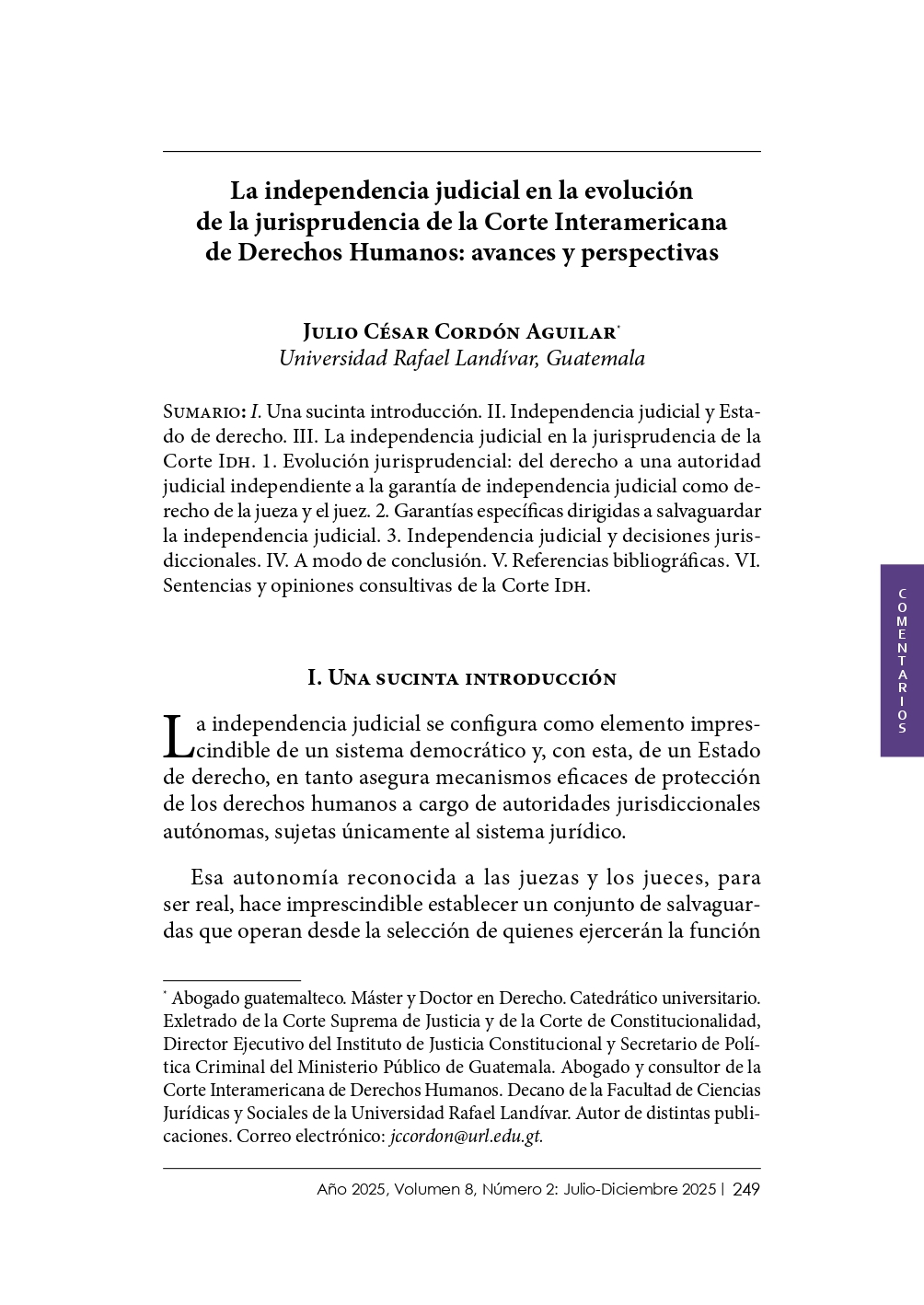
Judicial independence is an essential element of a democratic system and, by extension, of the rule of law, as it ensures effective mechanisms for the protection of human rights by autonomous judicial authorities, subject only to the legal system.
For this autonomy granted to judges to be genuine, it is essential to establish a set of safeguards that operate from the selection of those who will exercise judicial functions, through their stability and irremovability from office, to the provision of specific grounds that would allow for their eventual removal.
All of the above has been the subject of case law derived from the rulings of the Inter-American Court of Human Rights, a brief overview of which is presented in this paper.
Downloads
References
Díez-Picazo, Luis María (1992): “Notas de Derecho comparado sobre la independencia judicial”, en Revista Española de Derecho Constitucional, vol. 12, núm. 34, 19-39.
Downloads
Published
Issue
Section
License
Copyright (c) 2026 RRevista Internacional y Comparada de Derechos Humanos

This work is licensed under a Creative Commons Attribution-NonCommercial-ShareAlike 4.0 International License.
This means that anyone may read, download, copy, distribute, print, link to, and reuse the content, provided that proper credit is given to the authors and the journal.
