
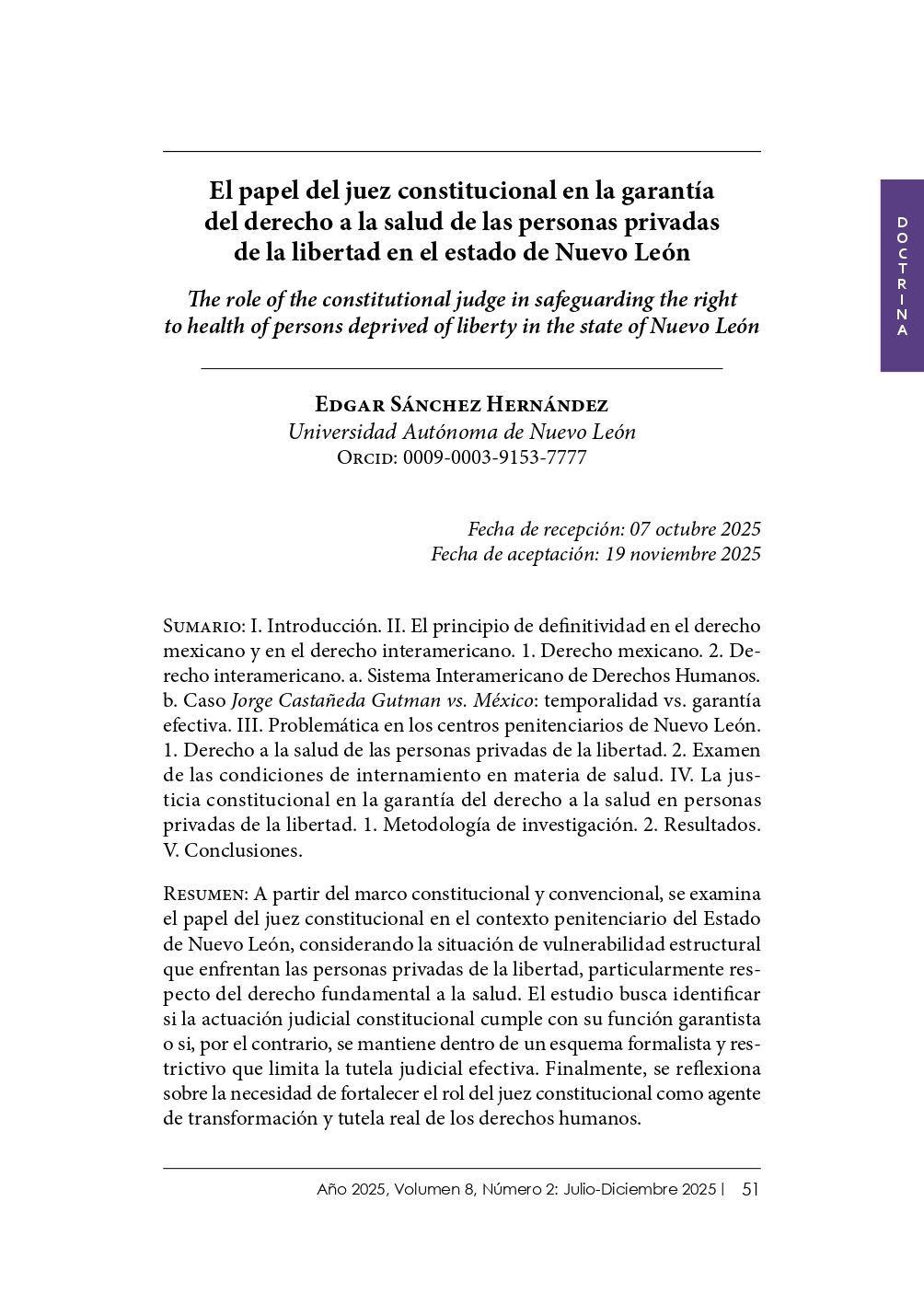
The role of the constitutional judge in safeguarding the right to health of persons deprived of liberty in the state of Nuevo León
Keywords:
constitutional law, writ of amparo, penitentiary lawAbstract
Based on the constitutional and conventional framework, this study examines the role of the constitutional judge within the penitentiary context of the State of Nuevo León, taking into account the structural vulnerability faced by persons deprived of liberty, particularly with respect to their fundamental right to health. The analysis seeks to determine whether constitutional judicial action fulfills its protective function or, conversely, remains confined to a formalistic and restrictive approach that limits effective judicial protection. Finally, the study reflects on the need to strengthen the role of the constitutional judge as an agent of transformation and as a guarantor of the real and substantive protection of human rights.
Downloads
References
Araújo-Oñate, Rocío Mercedes (2011): “Acceso a la justicia y tutela judicial efectiva. Propuesta para fortalecer la justicia administrativa. Visión de derecho comparado”, en Revista Estudios Socio-Jurídicos, vol. 13, núm. 1, 247-291.
Bidart Campos, German José (1993): Teoría general de los derechos humanos, Universidad Nacional Autónoma de México, México.
Campuzano Gallegos, Adriana (2020): Manual para entender el juicio de amparo. Thomson Reuters, Ciudad de México.
CEDHNL (2019): Diagnóstico de la situación penitenciaria de Nuevo León 2018-2019. Disponible en: «https://www.cedhnl.org.mx/bs/secciones/publicaciones/publicaciones-especiales/Dx-Penitenciario-NL-2018-2019-CEDHNL.pdf»
CEDHNL (2024): Diagnóstico Estatal de Supervisión Penitenciaria 2024. Disponible en: «https://www.cedhnl.org.mx/bs/secciones/publicaciones/publicaciones-especiales/CEDHNL-DESPNL-2024.pdf» [Consultado el 19 de septiembre de 2025]
CICR (2016). Protección de las Personas Privadas de Libertad, Comité Internacional de la Cruz Roja. Disponible en: «https://www.icrc.org/sites/default/files/topic/file_plus_list/0685_people-deprived-libert_spa_web_.pdf» [Consultado el 22 de septiembre de 2025]
CNDH (2022). Diagnóstico Nacional de Supervisión Penitenciaria 2022, Comisión Nacional de los Derechos Humanos. Disponibel en: «https://www.cndh.org.mx/sites/default/files/documentos/2023-06/DNSP_2022.pdf» [Consultado el 25 de septiembre de 2025]
Faúndez, Ledesma Héctor (2007): “El agotamiento de los recursos internos en el sistema interamericano de protección de los derechos humanos”, en Revista IIDH, núm. 46, 43-122.
Ferrer Mac-Gregor, Eduardo (2013): Panorámica del derecho procesal constitucional y convencional, Marcial Pons, Madrid.
García Huerta, Daniel Antonio (2023): Apuntes procesales para la defensa de los derechos humanos. Juicio de Amparo, Unidad General de Conocimiento Científico y Derechos Humanos de la Suprema Corte de Justicia de la Nación, Ciudad de México, México.
INEGI (2024). Censo Nacional de Sistema Penitenciario Federal 2024: Resultados generales, 18 julio 2024. Disponible en: «https://www.inegi.org.mx/contenidos/programas/cnsipef/2024/doc/cnsipef_2024_resultados.pdf» [Consultado el 19 de septiembre de 2025]
Palacios Pámanes, Gerardo Saúl (2009): La cárcel desde adentro. Editorial Porrúa, México.
Peces-Barba Gregorio (1999): Curso de derechos fundamentales, Universidad Carlos III de Madrid y Boletín Oficial del Estado, Madrid.
Pelayo Möller, Carlos María y Vázquez Camacho, Santiago J. (2009): “El caso Castañeda ante la Corte Interamericana de Derechos Humanos”, en Anuario Mexicano De Derecho Internacional, vol. 1, núm. 9, 791-812.
Ramírez Navarro, Luis Eduardo y Orozco Torres, Axel Francisco (2024): “Reinserción social como finalidad del sistema penitenciario internacional y su influencia en México”, en InterNaciones, vol. 11, núm. 26, 181-204.
Zaragoza Huerta, José (2009): El sistema penitenciario mexicano, Elsa G. De Lazcano, Nuevo León.
Downloads
Published
Issue
Section
License
Copyright (c) 2025 Personas autoras

This work is licensed under a Creative Commons Attribution-NonCommercial-ShareAlike 4.0 International License.
This means that anyone may read, download, copy, distribute, print, link to, and reuse the content, provided that proper credit is given to the authors and the journal.
