
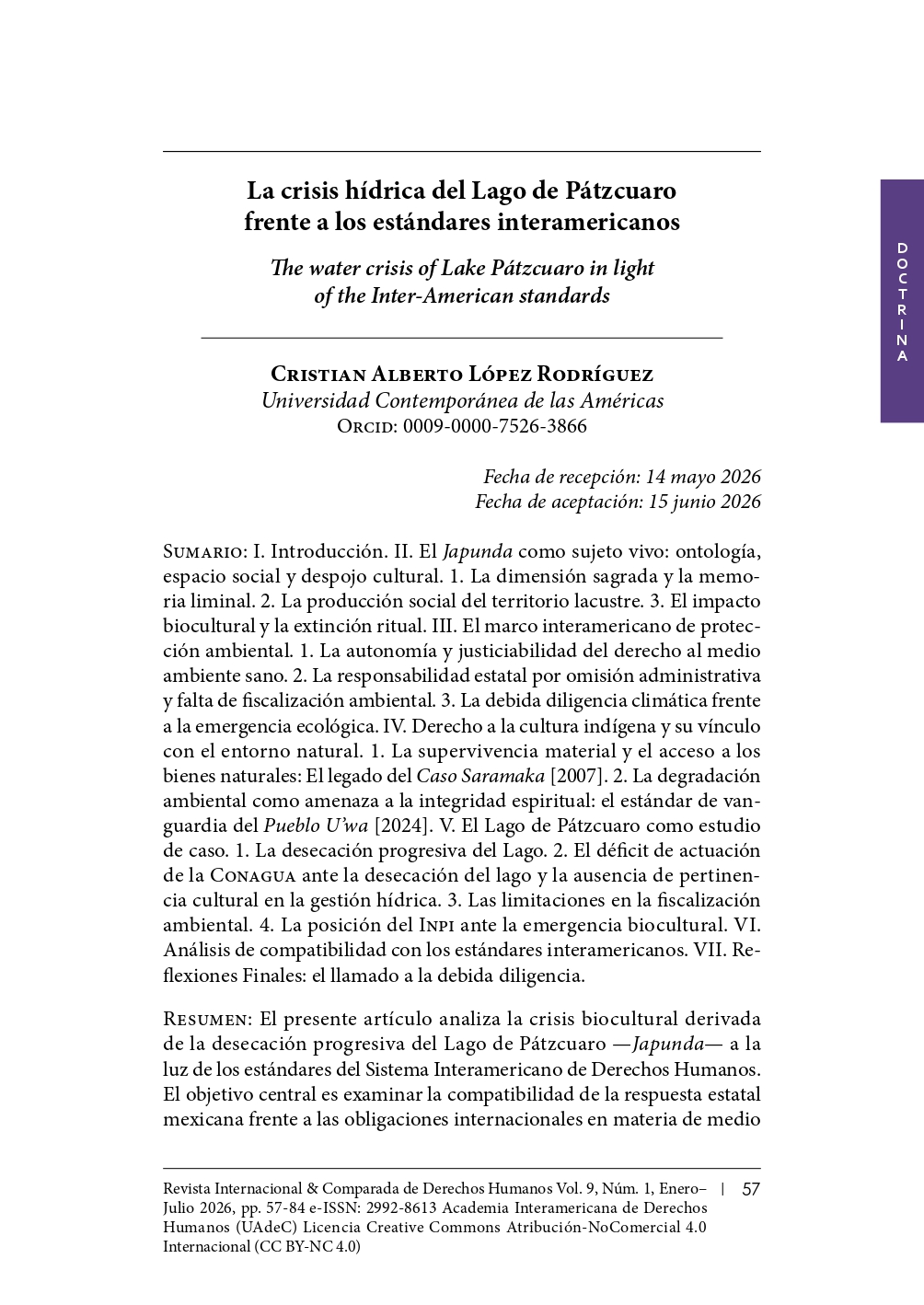
The water crisis of Lake Pátzcuaro in light of the Inter-American standards
Keywords:
Inter-American jurisprudence, human rights, biocultural rights, environmental due diligence, Lake Pátzcuaro, P'urhépecha peopleAbstract
This article analyzes the biocultural crisis resulting from the progressive desiccation of Lake Pátzcuaro —Japunda— in light of the standards of the Inter-American Human Rights System. The primary objective is to examine the compatibility of the Mexican State's response with international obligations regarding a healthy environment and cultural integrity. Employing a qualitative and dogmatic approach, cutting-edge Inter-American standards are contrasted with empirical data obtained through public information access mechanisms (Conagua and Inpi records). The findings reveal a significant gap in environmental due diligence and an institutional asymmetry characterized by the omission of cultural appropriateness in water management, which constitutes an ontological incompatibility with the P'urhépecha people's worldview. It concludes that administrative inaction and the lack of effective oversight represent an inobservance of the criteria established in the Inter-American Court's jurisprudence, highlighting the imperative need to transition towards biocultural justice frameworks that guarantee the material and spiritual survival of lacustrine communities.
Downloads
References
Arellanes Cancino, Yaayé et al (2017): “El tianguis de cambio de Pátzcuaro, Michoacán a través del Metabolismo Social desde Mesoamérica hasta el siglo XXI” en Estudios Sociales. Revista de Alimentación Contemporánea y Desarrollo Regional, vol. 27, núm. 50, 1-31.
Arellanes-Cancino, Yaayé y Ayala-Ortiz, Dante Ariel (2021): “Problemática de la pesca en el lago de Pátzcuaro: la invisibilidad entre la práctica y el discurso” en Estudios Sociales. Revista de Alimentación Contemporánea y Desarrollo Regional, vol. 31, núm. 57, 1-28.
Arellanes-Cancino, Yaayé y Kieffer, Maxime L. (2022): “El tianguis de cambio de Pátzcuaro desde la producción social del espacio” en Relaciones. Estudios de Historia y Sociedad, vol. 43, núm. 171, 130-153.
Argueta, Arturo y Castilleja, Aída (2008): “El agua entre los p'urhépecha de Michoacán” en Cultura y Representaciones Sociales, núm. 5, 113-134.
Gabriel-Martínez, Daniel (2025): “Un paisaje lacustre cambiante: Urandén y el desecamiento del lago de Pátzcuaro (1980-2022)” en Relaciones. Estudios de Historia y Sociedad, vol. 46, núm. 182, 1-28.
Mejía Argote, María Concepción et al (2024): “Tianguis de trueque Mojtakuntani: Gestión comunitaria y su interrelación con el territorio” en Revista Universidad y Sociedad, vol. 16, núm. 1, 65-78.
Naranjo Cruz, Andrea y Urquijo Torres, Pedro S. (2020): “Paisaje cultural y revisitación geográfica. El lago de Pátzcuaro, México” en Revista de Historia y Geografía, núm. 42, 131-157.
Downloads
Published
Issue
Section
License
Copyright (c) 2026 Cristian Alberto López Rodríguez (Autor/a)

This work is licensed under a Creative Commons Attribution-NonCommercial-ShareAlike 4.0 International License.
This means that anyone may read, download, copy, distribute, print, link to, and reuse the content, provided that proper credit is given to the authors and the journal.
