Diseño e implementación de un dispositivo háptico tipo pantalla térmica para aplicaciones de realidad virtual con fines educativos y de entrenamiento
Palabras clave:
Control difuso, Háptico, Interacción hombre-computadora, Realidad virtual.Resumen
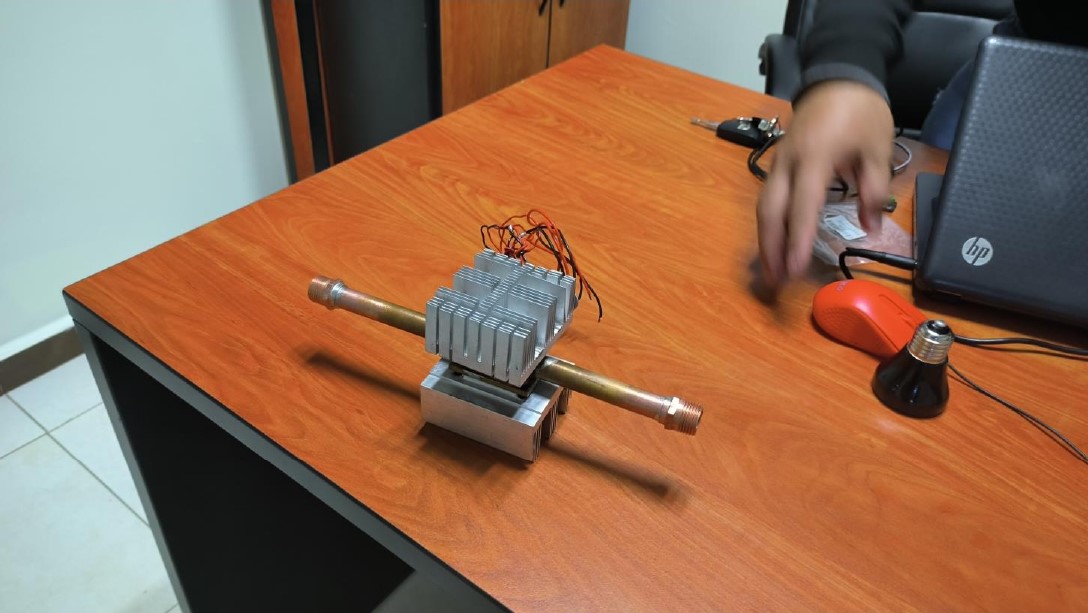
En este trabajo se detalla el diseño e implementación de un dispositivo de tipo pantalla térmica, enfocado en la presentación de información en forma de temperatura. De esta manera, el usuario puede percibir información al estar en contacto con el mismo y ser utilizado en aplicaciones de realidad virtual. Se especifica el circuito de control electrónico, el diseño de un controlador difuso tipo Sugeno, así como la descripción de una aplicación de realidad virtual desarrollada en Unity con fines didácticos. Se describe el arreglo que permite regresar a la condición inicial de operación, mediante una red de tuberías de enfriamiento por circulación interna de agua. El desarrollo se basa en la premisa de incrementar el realismo en aplicaciones de realidad virtual en virtud de focalizar la atención y enfoque de los usuarios durante el proceso de aprendizaje. Como resultados se presenta la curva de respuesta ante distintas entradas de referencia de temperatura, a fin de evaluar el desempeño del controlador difuso. Se presenta la escala dinámica de colores de temperatura en función de las mediciones de temperatura que realiza el controlador, proporcionando información térmica y visual de forma simultánea a través del dispositivo. Derivado de las pruebas de funcionamiento, se identificó la ilusión háptica temperatura-humedad durante la etapa de enfriamiento, por lo que en trabajos futuros se realizará una mayor exploración de ilusiones hápticas con realidad virtual.
Referencias
1. Zhou, NN., & Deng, YL. (2009). “Virtual Reality: A State-of-the-Art Survey.” International Journal of Automation and Computing 6(4):319–25. doi: 10.1007/s11633-009-0319-9.
2. Carmigniani, J., & Furht, B. (2011). “Augmented reality: an overview”. Handbook of augmented reality, 3-46.
3. Izard, S. G., Juanes Méndez, J. A., & Palomera, P. R. (2017). “Virtual reality educational tool for human anatomy”. Journal of medical systems, 41, 1-6.
4. Buentello-Montoya, D. A., Lomelí-Plascencia, M. G., & Medina-Herrera, L. M. (2021). “The role of reality enhancing technologies in teaching and learning of mathematics”. Computers & Electrical Engineering, 94, 107287.
5. Neroni, M. A., Oti, A., & Crilly, N. (2021). “Virtual Reality design-build-test games with physics simulation: opportunities for researching design cognition”. International Journal of Design Creativity and Innovation, 9(3), 139-173.
6. Cheng, A., Yang, L., & Andersen, E. (2017). “Teaching language and culture with a virtual reality game”. In Proceedings of the 2017 CHI conference on human factors in computing systems, 541-549.
7. Collaço, E., Kira, E., Sallaberry, L. H., Queiroz, A. C., Machado, M. A., Crivello Jr, O., & Tori, R. (2021). “Immersion and haptic feedback impacts on dental anesthesia technical skills virtual reality training”. Journal of Dental Education, 85(4), 589-598.
8. Sapkaroski, D., Baird, M., McInerney, J., & Dimmock, M. R. (2018). “The implementation of a haptic feedback virtual reality simulation clinic with dynamic patient interaction and communication for medical imaging students”. Journal of medical radiation sciences, 65(3), 218-225.
9. Richard, E., Tijou, A., Richard, P., & Ferrier, J. L. (2006). “Multi-modal virtual environments for education with haptic and olfactory feedback”. Virtual Reality, 10, 207-225.
10. Lontschar, S., Deegan, D., Humer, I., Pietroszek, K., & Eckhardt, C. (2020). “Analysis of haptic feedback and its influences in virtual reality learning environments”. In 2020 6th International Conference of the Immersive Learning Research Network (iLRN), 171-177. IEEE.
11. Edwards, B. I., Bielawski, K. S., Prada, R., & Cheok, A. D. (2019). “Haptic virtual reality and immersive learning for enhanced organic chemistry instruction”. Virtual Reality, 23, 363-373.
12. Grajewski, D., Górski, F., Hamrol, A., & Zawadzki, P. (2015). “Immersive and haptic educational simulations of assembly workplace conditions”. Procedia Computer Science, 75, 359-368.
13. Noghabaei, M., & Han, K. (2021). “Object manipulation in immersive virtual environments: Hand Motion tracking technology and snap-to-fit function”. Automation in Construction, 124, 103594.
14. Motaharifar, M., Norouzzadeh, A., Abdi, P., Iranfar, A., Lotfi, F., Moshiri, B., ... & Taghirad, H. D. (2021). “Applications of haptic technology, virtual reality, and artificial intelligence in medical training during the COVID-19 pandemic”. Frontiers in Robotics and AI, 8, 612949.
15. Sanfilippo, F., Blazauskas, T., Salvietti, G., Ramos, I., Vert, S., Radianti, J., ... & Oliveira, D. (2022). “A perspective review on integrating VR/AR with haptics into STEM education for multi-sensory learning”. Robotics, 11(2), 41.
16. Gallo, S., Rognini, G., Santos-Carreras, L., Vouga, T., Blanke, O., & Bleuler, H. (2015). “Encoded and crossmodal thermal stimulation through a fingertip-sized haptic display”. Frontiers in Robotics and AI, 2, 25.
17. Kim, S. W., Kim, S. H., Kim, C. S., Yi, K., Kim, J. S., Cho, B. J., & Cha, Y. (2020). “Thermal display glove for interacting with virtual reality”. Scientific reports, 10(1), 11403.
18. Hirai, S., & Miki, N. (2019). “A thermal tactile sensation display with controllable thermal conductivity”. Micromachines, 10(6), 359.
19. Carnahan, H., Dubrowski, A., & Grierson, L. E. (2010). “Temperature influences both haptic perception and force production when grasping”. International Journal of Industrial Ergonomics, 40(1), 55-58.
20. Kuhtz-Buschbeck, J. P., & Hagenkamp, J. (2020). “Cold and heavy: grasping the temperature–weight illusion”. Experimental brain research, 238, 1107-1117.
21. Ho, H. N., Chow, H. M., Tsunokake, S., & Roseboom, W. (2019). “Thermal-tactile integration in object temperature perception”. IEEE transactions on haptics, 12(4), 594-603.
22. Trojan, J., Fuchs, X., Speth, S. L., & Diers, M. (2018). “The rubber hand illusion induced by visual-thermal stimulation”. Scientific reports, 8(1), 12417.
23. Ho, H. N., Iwai, D., Yoshikawa, Y., Watanabe, J., & Nishida, S. Y. (2014). “Combining colour and temperature: A blue object is more likely to be judged as warm than a red object”. Scientific reports, 4(1), 5527.
24. Gil, J. J., Diaz, I., Justo, X., & Ciäurriz, P. (2014). “Educational haptic controller based on Arduino platform”. In 2014 XI Tecnologias Aplicadas a la Ensenanza de la Electronica (Technologies Applied to Electronics Teaching) (TAEE), 1-7. IEEE.
25. Sanfilippo, F., & Pettersen, K. Y. (2015). “A sensor fusion wearable health-monitoring system with haptic feedback”. In 2015 11th International conference on innovations in information technology (IIT), 262-266. IEEE.
26. Lira-Cortés, L., González Rodríguez, O. J., & Méndez-Lango, E. (2008). “Sistema de medición de la conductividad térmica de materiales sólidos conductores, diseño y construcción”. In Simposio de Metrología Santiago de Querétaro: Querétaro, Mexico.
27. Jingzhuo, W., & Chenglong, G. (2007). “Research on 1-wire bus temperature monitoring system”. In 2007 8th international conference on electronic measurement and instruments,3-722. IEEE.
28. Sattar, H., Bajwa, I. S., Amin, R. U., Sarwar, N., Jamil, N., Malik, M. A., ... & Shafi, U. (2019). “An IoT-based intelligent wound monitoring system”. IEEE Access, 7, 144500-144515.
29. Campbell, I. (2008). “Body temperature and its regulation”. Anaesthesia & Intensive Care Medicine, 9(6), 259-263.
30. Han, T., Wang, S., Wang, S., Fan, X., Liu, J., Tian, F., & Fan, M. (2020). “Mouillé: Exploring wetness illusion on fingertips to enhance immersive experience in vr”. In Proceedings of the 2020 CHI Conference on Human Factors in Computing Systems,1-10.
31. Peiris, R. L., Chan, L., & Minamizawa, K. (2018). “LiquidReality: wetness sensations on the face for virtual reality”. In Haptics: Science, Technology, and Applications: 11th International Conference, EuroHaptics 2018, Pisa, Italy, June 13-16, 2018, Proceedings, Part II 11, 366-378. Springer International Publishing.