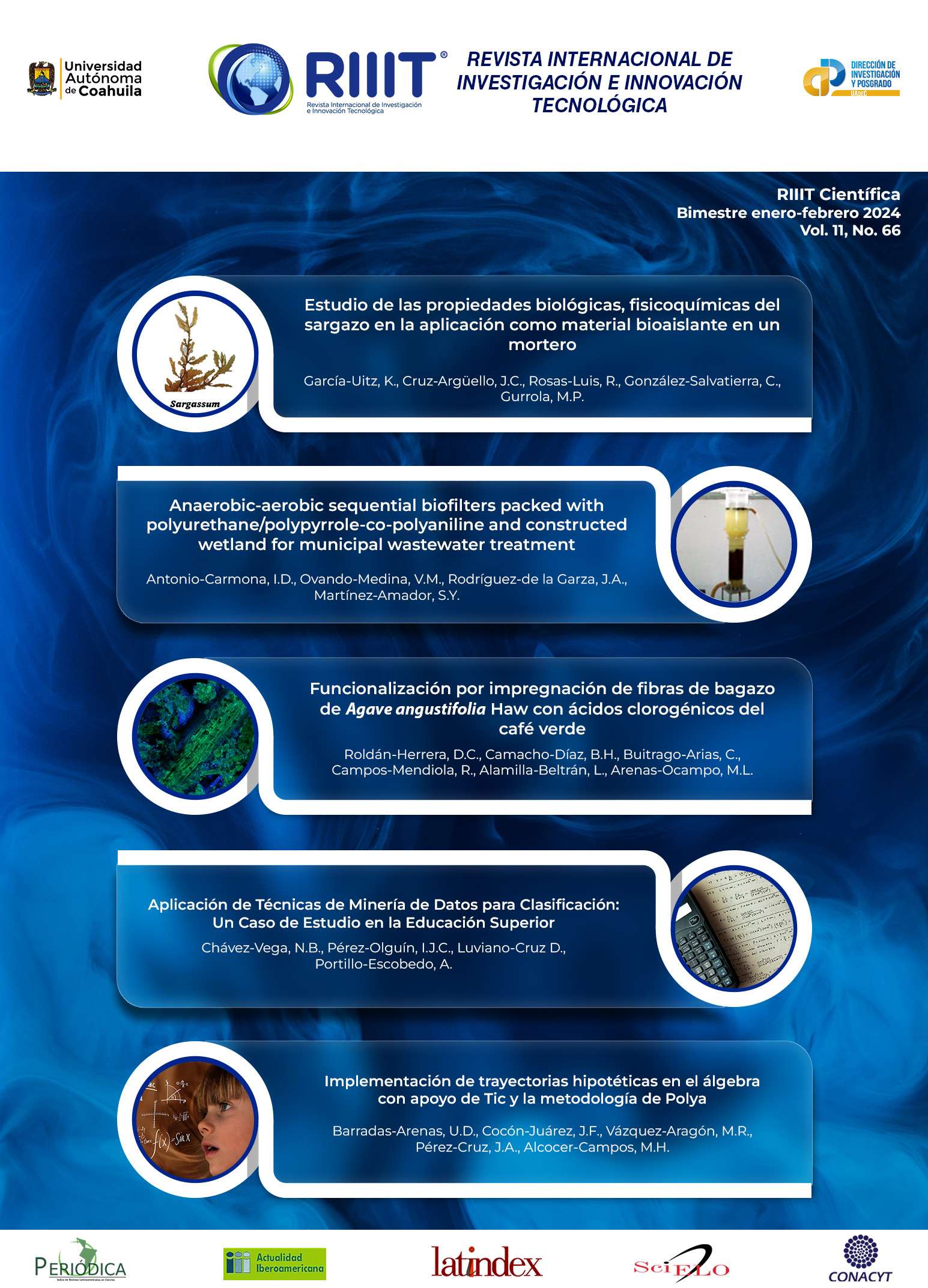
Estudio de las propiedades biológicas, fisicoquímicas del sargazo en la aplicación como material bioaislante en un mortero
Palabras clave:
sargazo, mortero, propiedades biológicas, fisicoquímicas, térmicas.Resumen
El objetivo de este estudio es evaluar las características biológicas, fisicoquímicas y térmicas en un mortero, utilizando sargazo como material cementante suplementario orgánico, que permita ser utilizado como aislante térmico. Se realizó la diferenciación y caracterización de las especies recolectadas, así como análisis fisicoquímicos para determinar la composición elemental, química y un análisis morfológico del sargazo con técnicas como DRX, FRX y EDS-SEM. Se evalúo el efecto del sargazo analizando proporciones de sustitución en un mortero con 5, 10, 15 y 20%. Los resultados muestran que la resistencia a la compresión mecánica, la conductividad térmica y la transmitancia térmica disminuyen con el incremento del contenido de sargazo en el mortero, sin embargo, el calor especifico aumenta con respecto al aumento del porcentaje de sustitución, indicando una disminución en la transferencia de calor dentro de la vivienda.
Estos resultados son confirmados con las correlaciones analizadas, ya que presentan valores por arriba de R2= 0.94. Se concluye que la sustitución del agregado pétreo con sargazo es posible utilizarlo hasta en un 5%, con 28 días con una resistencia mecánica mayor a 75MPa.
Referencias
Ahmad,W; Ahmad, A.; Ostrowski, K.A.; Aslam, F.; Joyklad, P. (2021). A scientometric review of waste material utilization in concrete for sustainable construction. Case Stud. Constr. Mater., 15, e00683.
Al-Kutti, W., Saiful Islam, A.B.M., Nasir, M., (2019). Potential use of date palm ash incement-based materials. J. King Saud Univ. Eng. Sci. 31, 26–31.
Asdrubali F., D’Alessandro F, Schiavoni S. (2015). A review of unconventional sustainable building insulation materials. Sustainable Materials and Technologies. 4 1-17.
ASTM C109/109M-16a, 2016. Standard test method for compressive strength of hydraulic cement mortars (using 2-in. or [50-mm] cube specimens).
ASTM E1530-99 Standard Test Method For Evaluating The Resistance To Thermal Transmission Of Thin Specimens Of Materials By The Guarded Heat Flow Meter Technique.
Benmansour, N. Agoudjil B., Gherabli, A. Kareche, A Boundenne A. (2014) Thermal and mechanical performance of natural mortar reinforced with date palm fibers for use as insulating materials in building. 81 98-104.
Bunganaen, W., Hunggurami, E., Beingala, Y. (2006). Pengaruh penambahan gula pasir terhadap kuat tekan dan sifat kedap air mortar. J. Teknik Sipil Univ. Nusa Cendana 5 (1), 105–116.
Castellanos, I., Gasca, R. (2002). Eufáusidos (Crustacea:Malacostraca) del centro y sur del Mar Caibe mexicano. Rev. Biol. Trop., 50(1): 77-85.
Chahbi M., Mortadi A., El Moznine R., Monkade M., Zaim S., Nmila R. & Rchide H. (2022). A new approach to investigate the hydration process and the effect of algae powder on the strength properties of cement paste. Australian Journal of Mechanical Engineering 1-10.
Chen X, Mohammad G M, Beatty D, and. Srubar W. (2021). Retardation of Portland Cement Hydration with Photosynthetic Algal Biomass. ACS Sustainable Chem. Eng. 9, 13726−13734.
Gregor J y Marsálek B. (2004). Freshwater phytoplankton quantification by chlorophyll a: a comparative study of in vitro, in vivo and in situ methods. Water Research 38(3):517-22. doi: 10.1016/j.watres.2003.10.033
Guiry, M.D., Guiry, G.M., (2022). Algae Base. World-Wide Electronic Publication. National University of Ireland, Galway. https://www.algaebase.org.
Hernández, E. F.; Cano-Barrita, P.F.d.J.; Torres-Acosta, A. A. (2016). Influence of cactus mucilage and marine brown algae extract on the compressive strength and durability of concrete. Mater. Constr., 66, 7514.
Hossain, M.M., Karim, M.R., Hasan, M., Hossain, M.K., Zain, M.F.M., (2016). Durability of mortar and concrete made up of pozzolans as a partial replacement of cement: a review. Constr. Build. Mater. 116, 128–140.
Ippolitov, A., Rzhavsky, A. (2015). Tube morphology, ultrastructures and mineralogy in recent Spirorbinae (Annelida: Polychaeta: Serpulidae). II. Tribe Spirorbini, Invert. Zool., 12, 61–92.
Jeffrey SW. y Humprey GF. (1975). New Spectrophotometric equations for determining cholorophylls a, b, c1 y c2 in Higher plants, algae and natural phytoplankton. Biochem. Physiol. Pflanzen 167 191-194
Johns, E. M., Lumpkin, R., Putman, N. F., Smith, R. H., Muller-Karger, F. E., Rueda-Roa, T. (2020). The establishment of a pelagic Sargassum population in the tropical Atlantic: biological consequences of a basin-scale long distance dispersal event. Prog. Oceanogr. 182:102269. doi: 10.1016/j.pocean.2020.102269
Khan, M.N.N., Jamil, M., Karim, M.R., Zain, M.F.M., Kaish, A.B.M.A., (2017). Filler effect of pozzolanic materials on the strength and microstructure development of mortar. KSCE J. Civ. Eng. 21, 274–284.
León-Martínez, F. M.; Cano-Barrita, P.F.d.J.; Lagunez-Rivera, L.; Medina-Torres, L. (2014). Study of nopal mucilage and marine Brown algae extract as viscosity-enhancing admixtures for cement based materials. Constr. Build. Mater. 53, 190−202.
Lobban CS y Harrison PJ. (2004). Seaweed ecology and physiology. Cambridge University Press. ISBN-13 978-0-521-40334-4
Michalak, I.; Chojnacka, K. (2018). Introduction: Toward algae-based products, in: hojnacka, K.; Wieczorek, P.P.; Schroeder, G.; Michalak, I. (Eds.) Algae biomass: characteristics and applications: towards algae-based products; Springer International Publishing: Cham; pp 1−5. DOI: 10.1007/978-3-319-74703-3_1.
Mistry A, Ganta U, Chakrabarty J and Dutta S. (2019). Mistry, A. N.; et al. A review on biological systems for CO2msequestration: Organisms and their pathways. Environ. Prog. Sustainable Energy 38 (1), 127−136.
Moreira L. y Suarez A. (2002). Estudio del género Sargassum C. AGARDH, 1820 Phaeophyta, Fucales, Sargassaceae) en aguas cubanas. 2. Variaciones morfológicas en Sargassum natans (Linnaeus) Meyer en dos localidades. Rev. Invest. Mar. 23, 51-68.
Moreira A. y Alfonso G. (2013). Inusual arribazón de Sargassum fluitans (Borgesen) Borgesen en la costa centro-sur de Cuba. Rev Invest Mar 33(2): 17-20
Moreno, A.G. (2019). Ectoproctos (= Briozoos). Apuntes de Zoología. 1-2. https://www.ucm.es/data/cont/docs/465-2013-08-22-I4%20ECTOPROCTOS.pdf Descargado 25 de mayo 2019.
NMX-C077-ONNCCE-2018. Industria de la Construcción-Agregados para Concreto-Análisis Granulométrico-Método de Ensayo.
Osseni, S. O. G. Ahouannou C., Sanya, E. A. Jannot Y. (2016). Investigation on the use of the cemente mortar containing banana fibers as thermal insulator in building. 4,1142-1152.
Panesar D and Shindman B. (2012). The mechanical, transport and thermal properties of mortar and concrete containing waste cork. Cement & Concrete Composites. 34 982-992.
Pinto A., Von Sperling E., Perling E. y Moreira R. (2001). Chlorophyll-a determination via continuous measurement of plankton fluorescence: methodology development. Water Res. 35(16): 3977-3981.
Ramakrishna and Sundararajan, (2019). A novel approach to rheological and impact strength of fibrereinforced cement/cementitious composites for durability evaluation. In: Durability and Life Prediction in Biocomposites, Fibre- Reinforced Composites and Hybrid Composites, Woodhead Publishing, Cambridge, US, 389–405.
Saidi T, and Hasan M. (2022). The effect of partial replacement of cement with diatomaceous earth (DE) on the compressive strength and absorption of mortar. Journal of King Saud University – Engineering Sciences 34 250–259
Shafigh P., Asadi, I, Akhiani A, Mahyuddin N, Hashemi M. (2020). Thermal properties of cement mortar with different mix proportions. Mater. Construcc. 70 [339], e224 https://doi.org/10.3989/mc.2020.09219.