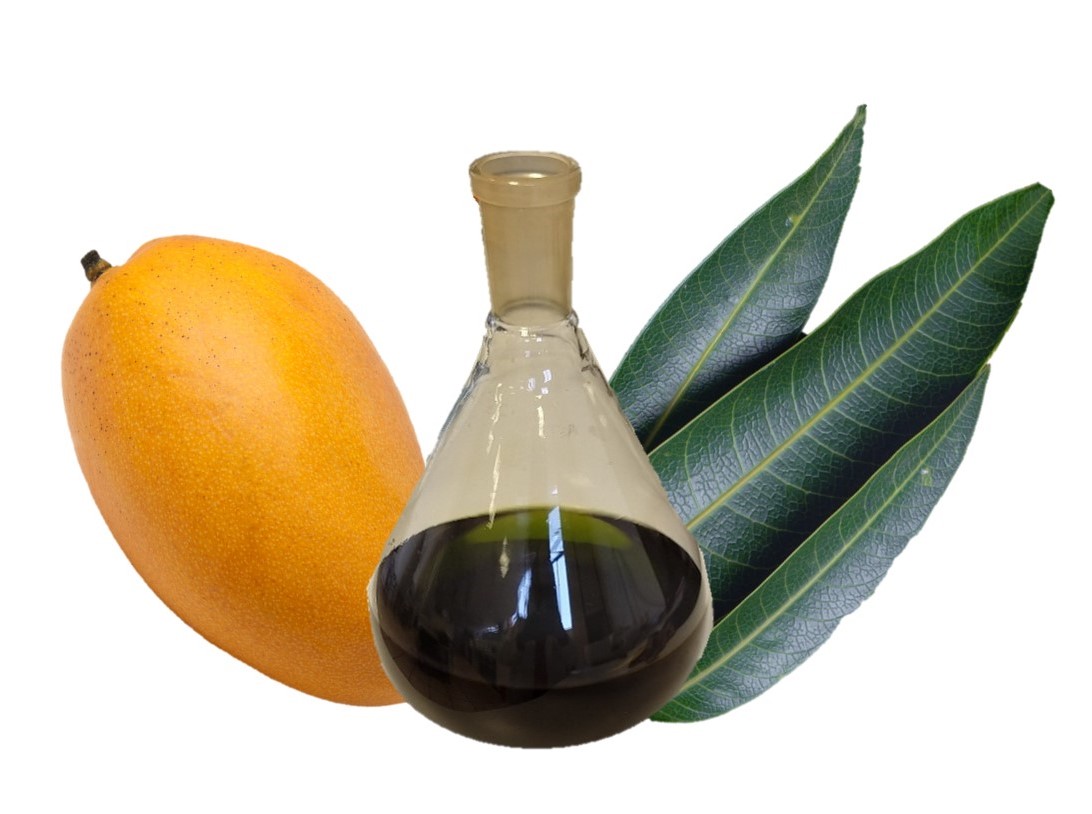
Extracto polifenólico de hojas de mango (Mangifera indica L.): Caracterización y actividad antifúngica in vitro
Palabras clave:
Capacidad antifúngica, Composición fitoquímica, Extracción asistida por ultrasonido, Subproducto agroindustrial.Resumen
La creciente búsqueda de fungicidas naturales y amigables con el ambiente ha causado que las investigaciones se dirijan hacia el aprovechamiento de los subproductos agroindustriales. Las hojas de mango, obtenidas de la poda de los huertos, son una fuente importante de compuestos de alto valor biológico (CAVB) con posible actividad antifúngica. El objetivo del estudio fue evaluar la viabilidad del uso de un extracto de hojas de mango obtenido por ultrasonido en la inhibición de fitopatógenos que infectan frutos de interés comercial. Para obtener el extracto se aplicó ultrasonido a diferentes tiempos (10, 20 y 30 min) y se evaluó la capacidad antioxidante, fenoles solubles totales y flavonoides totales. La identificación fitoquímica del extracto se realizó mediante HPLC-UV/VIS y se evaluó la actividad antifúngica frente a Penicillium digitatum y Botrytis cinerea. La extracción por 30 min permitió obtener mayor cantidad de polifenoles (305.92 ± 3.52 mg. eq. trolox, 141.35 ± 3.18 mg EAG y 18.95 ± 0.66 mg eq. rutina, para capacidad antioxidante, fenoles solubles totales y flavonoides totales, respectivamente). Los compuestos identificados fueron mangiferina y el ácido clorogénico, hidroxibenzoico, cafeico y cumárico. Se obtuvo una inhibición total de P. digitatum y B. cinerea a concentraciones de 20.51 y 9.35 mg/mL de extracto, respectivamente. El extracto de hojas de mango es una fuente importante de CAVB con buena capacidad antifúngica contra hongos de interés comercial. Esto sugiere su potencial uso como una alternativa natural a los fungicidas convencionales, ofreciendo una opción segura para el tratamiento de frutos en la etapa de poscosecha.
Referencias
1. Rebolledo-Martínez, A., Peralta-Antonio, N., Rebolledo-Martínez, L., Becerril-Román, E. A. & Rebolledo-García, R. L. (2019). Effect of rootstock in tree growth, dry matter, flowering, yield and quality of ‘Manila’ mango. Scientia Horticulturae, 251, 155–61. https://doi.org/10.1016/j.scienta.2019.03.0122
2. Avilán, L., Horci- Escalante, L., Marín R, C., Soto, E., Pérez, M., Rodríguez, M., et al. (2007). Contenido estimado de npk en el follaje removido por la poda en mango sembrado en alta densidad. Agronomía Tropical, 57(2), 113–21.
3. Ramos-Hernández, J., Ragazzo-Sánchez, J., Calderón-Santoyo, M., Ortiz-Basurto, R., Prieto, C. & Lagaron, J. (2018). Use of electrosprayed agave fructans as nanoencapsulating hydrocolloids for bioactives. Nanomaterials, 8(11), 868. https://doi.org/10.3390/nano8110868
4. Guamán-Balcázar, M. C., Montes, A., Pereyra, C. & de la Ossa E, M. (2017). Precipitation of mango leaves antioxidants by supercritical antisolvent process. Journal of Supercritical Fluids, 128, 218–26. https://doi.org/10.1016/j.supflu.2017.05.031
5. Rodríguez-García, S. L. & Raghavan, V. (2022). Green extraction techniques from fruit and vegetable waste to obtain bioactive compounds—A review”. Critical Reviews in Food Science and Nutrition 62(23), 6446. https://doi.org/10.1080/10408398.2021.1901651
6. García-Santoyo, K., Ozuna-López, C. & Mares-Mares, E. (2020). Extracción de compuestos bioactivos y capacidad antioxidante de flor de jamaica (Hibiscus sabdariffa L.) asistida por ultrasonidos de potencia. Investigación y Desarrollo en Ciencia y Tecnología de Alimentos, 5, 227–232.
7. Aziz, N. A., Hasham, R., Sarmidi, M. R., Suhaimi, S. H. & Idris, M. K. H. (2021). A review on extraction techniques and therapeutic value of polar bioactives from Asian medicinal herbs: Case study on Orthosiphon aristatus, Eurycoma longifolia and Andrographis paniculate. Saudi Pharmaceutical Journal, 29(2), 143–65. https://doi.org/10.1016/j.jsps.2020.12.016
8. Dzah, C. S., Duan, Y., Zhang, H., Wen, C., Zhang, J., Chen, G., et al. (2020). The effects of ultrasound assisted extraction on yield, antioxidant, anticancer and antimicrobial activity of polyphenol extracts: A review. Food Bioscience, 35, 100547. https://doi.org/10.1016/j.fbio.2020.100547
9. Lavilla, I. & Bendicho, C. (2017). Fundamentals of ultrasound-assisted extraction. in: water extraction of bioactive compounds”. Elsevier; p. 291–316. https://doi.org/10.1016/B978-0-12-809380-1.00011-5
10. Kumar, K., Srivastav, S. & Sharanagat, V. S. (2021). Ultrasound assisted extraction (UAE) of bioactive compounds from fruit and vegetable processing by-products: A review. Ultrasonics Sonochemistry, 70, 105325. https://doi.org/10.1016/j.ultsonch.2020.105325
11.Castañeda-Valbuena, D., Ayora-Talavera, T., Luján-Hidalgo, C., Álvarez-Gutiérrez, P., Martínez-Galero, N. & Meza-Gordillo, R. (2021). Ultrasound extraction conditions effect on antioxidant capacity of mango by-product extracts. Food and Bioproducts Processing, 127, 212–24. 212–224. https://doi.org/10.1016/j.fbp.2021.03.002
12. Oseghale, F. O., Fasina, K. A., Ohifueme, A. & Omoruyi, J. (2020). Biocontrol of food spoilage microorganisms using leaf extracts from Magnifera indica (Mango) and Psidium guajava (Guava). Journal of Chemical Society of Nigeria, 45(4), 712–23. https://doi.org/10.46602/jcsn.v45i4.496
13. Ballesteros, L. F., Ramirez, M. J., Orrego, C. E., Teixeira, J. A., & Mussatto, S. I. (2017). Encapsulation of antioxidant phenolic compounds extracted from spent coffee grounds by freeze-drying and spray-drying using different coating materials. Food Chemistry, 237, 623–631. https://doi.org/10.1016/j.foodchem.2017.05.142
14. Bhatta, U. K. (2022). Alternative management approaches of citrus diseases caused by Penicillium digitatum (Green mold) and Penicillium italicum (Blue mold). Frontiers in Plant Science, 12, 833328. https://doi.org/10.3389/fpls.2021.833328
15. Chacón, F. I., Sineli, P. E., Mansilla, F. I., Pereyra, M. M., Diaz, M. A., Volentini, S. I., et al. (2022). Native cultivable bacteria from the blueberry microbiome as novel potential biocontrol agents. Microorganisms, 10(5), 969. https://doi.org/10.3390/microorganisms10050969
16.Vázquez-González, Y., Ragazzo-Sánchez, J. A. & Calderón-Santoyo, M. (2020). Characterization and antifungal activity of jackfruit (Artocarpus heterophyllus Lam.) leaf extract obtained using conventional and emerging technologies. Food Chemistry, 330, 127211. https://doi.org/10.1016/j.foodchem.2020.127211
17. Ruiz-Montañez, G., Burgos-Hernández, A., Calderón-Santoyo, M., López-Saiz, C. M., Velázquez-Contreras, C. A., Navarro-Ocaña, A., et al. (2015). Screening antimutagenic and antiproliferative properties of extracts isolated from Jackfruit pulp (Artocarpus heterophyllus Lam). Food Chemistry, 175, 409–16. https://doi.org/10.1016/j.foodchem.2014.11.122
18. Calderón-Chiu, C., Calderón-Santoyo, M., Herman-Lara, E. & Ragazzo-Sánchez, J. A. (2021). Jackfruit (Artocarpus heterophyllus Lam) leaf as a new source to obtain protein hydrolysates: Physicochemical characterization, techno-functional properties and antioxidant capacity. Food Hydrocolloids, 1(112), 106319. https://doi.org/10.1016/j.foodhyd.2020.106319
19. Liu, S., Lin, J., Wang, C., Chen, H. & Yang, D. (2009). Antioxidant properties of various solvent extracts from lychee (Litchi chinenesis Sonn.) flowers. Food Chemistry, 114(2), 577–81. https://doi.org/10.1016/j.foodchem.2008.09.088
20. Dobravalskytė, D., Rimantas-Venskutonis, P., Talou, T., Zebib, B., Merah, O. & Ragažinskienė, O. (2013). Antioxidant properties and composition of deodorized extracts of Tussilago farfara L. Records of Natural Products, 7(3), 201-209.
21. Lerma-Torres, J. M., Navarro-Ocaña, A., Calderón-Santoyo, M., Hernández-Vázquez, L., Ruiz-Montañez, G. & Ragazzo-Sánchez, J. A. (2019). Preparative scale extraction of mangiferin and lupeol from mango (Mangifera indica L.) leaves and bark by different extraction methods. Food Science and Technology, 56(10), 4625–31. https://doi.org/10.1007/s13197-019-03909-0
22. Covarrubias-Rivera, L., López-Cruz, R., Ragazzo-Sánchez, J. A., Iñiguez-Moreno, M. & Calderón-Santoyo, M. (2022). Determination by isothermal microcalorimetry of the sensitivity of phytopathogenic fungi of tropical fruits against an ethanolic extract of jackfruit leaf (Artocarpus heterophyllus Lam.). Journal of Microbiological Methods, 195, 106457. https://doi.org/10.1016/j.mimet.2022.106457
23. Calderón-Santoyo, M., González-Gutiérrez, K. N., Vilchis-Gómez, D. S., Dominguez-Ruvalcaba, J. E. & Ragazzo-Sanchez, J. A. (2024). Dalea carthagenensis una nueva fuente de compuestos antioxidantes: Identificación de polifenoles y actividad antifúngica contra Rhizopus stolonifer en yaca. Revista Bio Ciencias. https://doi.org/10.15741/revbio.11.e1686
24. Zakaria, F., Tan, J. K., Mohd-Faudzi, S. M., Abdul-Rahman, M. B. & Ashari, S. E. (2021). Ultrasound-assisted extraction conditions optimisation using response surface methodology from Mitragyna speciosa (Korth.) Havil leaves. Ultrasonic Sonochemistry, 81, 105851. https://doi.org/10.1016/j.ultsonch.2021.105851
25. Zou, T. B., Xia, E. Q., He, T. P., Huang, M. Y., Jia, Q. & Li, H. W. (2014). Ultrasound-assisted extraction of mangiferin from mango (Mangifera indica L.) leaves using response surface methodology. Molecules, 19(2), 1411–21. https://doi.org/10.3390/molecules19021411
26. Wu, L., Wu, W., Cai, Y., Li, C. & Wang, L. (2020). HPLC fingerprinting-based multivariate analysis of phenolic compounds in mango leaves varieties: Correlation to their antioxidant activity and in silico α-glucosidase inhibitory ability. Journal of Pharmaceutical and Biomedical Analysis, 191, 113616. https://doi.org/10.1016/j.jpba.2020.113616
27. Yang, L., Wen, K. S., Ruan, X., Zhao, Y. X., Wei, F. & Wang, Q. (2018). Response of plant secondary metabolites to environmental factors. Molecules, 23(4), 762. https://doi.org/10.3390/molecules23040762
28. Drevelegka, I. & Goula, A. M. (2020). Recovery of grape pomace phenolic compounds through optimized extraction and adsorption processes. Chemical Engineering and Processing - Process Intensification, 149, 107845. https://doi.org/10.1016/j.cep.2020.107845
29. Medina-Torres, N., Ayora-Talavera, T., Espinosa-Andrews, H., Sánchez-Contreras, A. & Pacheco, N. (2017). Ultrasound assisted extraction for the recovery of phenolic compounds from vegetable sources. Agronomy, 7(3), 47. https://doi.org/10.3390/agronomy7030047
30. Lang, Q. & Wai, C. M. (2001). Supercritical fluid extraction in herbal and natural product studies-a practical review. Talanta, 53(4), 771–782. https://doi.org/10.1016/s0039-9140(00)00557-9
31. Falleh, H., Ksouri, R., Lucchessi, ME., Abdelly, C. & Magné, C. (2012). Ultrasound-assisted extraction: Effect of extraction time and solvent power on the levels of polyphenols and antioxidant activity of Mesembryanthemum edule L. Aizoaceae Shoots. Tropical Journal of Pharmaceutical Research, 11(2), 243–9. https://doi.org/10.4314/tjpr.v11i2.10
32. Pak-Dek, M., Osman, A., Gooda-Sahib, N., Saari, N., Markom, M., Hamid, A. A., et al. (2011). Effects of extraction techniques on phenolic components and antioxidant activity of Mengkudu (Morinda citrifolia L.) leaf extracts. Journal of Medicinal Plants Research, 5(20), 5050–5057.
33. Cao, Y., Fang, S., Fu, X., Shang, X. & Yang, W. (2019). Seasonal variation in phenolic compounds and antioxidant cctivity in leaves of Cyclocarya paliurus (Batal.) Iljinskaja. Forests, 10(8), 624. https://doi.org/10.3390/f10080624
34. Zhang, L., Shan, Y., Tang, K. & Putheti, R. (2009). Ultrasound-assisted extraction flavonoids from Lotus (Nelumbo nuficera Gaertn) leaf and evaluation of its anti-fatigue activity. International Journal of Physical Sciences, 4(8), 418-422
35. Yang, L., Cao, Y. L., Jiang, J. G., Lin, Q. S., Chen, J. & Zhu, L. (2010). Response surface optimization of ultrasound-assisted flavonoids extraction from the flower of Citrus aurantium L”. var. amara Engl. Journal of Separartion Science, 33(9), 1349–55. https://doi.org/10.1002/jssc.200900776
36. Biesaga, M. (2011). Influence of extraction methods on stability of flavonoids. Journal of Chromatography A, 1218(18), 2505–2812. https://doi.org/10.1016/j.chroma.2011.02.059
37. Zhang, J., Wang, Y. D., Xue, Q. W., Zhao, T. R., Khan, A., Wang, Y. F., et al. (2022). The effect of ultra-high pretreatment on free, esterified and insoluble-bound phenolics from mango leaves and their antioxidant and cytoprotective activities. Food Chemistry, 368, 130864. https://doi.org/10.1016/j.foodchem.2021.130864
38. Alshammaa, D. (2016). Preliminary screening and phytochemical profile of Mangifera indica leave’s extracts, cultivated in Iraq. International Journal of Current Microbiology and Applied Sciences, 5(9), 163–73. https://doi.org/10.20546/ijcmas.2016.509.018
39. Zhang, J., Wang, Y. D., Xue, Q. W., Zhao, T. R., Khan, A., Wang, Y. F., et al. (2022). The effect of ultra-high pretreatment on free, esterified and insoluble-bound phenolics from mango leaves and their antioxidant and cytoprotective activities. Food Chemistry, 368, 130864. https://doi.org/10.1016/j.foodchem.2021.130864
40. Pobiega, K., Kraśniewska, K., Derewiaka, D. & Gniewosz, M. (2019). Comparison of the antimicrobial activity of propolis extracts obtained by means of various extraction methods. Journal of Food Science and Technology, 56(12), 5386–95. https://doi.org/10.1007/s13197-019-04009-9.
41. Bashi, D. S., Dowom, S. A., Bazzaz, B. S. F., Khanzadeh, F., Soheili, V. & Mohammadpour, A. (2016). Evaluation, prediction and optimization the ultrasound-assisted extraction method using response surface methodology: Antioxidant and biological properties of Stachys parviflora L. Iranian Journal of Basic Medical Sciences, 19(5), 529–41. http://www.ncbi.nlm.nih.gov/pubmed/27403260
42. Safdar, M. N., Kausar, T., Jabbar, S., Mumtaz, A., Ahad, K. & Saddozai, A. A. (2017). Extraction and quantification of polyphenols from kinnow (Citrus reticulate L.) peel using ultrasound and maceration techniques. Journal of Food and Drug Analysis, 25(3), 488–500. https://doi.org/10.1016/j.jfda.2016.07.010
43. Kyselka, J., Rabiej, D., Dragoun, M., Kreps, F., Burčová, Z., Němečková, I., et al. (2017). Antioxidant and antimicrobial activity of linseed lignans and phenolic acids. European Food Research and Technology, 243(9), 1633–44. https://doi.org/10.1007/s00217-017-2871-9
44. Kumar, M., Saurabh, V., Tomar, M., Hasan, M., Changan, S., Sasi, M., et al. (2021). Mango (Mangifera indica L.) leaves: Nutritional composition, phytochemical profile, and health-promoting bioactivities. Antioxidants, 10(2), 299. https://doi.org/10.3390/antiox10020299
45. Tayel, A. A., Moussa, S. H., Salem, M. F., Mazrou, K. E. & El‐Tras, W. F. (2016). Control of citrus molds using bioactive coatings incorporated with fungal chitosan/plant extracts composite. Journal of the Science of Food and Agriculture, 96(4), 1306–1312. https://doi.org/10.1002/jsfa.7223
46. Ma, C. M., Kully, M., Khan, J. K., Hattori, M. & Daneshtalab, M. (2007). Synthesis of chlorogenic acid derivatives with promising antifungal activity. Bioorganic & Medicinal Chemistry, 15(21), 6830–33. https://doi.org/10.1016/j.bmc.2007.07.038
47. Luo, J., Xu, F., Zhang, X., Shao, X., Wei, Y. & Wang, H. (2020). Transcriptome analysis of Penicillium italicum in response to the flavonoids from Sedum aizoon L. World Journal of Microbiology and Biotechnology, 36, 62. https://doi.org/10.1007/s11274-020-02836-z
48. Ahmadu, T., Ahmad, K., Ismail, S. I., Rashed, O., Asib, N. & Omar, D. (2021). Antifungal efficacy of Moringa oleifera leaf and seed extracts against Botrytis cinerea causing gray mold disease of tomato (Solanum lycopersicum L.). Brazilian Journal of Biology, 81(4), 1007–22. https://doi.org/10.1590/1519-6984.233173
49. Tayel, A. A., El-Baz, A. F., Salem, M. F. & El-Hadary, M. H. (2009). Potential applications of pomegranate peel extract for the control of citrus green mould. Journal of Plant Diseases and Protection, 116(6), 252-256. https://doi.org/10.1007/BF03356318.
50. Luo, J., Xu, F., Zhang, X., Shao, X., Wei, Y. & Wang, H. (2020). Transcriptome analysis of Penicillium italicum in response to the flavonoids from Sedum aizoon L. World Journal of Microbiology and Biotechnology, 36(5), 62. https://doi.org/10.1007/s11274-020-02836-z
51. Rao, A., Zhang, Y., Muend, S. & Rao, R. (2010). Mechanism of antifungal activity of terpenoid phenols resembles calcium stress and inhibition of the TOR pathway. Antimicrobial Agents and Chemotherapy, 54(12), 5062–5069. https://doi.org/10.1128/AAC.01050-10
52. Muriithi, B. W., Dubois, T., Kirui, L., Lattorff, H. M. G., Mohamed, S., Abdel-Rahman, E. M., et al. (2024). Impact of integrating pest and pollinator management training on knowledge, perceptions, and livelihoods of avocado farmers in Kenya. Journal of Integrated Pest Management, 15(1), 35. https://doi.org/10.1093/jipm/pmae025