Efluentes de fermentación obscura aprovechados como inóculo y substrato para producción de electricidad en celdas de combustible microbianas
Palabras clave:
Efluentes de fermentación obscura, Celdas de combustible microbianas, Comunidad microbiana, relación inoculo-substrato, Resistencia a la transferencia de carga.Resumen
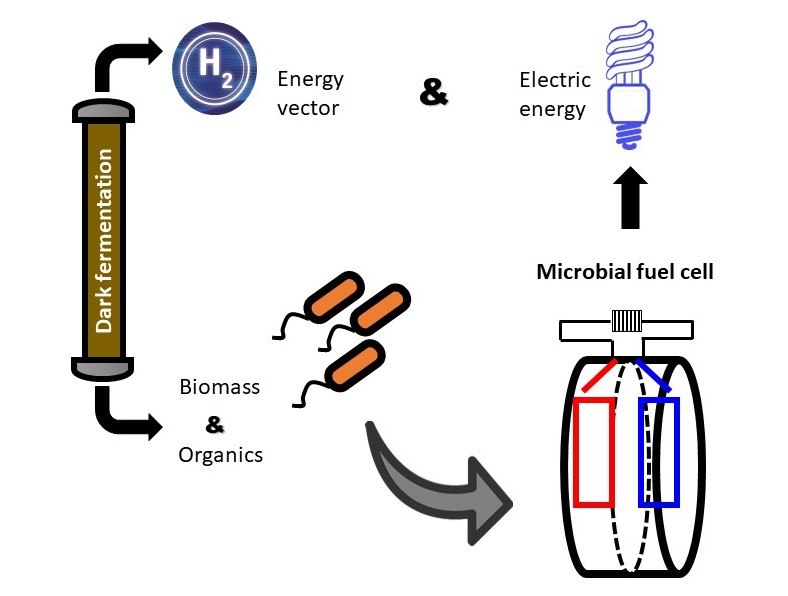
La vinculación directa de la fermentación obscura con las celdas de combustible microbianas (MFC) podría verse limitada por la variabilidad en la composición de los efluentes de fermentación oscura (DFE) y por el uso de un inóculo externo. En esta investigación se probaron dos tipos de DFE reales en tres series para determinar la viabilidad de usar directamente los efluentes como inóculo y sustrato en una MFC. En cada prueba se investigó la composición del DFE real, la relación inóculo-sustrato (ISR), la comunidad microbiana y la resistencia a la transferencia de carga en circuito abierto y cerrado. La mayor densidad de potencia (0.4 a 0.5 mW m-2) se atribuyó al contenido de sólidos volátiles y a un DFE menos complejo con una ISR de 0.35 y 0.52. El porcentaje de abundancia relativa de microorganismos electroactivos fue solo del 30%, lo que indica la necesidad de un procedimiento de enriquecimiento de este tipo de microorganismos. Las mediciones de resistencia a la transferencia de carga fueron más precisas cuando las MFC estaban en circuito abierto, y la distribución de resistencias reveló que el cátodo era el electrodo limitante. La vinculación directa de la fermentación oscura con la MFC fue factible; sin embargo, aún son necesarias mejoras que conduzcan al enriquecimiento de la comunidad electroactiva y a la disminución de la resistencia en el cátodo. Los resultados de esta investigación contribuyen al aprovechamiento de las aguas residuales procedentes de bioprocesos para producción de electricidad.
Referencias
[1] Sinha, P., Pandey, A. “An evaluative report and challenges for fermentative biohydrogen production”. International Journal of Hydrogen Energy. 36.13 (2011):7460-78.
[2] Mohanakrishna, G., S. V. Mohan, and P. N. Sarma. "Utilizing Acid-Rich Effluents of Fermentative Hydrogen Production Process as Substrate for Harnessing Bioelectricity: An Integrative Approach". International Journal of Hydrogen Energy 35.8 (2010): 3440-49.
[3] ElMekawy, A., Srikanth, S., Vanbroekhoven, K., De Wever, H., Pant, D. "Bioelectro-Catalytic Valorization of Dark Fermentation Effluents by Acetate Oxidizing Bacteria in Bioelectrochemical System (BES)". Journal of Power Sources 262 (2014): 183-91.
[4] Choi, Jin-dal-rae, Ho Nam Chang, and Jong-In Han. "Performance of Microbial Fuel Cell with Volatile Fatty Acids from Food Wastes". Biotechnology Letters 33.4 (2011): 705-14.
[5] Rosales-Sierra, A., Rosales-Mendoza, S., Monreal-Escalante, E., Celis, L. B., et al. "Acclimation Strategy Using Complex Volatile Fatty Acid Mixtures Increases the Microbial Fuel Cell (Mfc) Potential". Chemistryselect 2.22 (2017): 6277-85.
[6] Rozsenberszki, T., Kook, L., Bakonyi, P., Nemestothy, N., et al. "Municipal Waste Liquor Treatment Via Bioelectrochemical and Fermentation (H-2 + Ch4) Processes: Assessment of Various Technological Sequences". Chemosphere 171 (2017): 692-701.
[7] Varanasi, J. L., P. Sinha, and D. Das. "Maximizing Power Generation from Dark Fermentation Effluents in Microbial Fuel Cell by Selective Enrichment of Exoelectrogens and Optimization of Anodic Operational Parameters". Biotechnology Letters 39.5 (2017): 721-30.
[8] Wenzel, J., Fuentes, L., Cabezas, A., Etchebehere, C. "Microbial Fuel Cell Coupled to Biohydrogen Reactor: A Feasible Technology to Increase Energy Yield from Cheese Whey". Bioprocess and Biosystems Engineering 40.6 (2017): 807-19.
[9] Chandra, Rashmi, J. Annie Modestra, and S. Venkata Mohan. "Biophotovoltaic Cell to Harness Bioelectricity from Acidogenic Wastewater Associated with Microbial Community Profiling". Fuel 160 (2015): 502-12.
[10] Pasupuleti, S. B., Srikanth, S., Mohan, S. V., Pant, D. "Continuous Mode Operation of Microbial Fuel Cell (Mfc) Stack with Dual Gas Diffusion Cathode Design for the Treatment of Dark Fermentation Effluent". International Journal of Hydrogen Energy 40.36 (2015): 12424-35.
[11] Varanasi, J. L., Roy, S., Pandit, S., Das, D. "Improvement of Energy Recovery from Cellobiose by Thermophillic Dark Fermentative Hydrogen Production Followed by Microbial Fuel Cell". International Journal of Hydrogen Energy 40.26 (2015): 8311-21.
[12] Yang, F., Ren, L., Pu, Y., Logan, B. E. "Electricity Generation from Fermented Primary Sludge Using Single-Chamber Air-Cathode Microbial Fuel Cells". Bioresource Technology 128 (2013): 784-87.
[13] Mohan, S. Venkata, G. Mohanakrishna, and P. Chiranjeevi. "Sustainable Power Generation from Floating Macrophytes Based Ecological Microenvironment through Embedded Fuel Cells Along with Simultaneous Wastewater Treatment". Bioresource Technology 102.14 (2011): 7036-42.
[14] Li, J., Zou, W., Xu, Z., Ye, D., et al. "Improved Hydrogen Production of the Downstream Bioreactor by Coupling Single Chamber Microbial Fuel Cells between Series-Connected Photosynthetic Biohydrogen Reactors". International Journal of Hydrogen Energy 38.35 (2013): 15613-19.
[15] Cisneros-Perez, C., Etchebehere, C., Celis, L.B., Carrillo-Reyes, J., Alatriste-Mondragon, F., Razo-Flores, E. “Effect of inoculum pretreatment on the microbial community structure and its performance during dark fermentation using anaerobic fluidized-bed reactors”. International Journal of Hydrogen Energy. 42.15 (2017):9589-99.
[16] Eaton, A. D., Clesceeri, L. S., Rice, E. W., & Greenberg, A. E. (2005). Standard methods for the examination of water and wastewater. 22nd ed., 5220-5310. American Public Health Association/American Water Works Association/Water Environment Federation. Washington DC, USA.
[17] Davila-Vazquez, G., Alatriste-Mondragon, F., de Leon-Rodriguez, A., Razo-Flores, E. "Fermentative Hydrogen Production in Batch Experiments Using Lactose, Cheese Whey and Glucose: Influence of Initial Substrate Concentration and Ph". International Journal of Hydrogen Energy 33.19 (2008): 4989-97.
[18] Cisneros-Perez, C., Carrillo-Reyes, J., Cells, L. B., Alatriste-Mondragon, F., et al. "Inoculum Pretreatment Promotes Differences in Hydrogen Production Performance in Egsb Reactors". International Journal of Hydrogen Energy 40.19 (2015): 6329-39.
[19] Carrillo-Reyes, J., Celis, L. B., Alatriste-Mondragon, F., Razo-Flores, E."Different Start-up Strategies to Enhance Biohydrogen Production from Cheese Whey in Uasb Reactors". International Journal of Hydrogen Energy 37.7 (2012): 5591-601.
[20] Cercado, B., Felipe Chazaro-Ruiz, L., Ruiz, V., de Jesus Lopez-Prieto, I., et al. "Biotic and Abiotic Characterization of Bioanodes Formed on Oxidized Carbon Electrodes as a Basis to Predict Their Performance". Biosensors & Bioelectronics 50 (2013): 373-81.
[21] Liu, Z., Li, H. “Effects of bio- and abio-factors on electricity production in a mediatorless microbial fuel cell”. Biochemical Engineering Journal 36 (2007): 209-214.
[22] Shah, F. A., Mahmood, Q., Shah, M. M., Pervez, A., Asad, S. A. "Microbial Ecology of Anaerobic Digesters: The Key Players of Anaerobiosis". Scientific World Journal (2014).
[23] Moset, Veronica, Nawras Al-zohairi, and Henrik B. Moller. "The Impact of Inoculum Source, Inoculum to Substrate Ratio and Sample Preservation on Methane Potential from Different Substrates". Biomass & Bioenergy 83 (2015): 474-82.
[24] Wang, H. M., J. D. Park, and Z. J. Ren. "Practical Energy Harvesting for Microbial Fuel Cells: A Review". Environmental Science & Technology 49.6 (2015): 3267-77.
[25] Garita-Meza, M. A., Ramirez-Balderas, L. A., Contreras-Bustos, R., Chavez-Ramirez, A. U., Cercado, B. "Blocking Oscillator-Based Electronic Circuit to Harvest and Boost the Voltage Produced by a Compost-Based Microbial Fuel Cell Stack". Sustainable Energy Technologies and Assessments 29 (2018): 164-70.
[26] Miceli, J. F., Parameswaran, P., Kang, D. W., Krajmalnik-Brown, R., Torres, C. I. "Enrichment and Analysis of Anode-Respiring Bacteria from Diverse Anaerobic Inocula". Environmental Science & Technology 46.18 (2012): 10349-55.
[27] Hasany, M., M. M. Mardanpour, and S. Yaghmaei. "Biocatalysts in Microbial Electrolysis Cells: A Review". International Journal of Hydrogen Energy 41.3 (2016): 1477-93.
[28] Tchobanouglous, G., Burton, F. L., (1991). Wastewater engineering. Treatment, disposal, and reuse. McGraw-Hill. Singapore.
[29] Parihar, P., Keshavkant, S., Jadhav, S. “Electrogenic potential of Enterococcus faecalis DWW1 isolated from the anodic biofilm of a dairy wastewater fed dual chambered microbial fuel cell”. Journal of Water Process Engineering 45 (2022):102503.
[30] Ng, I. S., Hsueh, C. C., Chen, B. Y. “Electron transport phenomena of electroactive bacteria in microbial fuel cells: a review of Proteus hauseri”. Bioresources and Bioprocesses. 4.53 (2017).
[31] Feng, C., Li, J., Qin, D., Chen, L., et al. “Characterization of exoelectrogenic bacteria Enterobacter strains isolated from a microbial fuel cell exposed to copper shock load”. Plos One 9.11 (2014): e113379.
[32] Bisquert, J., Garcia-Belmonte, G., Fabregat-Santiago, F., Ferriols, N. S., et al. "Doubling Exponent Models for the Analysis of Porous Film Electrodes by Impedance. Relaxation of TiO2 Nanoporous in Aqueous Solution". Journal of Physical Chemistry B 104.10 (2000): 2287-98.
[33] Borole, A. P., Aaron, D., Hamilton, C. Y., Tsouris, C. "Understanding Long-Term Changes in Microbial Fuel Cell Performance Using Electrochemical Impedance Spectroscopy". Environmental Science & Technology 44.7 (2010): 2740-44.
[34] Martin, E., Savadogo, O., Guiot, S. R., Tartakovsky, B. "Electrochemical Characterization of Anodic Biofilm Development in a Microbial Fuel Cell". Journal of Applied Electrochemistry 43.5 (2013): 533-40.