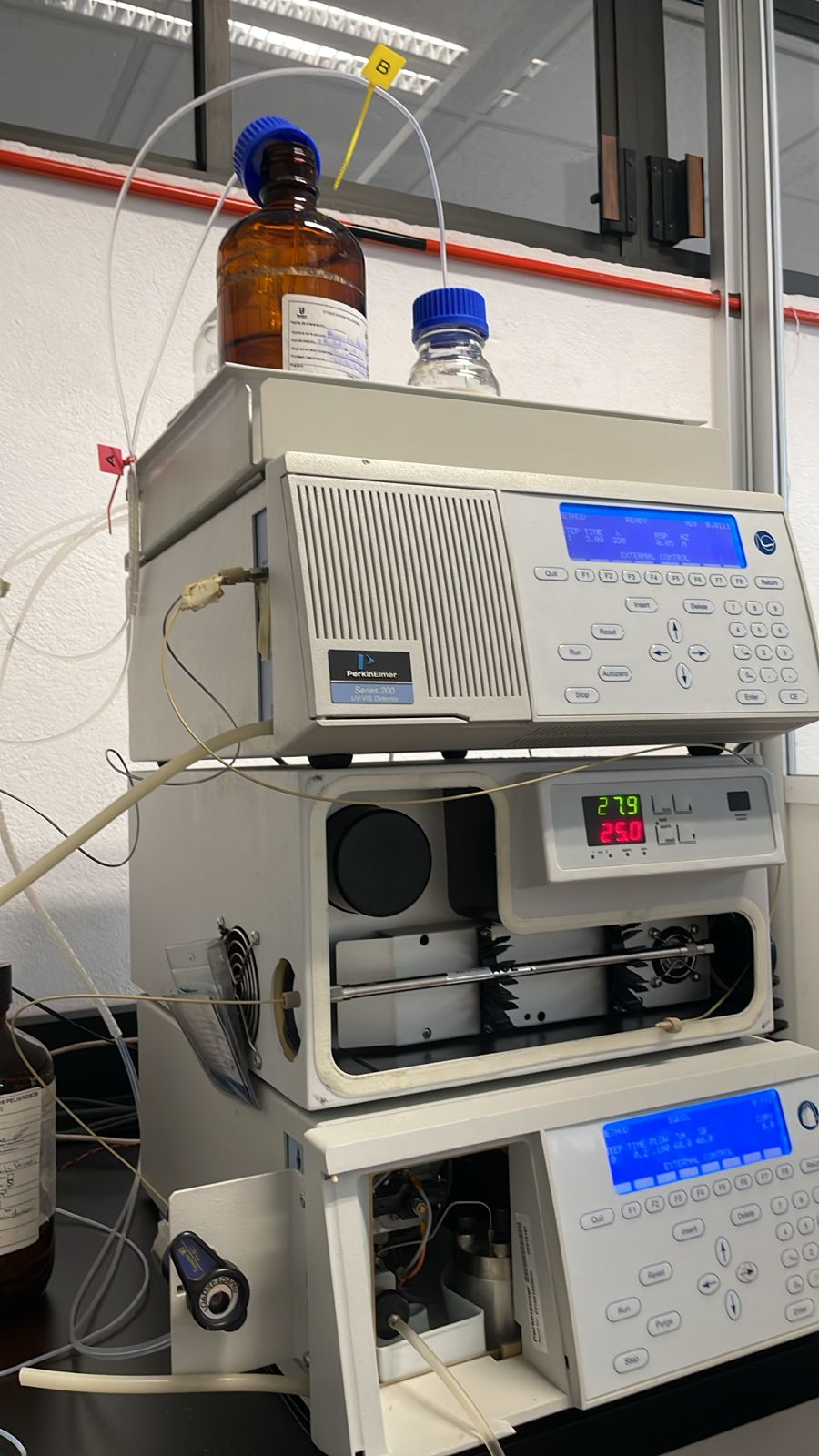
Desarrollo de un método analítico para la determinación de ciprofloxacino, diclofenaco, paracetamol y carbamazepina por Cromatografía de Líquidos de Alta Resolución
DOI:
https://doi.org/10.68038/6nct2t93Palabras clave:
Cromatografía, contaminantes emergentes, fármacos.Resumen
Los medicamentos utilizados en el presente estudio se caracterizan por ser comúnmente usados en México para tratar dolores articulares (diclofenaco), fiebre (paracetamol), infecciones bacterianas (ciprofloxacino) y epilepsia (carbamazepina). La Cromatografía Liquida de Alta Resolución (HPLC, por sus siglas en inglés) ha sido reportados para el análisis de diversos compuestos presentes en fluidos biológicos y ambientales. El objetivo del estudio fue desarrollar un método rápido y sencillo para la determinación de los medicamentos anteriormente mencionados en muestras de agua. Para lo cual se empleó el método de HPLC con detección ultravioleta a 277 nm, fase móvil isocrática y un rango de cuantificación de 1 a 50 μg∙mL-1. Los resultados mostraron tiempos de retención de 6.49, 8.45, 9.56 y 8.56 minutos para el diclofenaco, ciprofloxacino, paracetamol y carbamazepina respectivamente en la misma longitud de onda. La precisión y exactitud fueron superiores al 95% y el tiempo total de elución fue de 12 minutos por muestra. Se logró desarrollar e implementar un método analítico para la determinación de diclofenaco, ciprofloxacino, paracetamol y carbamazepina en agua, lo suficientemente sensible, exacto y reproductible, con un grado de error menor al 5%, lo cual lo vuelve adecuado para ser usado en posteriores estudios.
Referencias
[1] Ahmed, R. (2024). High-Performance Liquid Chromatography (HPLC): Principles, Applications, Versatility, Efficiency, Innovation and Comparative Analysis. Clinical Investigation, 14(9). ISSN: 2041-6792. Doi:
[2] Hussein J. (2025). Principles and Applications of High-Performance Liquid Chromatography (HPLC): A Review. Biomedical and Pharmacology Journal. 18(2). Doi: https://dx.doi.org/10.13005/bpj/3154
[3] Khan, M. A., Dalwadi, M., & Upadhayay, U. M. (2024). A review on high performance liquid chromatography technique for pharmaceutical analysis. International Journal of Pharmaceutical Research and Applications, 9(2), 2385-2389. ISSN: 2456-4494. Doi: 10.35629/4494-090223852389.
[4] Thermo Fisher Scientific. (2024, October 28). Conceptos básicos de la HPLC. Retrieved from Thermo Fisher Scientific: https://www.thermofisher.com/mx/es/home/industrial/chromatography/chromatography-learning-center/liquid-chromatography-information/hplc-basics.html
[5] Dhirendra K.M, Mahato A.K. & Koiri S. (2024). HPLC method development and validation: A review. World Journal of Pharmaceutical and Medical Research. 10 (1); 233-241. ISSN: 2455-3301. Retrieved from:
[6] Avilés-Flores, M., Sánchez-Zarza, M., & Tapia-Acosta, J. (2016). Proyecto "Métodos analíticos para determinación de contaminantes emergentes en agua" TC 1602.1. Morelos, México: Instituto Mexicano de Tecnología del Agua.
[7] Schieppati, D., Patience, N. A., Campisi, S., & Patience, G. S. (2021). Experimental methods in chemical engineering: High performance liquid chromatography—HPLC. In Canadian Journal of Chemical Engineering (Vol. 99, Issue 8, pp. 1663–1682). John Wiley and Sons Inc. https://doi.org/10.1002/cjce.24050
[8] Bounegru, A. V., Dinu Iacob, A., Iticescu, C., & Georgescu, P. L. (2025). Electrochemical Sensors and Biosensors for the Detection of Pharmaceutical Contaminants in Natural Waters—A Comprehensive Review. In Chemosensors (Vol. 13, Issue 2). Multidisciplinary Digital Publishing Institute (MDPI). https://doi.org/10.3390/chemosensors13020065
[9] Omitoyin, B. O., Ajani, E. K., Adesina, B. T., & Okunade, O. A. (2021). Acute effects of acetaminophen on the developmental, swimming performance and cardiovascular activities of African catfish embryos/larvae (Clarias gariepinus). Ecotoxicology and Environmental Safety, 208, 111482. https://doi.org/10.1016/j.ecoenv.2020.111482
[10] Patrolecco , L., Ademollo, N., Grenni, P., Tolomei, A., Caracciolo, A., & Capri, S. (2013). Simultaneous determination of human pharmaceuticals in water samples by solid phase extraction and HPLC with UV-fluorescence detection. Microchemical Journal, 107: 165-171. doi:https://doi.org/10.1016/j.microc.2012.05.035
[11] Tiwari, B., Sellamuthu, B., Ouarda, Y., Drogui, P., Tyagi, R., & Buelna, G. (2017). Review on Fate and Mechanism of removal of pharmaceutical pollutants from wastewaterusing biological approach. Bioresource Technology, 224: 1-12. doi:https://doi.org/10.1016/j.biortech.2016.11.042
[12] Mandaric, I., Celic, M. M., & Petrovic, M. (2016). Introduction on emerging contaminants in rivers and their enviromental risk. In M. Petrovic, S. Sabater, A. Elosegi, & D. Barceló, Emerging Contaminants in River Ecosystems: Occurrence and Effects Under Multiple Stress Conditions (p. 219). Suiza, Suiza: Springer.
[13] PerkinElmer. (2000). Curso básico de cromatografía de líquidos. México, CDMX: PerkinElmer de México, S.A.
[14] Scherer , R., Pereira , J., Firme , J., Lemos, M., & Lemos, M. (2014). Determination of Ciprofloxacin in Pharmaceutical Formulations Using HPLC Method with UV Detection. Indian Journal of Pharmaceutical Sciences, 76(6):541-4. doi:PMCID: PMC4293686 PMID: 25593388
[15] Sibinovi, P., Melcerovi, A., Palic, R., Dordevic, S., & Marinkovic, V. (2005). Ruggedness testing of an HPLC method for the determination of ciprofloxacin. Journal of the Serbian Chemical Society, 70 (7) 979–986. doi:10.2298/JSC0507979S
[16] Fukushima, A. R., Peña-Muñoz, J. W., Leoni, L. A. B., Nicoletti, M. A., Ferreira, G. M., Delorenzi, J. C. M. O. B., Ricci, E. L., Brandão, M. E., Pantaleon, L. de P., Gonçalves-Junior, V., Waziry, P. A. F., Maiorka, P. C., & Spinosa, H. de S. (2022). Development, Optimization, and Validation of Forensic Analytical Method for Quantification of Anticholinesterase Pesticides in Biological Matrices from Suspected Cases of Animal Poisoning. Toxics, 10(5). https://doi.org/10.3390/toxics10050269
[17] Long, G., & Winefordner, J. (1983). Limit of detection. A closer look at the IUPAC definition. Analytical chemistry, 55 (7): 712A-724A. doi:10.1021/ac00258a001
[18] Shah, V., Midha, K. K., Dighe, S., McGilveray, I. J., Skelly, J. P., Yacobi, A., . . . Spector, S. (1992). Analytical Methods Validation: Bioavailability, Bioequivalence and Pharmacokinetic Studies. Pharmaceutical Research, 9: 588–592.
[19] Frank, E., Prieto, A., & Castillo, M. (2009). Metodología de identificación cualitativa y cuantitativa de fibras textiles naturales. Córdoba: Sustentabilidad Productiva de Pequeños Rumiantes en Áreas.
[20] Synder, Lloyed R., Kirkland Joseph J. & Dolan, John (2010). Introduction to modern liquid chromatography, 3rd edition. Wiley & Sons Ltd. 960 pages, Hardcover. ISBN:9780470508183. Doi:10.1002/9780470508183
[21] Qasim, B., Razzak, A. A., Motelica-Heino, M., Kamil, G. M., & Morabito, D. (2020). Quantitative determination of fluoroquinolones in contaminated soils by HPLC with solid-phase extraction. Baghdad Science Journal, 17(1), 48–566. https://doi.org/10.21123/bsj.2020.17.1.0048
[22] Stafiej, A., Pyrzynska, K., & Regan, F. (2007). Determination of anti-inflammatory drugs and estrogens in water by HPLC with UV detection. Journal of Separation Science, 30 (7): 985-991. doi:https://doi.org/10.1002/jssc.200600433
[23] Opuni, K. F. M., Boadu, J. A., Amponsah, S. K., & Okai, C. A. (2021). High performance liquid chromatography: A versatile tool for assaying antiepileptic drugs in biological matrices. In Journal of Chromatography B: Analytical Technologies in the Biomedical and Life Sciences (Vol. 1179). Elsevier B.V. https://doi.org/10.1016/j.jchromb.2021.122750
[24] Said, A., El-Nabtity, S., Mobarez, E., & Abdel-Hafeez, M. (2015). Residues of Ciprofloxacin in Rabbit Tissues by HPLC. Zagazig Veterinary Journal, 43 ( 3): 28-36. doi:10.21608/zvjz.2015.28439
[25] Mongolodi Dimpe K. & Nomngongo P.N. (2019). Original Application of activated carbon-decorated polyacrylonitrile nanofibers as an adsorbent in dispersive solid-phase extraction of fluoroquinolones from wastewater. Journal of Pharmaceutical Analysis. 9: 117-126. DOI:10.1016/j.jpha.2019.01.003
[26] Jiménez Alemán, Narda M., Calero Carbonell, Jorge E., Padrón Yaquis, Alejandro S., & Izquierdo Lozano, Julio C.. (2007). Método analítico por cromatografía líquida de alta resolución para la determinación de carbamazepina en plasma humano. Revista Cubana de Farmacia, 41(1) R Retrieved from http://scielo.sld.cu/scielo.php?script=sci_arttext&pid=S0034-75152007000100007&lng=es&tlng=es.
[27] Farré M., Abanades S., Álvarez Y., Barral D. & Roset P.N. (2004). Paracetamol. Dolor. 19:5-15. Retrieved from https://www.researchgate.net/publication/287337779_Paracetamol
[28] Christianah M. Adeyeye & Pui-Kai Li (1990). Diclofenac Sodium. Analytical Profiles of Drug Substances, Academic Press. 19: 123-144. ISSN 0099-5428. ISBN 9780122608193. https://doi.org/10.1016/S0099-5428(08)60366-4.
[29] Brito, J. C. M., Bernardoni, V., da Silva, T. M. L., Ramos, L. S. X. S., Gomes, M. P., & de Assis, D. C. S. (2022). Development and Validation of a Rapid and Reliable HPLC-FLD Method for the Quantification of Ciprofloxacin and Enrofloxacin Residues in Zea mays. Journal of the Brazilian Chemical Society, 33(2), 128–134. https://doi.org/10.21577/0103-5053.20210129
[30] Mohamed, M., Mahgoub, S., Elsherief, A., khaled, rehab, Mahmoud, M., & Binsaleh, A. (2023). Validated stability indicating Eco-friendly RP-HPLC method for the concurrent quantification of Gabapentin and Diclofenac K in wastewater and pharmaceutical formulations. Egyptian Journal of Chemistry, 0(0), 0–0. https://doi.org/10.21608/ejchem.2023.213243.8018
[31] Bala, A., & Mandal, S. (2024). Spectrophotometric and HPLC analysis of amoxicillin trihydrate in presence of acetaminophen in different pH media. Future Journal of Pharmaceutical Sciences, 10(1), 174. https://doi.org/10.1186/s43094-024-00747-6
[32] Gupta, V., Jain, A., Gill, N., & Gupta, K. (2012).G Development and validation of HPLC method - a review. Int. Res J Pharm. App Sci., 2(4): 17-25. Retrieved from https://scienztech.org/index.php/irjpas/article/view/307
[33] Bhardwaj , S., Dwivedia, K., & Agarwal, D. (2015). A Review: HPLC Method Development and Validation. International Journal of Analytical and Bioanalytical Chemistry, 5(4): 76-81. Obtenido de https://www.researchgate.net/profile/Dr-Santosh-Bhardwaj/publication/284717827_A_Review_HPLC_Method_Development_and_Validation/links/569cfff508ae03384dd03f82/A-Review-HPLC-Method-Development-and-Validation.pdf
[34] Kim, D., Choi, D., Cheon, S., Ko, S., & Kang, S. (2020). Addition of biochar into activated sludge improves removal of antibiotic ciprofloxacin. Journal of water process engineering, 33: 101019. doi:https://doi.org/10.1016/j.jwpe.2019.101019
[35] Ozbay, T., Gurbetoglu, G. P., Sarracoglu, N., Doganay, A. A., & Pinarbasli, O. (2023). A validated RP-HPLC assay method for Tofacitinib in pharmaceutical drug products. Journal of Chemical Metrology, 17(2), 139–147. https://doi.org/10.25135/jcm.97.2307.2859
[36] Ahmed, M. T. (2024). Validation of An Efficient 2D-HPLC Method for The Determination of Pentazocine. Indonesian Journal of Chemistry, 24(3), 742–754. https://doi.org/10.22146/ijc.87947
[37] Falquez-Manotas, A., & Sarmiento-Rubiano, L. (2013). desarrollo y validación deun método analítico para la determinación deciprofloxacina en suero por cromatografía liquida dealta precisión con detección ultravioleta. Archivos de Medicina (Manizales), 13 (2): 119-126.