Determinación de fenoles y flavonoides totales, capacidad antioxidante y análisis proximal de semilla de Carica papaya y Citrullus lanatus
DOI:
https://doi.org/10.68038/tfht8p27Palabras clave:
Análisis químico proximal, Antioxidantes, Compuestos fenólicos, Semillas.Resumen
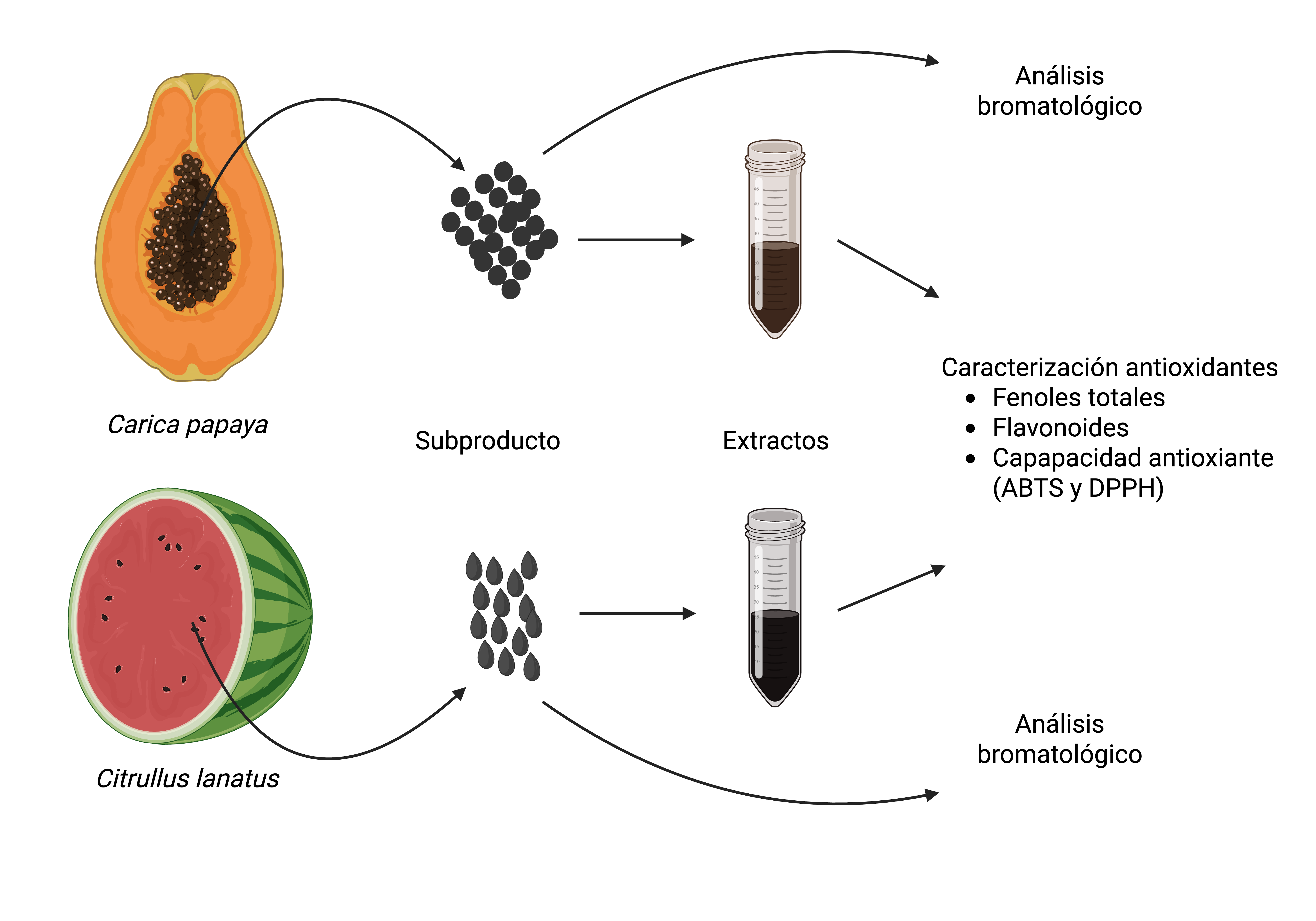
La papaya (Carica papaya) y sandía (Citrullus lanatus) son frutas cuya pulpa se ingiere, mientras que sus semillas son desechadas, sin considerar que son fuente de nutrientes y de antioxidantes. El objetivo de la presente investigación fue extraer y cuantificar compuestos fenólicos totales, flavonoides totales, evaluación de la capacidad antioxidante y análisis químico proximal de dichas semillas. La capacidad antioxidante se determinó por los métodos de inhibición del radical (1,1-difenil-2-picrilhidrazilo) DPPH• y (2,2’-azino- bis- 3-etilbenzotiazolina -6- ácido sulfónico) ABTS•+, se cuantificó el contenido fenólico y flavonoides por el método Folin Ciocalteu y tricloruro de aluminio respectivamente, el análisis proximal mediante las técnicas de la Association of Official Analytical Chemists (AOAC). Los resultados mostraron que el extracto de semilla de sandía presentó el mayor contenido de compuestos fenólicos totales (22.83 mg EAG/g) y de compuestos flavonoides totales (105.94 mg EQ/g), así como una mejor capacidad antioxidante directamente relacionada con el contenido de compuestos fenólicos totales. Además, el análisis proximal indicó que la semilla de sandía es fuente importante de grasa (45.76%), la de papaya de fibra (26%), ambas de proteínas (31.73% sandía, 26.45% papaya) y de compuestos fenólicos y flavonoides totales con capacidad antioxidante considerándose a ambas semillas como un ingrediente funcional fuente de nutrientes y de compuestos bioactivos para ser utilizados como ingrediente alimentario y en la industria farmacéutica y cosmética, contribuyendo a que no sean fuentes de desecho que dañen el medio ambiente.
Referencias
[1] Muhammad, N., Maham, N., Kashif, A., Aqsa, I., Faiqa, M., Muhamad, M. A. N. R., Hira, F., Aftab A. and Din, A. (2022). A comprehensive review on the watermelon phytochemical profile and their bioactive and therapeutic effects. Korean J. Food Preserv. 29(4):546-576. https://doi.org/10.11002/kjfp.2022.29.4.546 https://www.ekosfop.or.kr/archive/view_article?pid=kjfp-29-4-546
[2] Álvarez, H. J. C., Castillo, M. C. R. y Apaez, B. M. (2024). Evaluación de líneas seleccionadas de papaya para la conservación de características deseables. inifap. Revista Mexicana de Ciencias Agrícolas. 15(5). https://doi.org/10.29312/remexca.v15i5.3723 https://cienciasagricolas.inifap.gob.mx/index.php/agricolas/article/view/3723
[3] Pulido, S.A.A., Sánchez, M.D.L.L.H., Cárdenas, J.C.G., García, F.E., García, E.P.V. (2022). Producción y manejo del cultivo de papaya (Carica papaya L.). Revista Biológico Agropecuaria Tuxpan, 10(1), 164-169. https://doi.org/10.47808/revistabioagro.v10i1.414
[4] Gagan, D. Ch. y Ranjana, S. (2024). Circular Beauty: Sustainable Resource Recovery and Waste Management in the Cosmetic Industry. In book: Technological Advancements in Waste Management: Challenges and Opportunities (pp.379-399). DOI:10.1007/978-981-97-6024-4_26 https://www.researchgate.net/publication/385941017_Circular_Beauty_Sustainable_Resource_Recovery_and_Waste_Management_in_the_Cosmetic_Industry
[5] Vinocunga, P. D. R. y Jiménez, T. F. M. (2025). Análisis de las propiedades funcionales de productos a partir de subproductos agroindustriales: Revisión sistemática. Revista Amazónica Ciencia y Tecnología. 10(1) pp 1-19. https://doi.org/10.59410/RACYT-v10n01ep01-0153 https://revistas.uea.edu.ec/index.php/racyt/article/view/153
[6] Razavi, S. M. A., Milani, E. (2006). Some physical properties of the watermelon seeds. African Journal of Agricultural Research, 1(3), 65-69.
https://academicjournals.org/journal/AJAR/article-full-text-pdf/06539CE26636
[7] Koocheki, A., Razavi, S. M. A., Milani, E., Moghadam, T. M., Abedini, M., Alamatiyan, S., & Izadkhah, S. (2007). Physical properties of watermelon seed as a function of moisture content and variety. International Agrophysics, 21(4),349-359. http://www.international-agrophysics.org/pdf-106567-37409?filename=Physical%20properties%20of.pdf
[8] Petchsomrit, A., McDermott, M. I., Chanroj, S., Choksawangkarn, W. (2020). “Watermelon seeds and peels: fatty acid composition and cosmeceutical potential”. OCL - Oilseeds and Fats, Crops and Lipids, 27. https://doi.org/10.1051/ocl/2020051
[9] Braide, W.O.I.J., Odiong, I.J. and Oranusi, S. (2012). Phytochemical and antibacterial properties of the seed of watermelon (Citrullus lanatus).
[10] Khee, Y.L., Kiew, P.L., Chung, Y.T. (2023). Valorizing papaya seed waste for wastewater treatment: a review. International Journal of Environmental Science and Technology, 20(2), 2327-2346. https://doi.org/10.1007/s13762-022-04178-9
[11] Tan, C. X., Tan, S. T., Tan, S.S. (2020). An overview of papaya seed oil extraction methods. International Journal of Food Science and Technology, 55(4), 1506-1514.
https://doi.org/10.1111/ijfs.14431
[12] Sugiharto, S. (2020). Papaya (Carica papaya L.) seed as a potent functional feedstuff for poultry–A review. Veterinary world, 13(8), 1613. https://doi,org/10.14202/vetworld.2020.1613-1619
[13] Zhou, K., Wang, H., Mei, W., Li, X., Luo, Y., Dai, H. (2011). Antioxidant activity of papaya seed extracts. Molecules, 16(8), 6179-6192. https://doi.org/10.3390/molecules16086179
[14] Jia, Y. C. K., Perveen, N., Paliwal, N. and Khan, N. H. (2021). Phytochemical Analysis, Antioxidant and Antibacterial Activity Determination of Ethanolic Extract of Carica Papaya Seeds. Biomedical, Journal of Scientific and Techinical Research. 33(5), pp 26171-26174. DOI: 10.26717/BJSTR.2021.33.005459 https://biomedres.us/fulltexts/BJSTR.MS.ID.005459.php
[15] Zhou, Y., Cao, Y., Li, J., Tuncay, A. O., Barrow, C., Dunshea, F. and Suleria, H. A. R. (2023). Screening and characterization of phenolic compounds by LC-ESI-QTOF-MS/MS and their antioxidant potentials in papaya fruit and their by-products activities. Elsevier. 52. https://doi.org/10.1016/j.fbio.2023.102480 https://www.sciencedirect.com/science/article/abs/pii/S2212429223001311
[16] Brighente, I.M.C. Dias, M., Verdi, L. G., Pizzolatti, M. G. (2008). Antioxidant Activity and Total Phenolic Content of Some Brazilian Species. Pharmaceutical Biology. 45, 156–161. https://doi.org/10.1080/13880200601113131
[17] Liu, M. Li, X. Q., Weber, C., Lee, C. Y., Brown, J. and Liu, R. H. (2002). Antioxidant and antiproliferative activities of raspberries. J. Agric. Food Chem. 50(10). pp 2926-2930. http://dx.doi.org/10.1021/jf0111209
[18] Re, R., Pellegrini, N., Proteggente, A., Pannala, A., Yang, M., Rice-Evans, C. (1999) Antioxidant activity applying an improved ABTS radical cation decolorization assay. Free Radical Biology & Medicine, 26(9-10), 1231–1237. https://doi.org/10.1016/s0891-5849(98)00315-3
[19] AOAC. Official Methods of Analysis of AOAC International. 2023. https://www.aoac.org/official-methods-of-analysis/
[20] Tabiri, B., Agbenorhevi, J.K., Wireko-Manu, F.D., Ompouma, E.I. (2016). Watermelon Seeds as Food: Nutrient Composition, Phytochemicals and Antioxidant Activity. International Journal of Nutrition and Food Sciences, 5(2), 139–144. https://doi.org/10.11648/j.ijnfs.20160502.18
[21] Tlili, I., Hdider, C., Lenucci, M. S., Riadh, I., Jebari, H. and Dalessandro, G. (2011). Bioactive compounds and antioxidant activities of different watermelon (Citrullus lanatus (Thunb.) Mansfeld) cultivars as affected by fruit sampling area. Journal of Food Composition and Analysis 24(3). pp 307-314. https://doi.org/10.1016/j.jfca.2010.06.005 https://www.sciencedirect.com/science/article/abs/pii/S0889157510002267?via%3Dihub
[22] Muhammad, N., Maham, N., Kashif, A., Farzana, S., Aqsa, I., Faiqa, M., Muhamad, M. A. N. R., Zarina, Y., Rabia, K. and Sadaf, J. (2022). Perfil nutricional de la sandía, actividad antioxidante y procesamiento. Korean J. Food preserv. 29(4) pp 531-545. https://doi.org/10.11002/kjfp.2022.29.4.531 https://www-ekosfop-or-kr.translate.goog/archive/view_article?pid=kjfp-29-4-531&_x_tr_sl=en&_x_tr_tl=es&_x_tr_hl=es&_x_tr_pto=tc
[23] Gaye, A.A., Cisse, O.I., Ndiaye, B., Ayessou, N.C., Cisse, M. and Diop, C.M. (2019) Evaluation of Phenolic Content and Antioxidant Activity of Aqueous Extracts of Three Carica papaya Varieties Cultivated in Senegal. Food and Nutrition Sciences, 10, 276-289. https://doi.org/10.4236/fns.2019.103021. https://www.researchgate.net/figure/Total-phenolic-and-total-flavonoid-content-of-three-varieties-of-Carica-papaya_tbl1_331709089
[24] Manivannan, A., Lee, E.S., Han, K., Lee, H.E., Kim, D.S. (2020). Versatile Nutraceutical Potentials of Watermelon-A Modest Fruit Loaded with Pharmaceutically Valuable Phytochemicals. Molecules, 25(22), 5258. https://doi.org/10.3390/molecules25225258
[25] Jurinjak Tušek, A., Šamec, D., & Šalić, A. (2022). Modern techniques for flavonoid extraction—to optimize or not to optimize?. Applied Sciences, 12(22), 11865. https://doi.org/10.3390/app122211865
[26] Ramírez, A.M.G., Borrroel G.V., Dimas, L.M.J., Nieto G.A. (2024). Extracción de compuestos antioxidantes en sandía y melón en la Comarca Lagunera. Ecosistemas y Recursos Agropecuarios, 11(1), e3953. https://doi.org/10.19136/era.a11n1.3953
[27] Oliveira, Ch. J., Corrêa, dS. M., Capelasso, dS. L., Lachos, P. D., Torres, M. P. C., da Fonseca, M. A. P., Forster, C. T., Vázquez, E. M., Velasco, G. dP. A., Fernández, B. G. y Rostagno, M. A. (2020). Extracción de flavonoides de fuentes naturales mediante técnicas modernas. frontiers in Chemistry. doi: 10.3389/fchem.2020.507887 https://pmc-ncbi-nlm-nih-gov.translate.goog/articles/PMC7546908/?_x_tr_sl=en&_x_tr_tl=es&_x_tr_hl=es&_x_tr_pto=tc
[28] Malathi, V.M., Abhimannue, A. P. Sharma, K., Muricken D. G and Tomy, T. L. (2024). Papaya seeds: nutraceutical potential and health promoting activities. Valorization of Fruit Seed Waste from Food Processing Industry. Insights on Nutritional Profile, Biological Functions, and Applications. Developments in Food Quality and Safety. pp 285-313. https://doi.org/10.1016/B978-0-443-15535-2.00009 https://www.sciencedirect.com/science/article/abs/pii/B9780443155352000098
[29] Robles, A. S. M., González, V. R. I., Ruíz, C. S., Estrada, A. M. I., Cira, Ch. L. A., Márquez, R. E., Del Toro, S. C. L., Ornelas, P. J. J., Suárez, J. G. M. and Ocaño, H. V. M. (2024). Optimization of Extraction Process for Improving Polyphenols and Antioxidant Activity from Papaya Seeds (Carica papaya L.) Using Response Surface Methodology. 12(12), 2729. https://doi.org/10.3390/pr12122729. https://www.mdpi.com/2227-9717/12/12/2729
[30] Heethal, S. K., Krishnakumar, K. and Mathew, J. (2022). Flavonoids from the butanol extract of Carica papaya L. cultivar 'Red Lady' leaf using UPLC-ESI-Q-ToF-MS/MS analysis and evaluation of the antioxidant activities of its fractions. Food Chemistry Advances. Elsevier. 1. https://doi.org/10.1016/j.focha.2022.100126
https://www.sciencedirect.com/science/article/pii/S2772753X22001149
[31] Yoon, A. J., Sun, W. Ch., Seong, Ch. K and Young, J. L. (2022). Comprehensive Assessment of Antioxidant and Anti-Inflammatory Properties of Papaya Extracts. Foods, 11(20), 321. doi: 10.3390/foods11203211 https://pmc.ncbi.nlm.nih.gov/articles/PMC9601897/?utm_source=chatgpt.com
[32] Chaves, J.O., De Souza, M.C., Da Silva, L.C., Lachos-Perez, D., Torres-Mayanga, P.C., Machado, A.P.D.F., Forster, C.T., Vazquez, E.M., Velasco, G. de P.A., Fernandez, B.G., Rostagno, M.A. (2020). Extraction of flavonoids from natural sources using modern techniques. Frontiers in Chemistry, 8, 507887. https://doi.org/10.3389/fchem.2020.507887
[33] Nissar, J., Sidiqi, U. S., Dar, A. H., & Akbar, U. (2025). Nutritional composition and bioactive potential of watermelon seeds: a pathway to sustainable food and health innovation. Sustainable Food Technology, 3(2), 375–395. https://doi.org/10.1039/d4fb00335g.
[34] Floegel, A. Kim D., Chung, S., Koo, S., Chun, O. (2011). Comparison of ABTS/DPPH assays to measure antioxidant capacity in popular antioxidant rich US foods. Journal of Food Composition and Analysis, 24(7), 1043-1048. https://doi.org/10.1016/j.jfca.2011.01.008.
[35] Neglo, D., Okraku, T. C., Ken, E. E., Korley, K. N., Agyemang, B.A., Hunkpe, G., Amarh, F., Kwashie, P. and Sayanika, D. W. (2021). Comparative antioxidant and antimicrobial activities of the peels, rind, pulp and seeds of watermelon (Citrullus lanatus) fruit. Scientific African. 11. https://doi.org/10.1016/j.sciaf.2020.e00582
https://www.sciencedirect.com/science/article/pii/S2468227620303203?via%3Dihub
[36] Priastomo, M., Adlia, A., Lumbantobing, V., Adnyana, I.K. (2024). Determination of Total Phenols, Total Flavonoids and Antioxidant Activity of Watermelon Peel and Rind from Several Cultivation Areas in Indonesia. Indian Journal of Agricultural Research, 58(5), 865-871. https://doi.org/10.18805/IJARe.AF-872
[37] Plaza, M., Pozzo, T., Liu, J., Ara, K. Z. G., Turner, C., & Karlsson, E. N. (2014). Substituent effects on in vitro antioxidizing properties, stability and solubility in flavonoids. Journal of Agricultural and Food Chemistry, 62(15), 3321–3333. https://doi.org/10.1021/jf405570u
[38] Wolosiak, R., Drużyńska, B., Derewiaka, D., Piecyk, M., Majewska, E., Ciecierska, M., Worobiej, E., Pakosz, P. (2022). Verification of the Conditions for Determination of Antioxidant Activity by ABTS and DPPH Assays—A Practical Approach. Molecules, 27(1), 50. https://doi.org/10.3390/molecules27010050
[39] Alara, O. R., Abdurahman, N. H., & Ukaegbu, C. I. (2021). Extraction of phenolic compounds: A review. Current research in food science, 4, 200-214. https://doi.org/10.1016/j.crfs.2021.03.011
[40] Salihović, M., Pazalja, M., Ajanović, A. (2022). Antioxidant Activity of Watermelon Seeds Determined by DPPH Assay. Kemija u Industriji, 71(5–6), 295–300. https://doi.org/10.15255/kui.2021.064
[41] Srivastava, R., Jaiswal, N., Kharkwal, H., Kumar, D. N. and Srivastava, R. (2025). Phytomedical Properties of Carica papaya for Boosting Human Immunity Against Viral Infections 17(2), 271. https://doi.org/10.3390/v17020271 https://www.mdpi.com/1999-4915/17/2/271
[42] Jacob A.G., Etong D.I., Tijjani A. (2015). Proximate, Mineral and Anti-nutritional Compositions of Melon (Citrullus lanatus) Seeds. British Journal of Research, 2(5), 142-151. https://www.researchgate.net/profile/Adikwu-Jacob/publication/283455369_Proximate_Mineral_and_Anti-nutritional_Compositions_of_Melon_Citrullus_lanatus_Seeds/links/5638af9e08ae7f7eb185d055/Proximate-Mineral-and-Anti-nutritional-Compositions-of-Melon-Citrullus-lanatus-Seeds.pdf
[43] Omoniyi, S. A. (2020). Nutrient and anti-nutritional composition of watermelon (Citrullus lanatus). Department of Home Science and Management, Federal University, Gashua, Yobe State, Nigeria. 5(1), 048-051. http://ftstjournal.com/uploads/docs/51%20Article%208.pdf
[44] Santos, C.M. dos, Abreu, C.M.P. de, Freire, J.M., Queiroz, E. de R., Mendonça, M.M. (2014). Chemical characterization of the flour of peel and seed from two papaya cultivars. Ciencia y Tecnología de Alimentos, 34(2), 353–357. https://doi.org/10.1590/fst.2014.0048
[45] Morais, D.R., Rotta, E.M., Sargi, S.C., Bonafe, E.G., Suzuki, R.M., Souza, N.E., Matsushita, M., Visentainer, J.V. (2017). Proximate composition, mineral contents and fatty acid composition of the different parts and dried peels of tropical fruits cultivated in Brazil. Journal of the Brazilians Chemical Society, 28(2), 308–318. http://dx.doi.org/10.5935/0103-5053.20160178
[46] Hanaa, S. S. G., Osama I. A. S. and Sanaa, M. A. H. (2023). Cakes fortified with papaya seeds effectively protects against CCl4-induced immunotoxicity. National Library of Medicine. PubMed. 30(51), pp 111511-111524. doi: 10.1007/s11356-023-30172-w https://pmc.ncbi.nlm.nih.gov/articles/PMC10625515/
[47] Mérida, L. E., Soto, S. S., Martínez, J. V. M., Quintero, L. A. y Piloni, M. J. (2023). Caracterización química, funcional y de textura aproximada de la harina de semilla de papaya (Carica papaya) para la elaboración de pan. Elsevier. Revista Internacional de Gastronomía y Ciencias de los Alimentos. 31. https://doi.org/10.1016/j.ijgfs.2023.100675 https://www-sciencedirect-com.translate.goog/science/article/abs/pii/S1878450X23000173?_x_tr_sl=en&_x_tr_tl=es&_x_tr_hl=es&_x_tr_pto=wa
[48] Tusneem, K., Muhammad, T. H. and Ghulam, M. D. (2020). Utilization of watermelon seed flour as protein supplement in cookies. Pure Appl. Biol., 9(1): 202-206. http://dx.doi.org/10.19045/bspab.2020.90024 https://www.researchgate.net/publication/339828491_Utilization_of_watermelon_seed_flour_as_protein_supplement_in_cookies
[49] Peters, D.E., Ogbeifun, H.E., Monanu, M.O. (2022). Nutrient Composition of Citrullus Lanatus (Water Melon) Seeds. International Journal of Research in Life Science, 9(3), 37–48. https://doi,org/10.5281/zenodo.7037580
[50] Fonseca, M., Kobelnik, M., Guadagnucci, F. G., Spirandeli, C. M y Augusto, R. C. (2023). Oil extraction from seeds of Carica papaya L.: Obtaining the lipid profile and thermal evaluation. Eclética Química, 48 (3), pp. 81-90. https://doi.org/10.26850/1678-4618eqj.v48.3.2023.p81-90 https://www.redalyc.org/journal/429/42976803005/html/
[51] Robles, A. S. M., González, V. R. I., Ruíz, C. S., Estrada, A. M. I., Cira, Ch. L. A., Márquez, R. E., Del Toro, S. C. L., Ornelas, P. J. J., Suárez, J. G. M. and Ocaño, H. V. M. (2024). Optimization of Extraction Process for Improving Polyphenols and Antioxidant Activity from Papaya Seeds (Carica papaya L.) Using Response Surface Methodology. 12(12), 2729. https://doi.org/10.3390/pr12122729 https://www.mdpi.com/2227-9717/12/12/2729