Potencial terapéutico de Hamelia patens Jacq. en la prevención de la dislipidemia en el síndrome metabólico
Palabras clave:
Compuestos fenólicos, Dislipidemia aterogénica, Mecanismos moleculares.Resumen
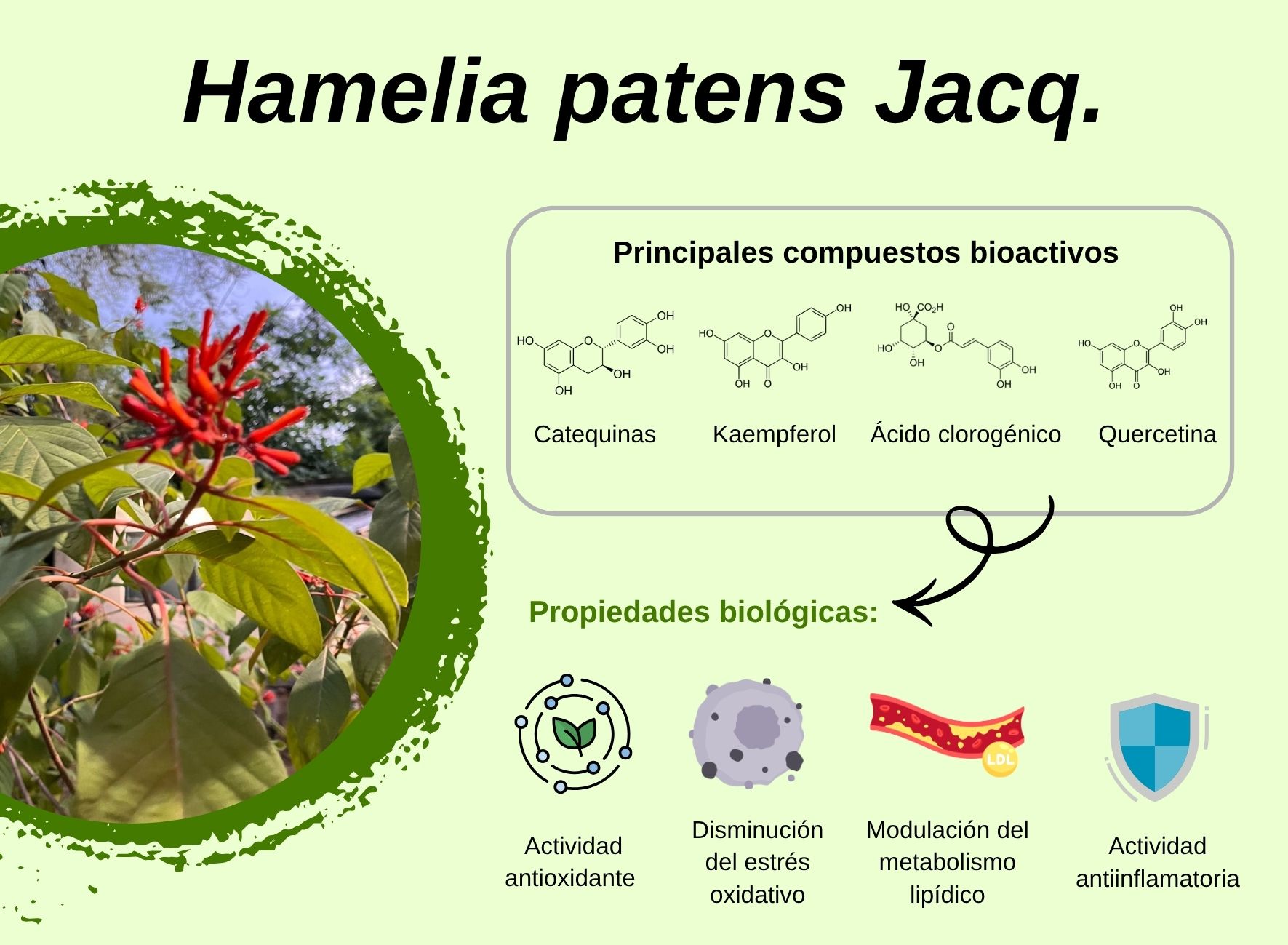
La dislipidemia aterogénica se distingue por la presencia de hipertrigliceridemia, acumulación plasmática de partículas LDL pequeñas y densas (sdLDL), así como el aumento de citocinas proinflamatorias como la IL-6. Estas alteraciones favorecen la penetración y oxidación de las sdLDL en la pared arterial, promoviendo la acumulación de estas partículas en el espacio subendotelial, lo que conduce a la formación de células espumosas y al desarrollo de la placa ateroesclerótica. Este proceso representa uno de los principales mecanismos involucrados en el desarrollo de enfermedades cardiovasculares (ECV). Debido a los efectos adversos que algunas personas pueden presentar en las terapias farmacológicas con estatinas y fibratos, se ha investigado el potencial de los compuestos bioactivos de origen vegetal como estrategia preventiva. H. patens es una planta con un potencial prometedor gracias a la presencia de compuestos bioactivos de tipo fenólico. Esta revisión analiza el potencial de los compuestos bioactivos de H. patens como una alternativa terapéutica en la prevención de la dislipidemia, revisando su composición química, efectos biológicos y mecanismos de acción propuestos mediante la revisión de evidencia científica actual. Las investigaciones han reportado que estos compuestos pueden regular el metabolismo lipídico mediante la modulación del estrés oxidativo y la respuesta inflamatoria, condiciones que favorecen la progresión de la dislipidemia. Estos efectos se asocian con la modulación de la actividad del factor de transcripción NF-kB y el Nfr2, junto con el aumento o disminución de enzimas que participan en la lipogénesis hepática como la HMG-CoA reductasa, carnitina palmitil transferasa y la sintasa de ácidos grasos. Concluyendo que H. patens es una fuente prometedora de compuestos bioactivos con potencial preventivo para la dislipidemia, sin embargo, se requieren de más investigaciones que respalden efectividad.
Referencias
Bays, H. E., Kirkpatrick, C. F., Maki, K. C., Toth, P. P., Morgan, R. T., Tondt, J., Christensen, S. M., Dixon, D. L., & Jacobson, T. A. (2024). Obesity, dyslipidemia, and cardiovascular disease: A joint expert review from the Obesity Medicine Association and the National Lipid Association 2024. Journal of Clinical Lipidology, 18(3), e320–e350. https://doi.org/10.1016/J.JACL.2024.04.001
Bereda, G. (2022). Pathophysiology and Management of Dyslipidaemia. Biomedical Journal of Scientific y Technical Research, 43(2), 34369.
Blagov, A., Sobenin, I., Sukhorukov, V., Glanz, V., Pleshko, E., & Orekhov, A. (2024). Development of Dyslipidemia in Atherosclerosis and Modern Approaches to its Treatment. The Heart Surgery Forum, 27(6), E680–E688. https://doi.org/10.59958/hsf.7341
Boarescu, P.-M., Boarescu, I., Pop, R. M., Roşian, Ş. H., Bocșan, I. C., Rus, V., Mada, R. O., Popa, I. D., Neagu, N., Bulboacă, A. E., Buzoianu, A. D., & Bolboacă, S. D. (2022). Evaluation of Oxidative Stress Biomarkers, Pro-Inflammatory Cytokines, and Histological Changes in Experimental Hypertension, Dyslipidemia, and Type 1 Diabetes Mellitus. International Journal of Molecular Sciences, 23(3), 1438. https://doi.org/10.3390/ijms23031438
Bowman, T. K., Oweidat, A., Chehade, N. E. H., Cheriyan, M., Ayad, S., & Hoyt, M. (2024). Neuraxial labor analgesia in a parturient with carnitine palmitoyl transferase type II deficiency: a case report. International Journal of Obstetric Anesthesia, 60, 104246. https://doi.org/10.1016/J.IJOA.2024.104246
Cho, Y., & Lee, S. Y. (2022). Useful Biomarkers of Metabolic Syndrome. International Journal of Environmental Research and Public Health, 19(22), 15003. https://doi.org/10.3390/IJERPH192215003
Choi, W., Li, C., Chen, Y., Wang, Y. Q., & Cheng, Y. (2025). Structural dynamics of human fatty acid synthase in the condensing cycle. Nature, 641, 529–536. https://doi.org/10.1038/S41586-025-08782-W
El-Sawi, S., Motawae, H., Kawy, M., Fekry, M., Youssef, H., Farghaly, A., & Maamoun, M. (2021). Novel anticancer drug delivery system based on zeolite encapsulating Hamelia patens leaf and flower extracts. Indian Journal of Natural Products and Resources, 12(2), 181–194.
Fahed, G., Aoun, L., Zerdan, M. B., Allam, S., Zerdan, M. B., Bouferraa, Y., & Assi, H. I. (2022). Metabolic Syndrome: Updates on Pathophysiology and Management in 2021. International Journal of Molecular Sciences, 23(2), 786. https://doi.org/10.3390/IJMS23020786
Feldman, F., Koudoufio, M., Desjardins, Y., Spahis, S., Delvin, E., & Levy, E. (2021). Efficacy of Polyphenols in the Management of Dyslipidemia: A Focus on Clinical Studies. Nutrient, 13(2), 672. https://doi.org/10.3390/NU13020672
Forman, H. J., & Zhang, H. (2021). Targeting oxidative stress in disease: promise and limitations of antioxidant therapy. Nature Reviews. Drug Discovery, 20(9), 709. https://doi.org/10.1038/S41573-021-00233-1
Gasmi, A., Mujawdiya, P. K., Noor, S., Lysiuk, R., Darmohray, R., Piscopo, S., Lenchyk, L., Antonyak, H., Dehtiarova, K., Shanaida, M., Polishchuk, A., Shanaida, V., Peana, M., & Bjørklund, G. (2022). Polyphenols in Metabolic Diseases. Molecules, 27(19), 6280. https://doi.org/10.3390/MOLECULES27196280
Gutiérrez-Sánchez, M. del C., Aguilar-Zárate, P., Michel-Michel, M. R., Ascacio-Valdés, J. A., & Reyes-Munguía, A. (2022). The Ultrasound-Assisted Extraction of Polyphenols from Mexican Firecracker (Hamelia patens Jacq.): Evaluation of Bioactivities and Identification of Phytochemicals by HPLC-ESI-MS. Molecules, 27(24), 8845. https://doi.org/10.3390/molecules27248845
Halli-Demeter, S., & Braun, L. T. (2022). Dyslipidemia. In Lifestyle Nursing (1st ed., pp. 253–267). CRC Press. https://doi.org/10.1201/9781003178330-21
Hu, Y., Chen, X., Hu, M., Zhang, D., Yuan, S., Li, P., & Feng, L. (2022). Medicinal and edible plants in the treatment of dyslipidemia: advances and prospects. Chinese Medicine, 17(113), 1–28. https://doi.org/10.1186/S13020-022-00666-9
Hussain, A., Cho, J. S., Kim, J. S., & Lee, Y. I. (2021). Protective Effects of Polyphenol Enriched Complex Plants Extract on Metabolic Dysfunctions Associated with Obesity and Related Nonalcoholic Fatty Liver Diseases in High Fat Diet-Induced C57BL/6 Mice. Molecules 2, 26(2), 302. https://doi.org/10.3390/MOLECULES26020302
Jacobsen, A. P., Whelton, S. P., Blumenthal, R. S., & Mcevoy, J. W. (2023). Dyslipidemia. In Hypertension (pp. 476–488). Elsevier. https://doi.org/10.1016/B978-0-323-88369-6.00042-6
Kaushik, C., & Singh, M. (2020). An updated phytopharmacological review on Hamelia patens Jacq. International Journal of Pharmacognosy, 7(3), 52–61. https://doi.org/10.13040/IJPSR.0975-8232
Khatana, C., Saini, N. K., Chakrabarti, S., Saini, V., Sharma, A., Saini, R. V., & Saini, A. K. (2020). Mechanistic Insights into the Oxidized Low-Density Lipoprotein-Induced Atherosclerosis. Oxidative Medicine and Cellular Longevity, 2020(1), 5245308. https://doi.org/10.1155/2020/5245308
Kuipers, E. N., van Dam, A. D., Held, N. M., Mol, I. M., Houtkooper, R. H., Rensen, P. C. N., & Boon, M. R. (2018). Quercetin Lowers Plasma Triglycerides Accompanied by White Adipose Tissue Browning in Diet-Induced Obese Mice. International Journal of Molecular Sciences, 19(6), 1786. https://doi.org/10.3390/IJMS19061786
Li, W., Jin, K., Luo, J., Xu, W., Wu, Y., Zhou, J., Wang, Y., Xu, R., Jiao, L., Wang, T., & Yang, G. (2022). NF-κB and its crosstalk with endoplasmic reticulum stress in atherosclerosis. Frontiers in Cardiovascular Medicine, 9, 988266. https://doi.org/10.3389/FCVM.2022.988266
Lin, C.-H., Wu, J.-B., Jian, J.-Y., & Shih, C.-C. (2017). (−)-Epicatechin-3-O-β-D-allopyranoside from Davallia formosana prevents diabetes and dyslipidemia in streptozotocin-induced diabetic mice. PLOS One, 12(3), e0173984. https://doi.org/10.1371/JOURNAL.PONE.0173984
Llauradó-Maury, G., Méndez-Rodríguez, D., Hendrix, S., Escalona-Arranz, J. C., Fung-Boix, Y., Pacheco, A. O., García-Díaz, J., Morris-Quevedo, H. J., Ferrer-Dubois, A., Isaac-Aleman, E., Beenaerts, N., Méndez-Santos, I. E., Orberá-Ratón, T., Cos, P., & Cuypers, A. (2020). Antioxidants in Plants: A Valorization Potential Emphasizing the Need for the Conservation of Plant Biodiversity in Cuba. Antioxidants, 9(11), 1048. https://doi.org/10.3390/ANTIOX9111048
López-Román, L., León-Lopez, A., & Olmedo-Angel, C. (2025). Tres hojitas (Hamelia Patens Jaq), más allá de la tradición. Pardalis, 1, e0022. https://pardalis.uan.edu.mx/index.php/PARDALIS/article/view/22/15
Lorenzatti, A., & Toth, P. (2020). New perspectives on atherogenic dyslipidaemia and cardiovascular disease. European Cardiology Review, 15(e04). https://doi.org/10.15420/ECR.2019.06
Lu, Z., Liu, L., Zhao, S., Zhao, J., Li, S., & Li, M. (2023). Apigenin attenuates atherosclerosis and non-alcoholic fatty liver disease through inhibition of NLRP3 inflammasome in mice. Scientific Reports, 13, 7996. https://doi.org/10.1038/s41598-023-34654-2
Noor, G., Ahmad, Md. A., Ahsan, F., Mahmood, T., Arif, M., & Khushtar, M. (2020b). A Phytochemical and Ethnopharmacological Recapitulation on Hamelia patens. Drug Research, 70(05), 188–198. https://doi.org/10.1055/a-1131-7856
NR, L. R., Nair, A. R., Senthilpandian, S., & Ravi, V. (2021). Hypolipidemic action of Rutin on Triton WR-1339 induced hyperlipidemia in rats. Journal of Pre-Clinical and Clinical Research, 15(2), 51–55. https://doi.org/10.26444/JPCCR/136231
Nyandwi, J. B., Ko, Y. S., Jin, H., Yun, S. P., Park, S. W., & Kim, H. J. (2021). Rosmarinic acid exhibits a lipid-lowering effect by modulating the expression of reverse cholesterol transporters and lipid metabolism in high-fat diet-fed mice. Biomolecules, 11(10), 1470. https://doi.org/10.3390/BIOM11101470
Pepe, G., Sommella, E., Cianciarulo, D., Ostacolo, C., Manfra, M., Di Sarno, V., Musella, S., Russo, M., Messore, A., Parrino, B., Bertamino, A., Autore, G., Marzocco, S., & Campiglia, P. (2018). Polyphenolic Extract from Tarocco (Citrus sinensis L. Osbeck) Clone “Lempso” Exerts Anti-Inflammatory and Antioxidant Effects via NF-kB and Nrf-2 Activation in Murine Macrophages. Nutrients, 10(12), 1961. https://doi.org/10.3390/NU10121961
Purva, A., Gaur, K., & Khan, Mohd. S. (2020). A Review on Dyslipidemia: Types, Risk Factors and Management. Asian Journal of Pharmaceutical Research and Development, 8(2), 96–98. https://doi.org/10.22270/ajprd.v8i2.682
Rojas-Martínez, R., Aguilar-Salinas, C. A., Romero-Martínez, M., Castro-Porras, L., Gómez-Velasco, D., & Mehta, R. (2021). Trends in the prevalence of metabolic syndrome and its components in Mexican adults, 2006-2018. Salud Pública de México, 63(6), 713–724. https://doi.org/10.21149/12835
Scavuzzi, B. M., & Dichi, I. (2025). Effects of a Diet Rich in Polyphenols on Lipid Metabolism: An Updated Narrative Review. Heart and Mind, 9(3), 264–276. https://doi.org/10.4103/hm.HM-D-24-00106
Thongtang, N., Sukmawan, R., Llanes, E. J. B., & Lee, Z.-V. (2022). Dyslipidemia management for primary prevention of cardiovascular events: Best in-clinic practices. Preventive Medicine Reports, 27, 101819. https://doi.org/10.1016/J.PMEDR.2022.101819
Umar, U., Ahmed, S., Iftikhar, A., Iftikhar, M., Majeed, W., Liaqat, A., Shahzad, S., Abbas, M., Mehmood, T., & Anwar, F. (2023). Phenolics Extracted from Jasminum sambac Mitigates Diabetic Cardiomyopathy by Modulating Oxidative Stress, Apoptotic Mediators and the Nfr-2/HO-1 Pathway in Alloxan-Induced Diabetic Rats. Molecules, 28(14), 5453. https://doi.org/10.3390/MOLECULES28145453
Valle-Ortiz, D. J., Aguila-Muñoz, D. G., Cruz-López, M. del C., Cortés-Espinosa, D. V., Rosales-Castro, M., & Jiménez-Montejo, F. E. (2025). Comparison of Secondary Metabolite Extraction Methods in Hamelia patens Jacq. and Their Inhibitory Effect on Fusarium oxysporum f. sp. radicis-lycopersici. Metabolites, 15(1), 23. https://doi.org/10.3390/METABO15010023
Yanai, H., & Yoshida, H. (2021). Secondary dyslipidemia: its treatments and association with atherosclerosis. Global Health & Medicine, 3(1), 15–23. https://doi.org/10.35772/ghm.2020.01078
Ye, X., Li, J., Gao, Z., Wang, D., Wang, H., & Wu, J. (2022). Chlorogenic Acid Inhibits Lipid Deposition by Regulating the Enterohepatic FXR-FGF15 Pathway. BioMed Research International, 2022(1), 4919153. https://doi.org/10.1155/2022/4919153
Zhang, J., Yuan, Y., Gao, X., Li, H., Yuan, F., Wu, D., Cui, Q., Piao, G., & Yuan, H. (2025). Scopoletin ameliorates hyperlipidemia and hepatic steatosis via AMPK, Nrf2/HO-1 and NF-κB signaling pathways. Biochemical Pharmacology, 231, 116639. https://doi.org/10.1016/J.BCP.2024.116639