Obtención y evaluación de tinte natural para cabello con base en ruezno de nogal Juglans sp.
Palabras clave:
Aloe vera, Euphorbia antisyphilitica, Fisher-saller, mordientes, colorante sintético.Resumen
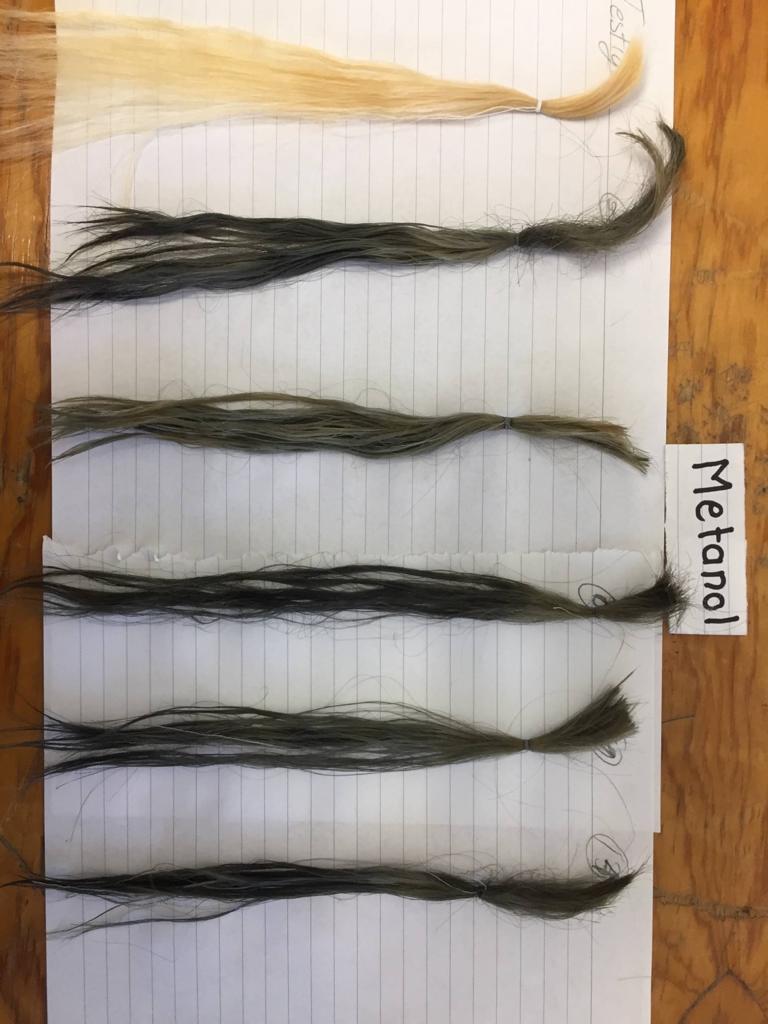
El ruezno o percarpio de nogal Juglans sp., es un desecho agrícola con fuente de compuestos orgánicos que aportan colorantes de forma natural. Estos pigmentos representan una alternativa a los productos de belleza que en su mayoría contienen alérgenos y carcinógenos. El objetivo del presente estudio fue evaluar la efectividad y pérdida de color de un colorante utilizando los extractos del pericarpio de Juglans sp. en mechones de cabello decolorado. Se obtuvieron extractos de pericarpio secos y molidos (10% p/v) a base de agua, etanol y metanol y se evaluaron en mechones de cabello decolorados con peróxido de hidrógeno. El cambio de color se evaluó utilizando la escala de Fisher-Saller asignando un número en lugar de una letra a cada mechón de cabello tratado. Los resultados de la escala modificada se evaluaron mediante análisis de varianza y se registró la pérdida de color lavando cada mechón 30 veces. Como resultados, no se encontró una pérdida de color significativa después de 30 lavados con detergente; tanto el extracto etanólico como el metanólico desarrollaron colores oscuros (U-Y en la escala de Fisher-Saller, 21-25), mientras que los extractos acuosos desarrollaron colores cenizoa (M-O en la escala de Fisher-Saller, 13-15). No existe ningún tinte para el cabello comercial a base de cáscara verde en el mercado. Esta investigación muestra una formulación semipermanente como una opción ecológica a los tintes sintéticos.
Referencias
[1] Huncharek, M.; Kupelnick, B. Personal use of hair dyes and the risk of bladder cancer: results of a meta-analysis. Public Health Rep. 2005, 120, 31–38. DOI: 10.1177/003335490512000107.
[2] AlGhamdi, K. M.; Moussa, N. A. Knowledge and practices of, and attitudes towards, the use of hair dyes among females visiting a teaching hospital in Riyadh, Saudi Arabia. Ann. Saudi Med. 2011, 31, 613–619. DOI: 10.4103/0256-4947.87099.
[3] Kim, K. H.; Kabir, E.; Jahan, S. A. The use of personal hair dye and its implications for human health. Environ. Int. 2016, 89-90, 222–227. DOI:10.1016/j.envint.2016.01.018.
[4] Zhang, Y.; Birmann, B. M.; Han, J.; Giovannucci, E.; Speizer, F. E.; Stampfer, M. J.; Rosner, B. E.; Schernhammer, E. S. Personal use of permanent hair dyes and cancer risk and mortality in US women: prospective cohort study. BMJ. 2020, 370. DOI:10.1136/bmj.m29422.
[5] Beiki, T.; Najafpour, G. D.; Hosseini, M. Evaluation of antimicrobial and dyeing properties of walnut (Juglans regia L.) green husk extract for cosmetics. Color. Technol. 2018, 134, 71–81. https://doi.org/10.1111/cote.12322
[6] Patel, D.; Narayana, S.; Krishnaswamy, B. Trends in use of hair dye: A cross-sectional study. Int. J. Trichology. 2013, 5, 140. DOI: 10.4103/0974-7753.125610.
[7] Abe, F. R.; Mendonça, J. N.; Moraes, L. A. B.; de Oliveira, G. A. R.; Gravato, C.; Soares, A. M. V.; Oliveira, D. P. Toxicological and behavioral responses as a tool to assess the effects of natural and synthetic dyes on zebrafish early life. Chemosphere. 2017, 178, 282–290. DOI:10.1016/j.chemosphere.2017.03.030.
[8] Lind, M. L.; Boman, A.; Sollenberg, J.; Johnsson, S.; Hagelthorn, G.; Meding, B. Occupational dermal exposure to permanent hair dyes among hairdressers. Ann Occup Hyg. 2005, 49, 473-480. DOI: 10.1093/annhyg/mei030.
[9] Carvalho, M.; Ferreira, P. J.; Mendes, V. S.; Silva, R.; Pereira, A.; Jerónimo, C.; Silva, B. M. Human cancer cell antiproliferative and antioxidant activities of Juglans regia L. Food Chem. Toxicol. 2010, 48, 441-447. DOI:10.1016/j.fct.2009.10.043.
[10] Mendelsohn, J. B.; Ji, Q. Z.; Li, B. T.; Shu, X. O.; Yang, G.; Li, H. L.; Zheng, W. Personal use of hair dye and cancer risk in a prospective cohort of Chinese women. Cancer Sci. 2009, 100, 1088-1091. https://doi.org/10.1111/j.1349-7006.2009.01149.x.
[11] Bolt, H. M.; Golka, K. The debate on carcinogenicity of permanent hair dyes: new insights. Crit. Rev. Toxicol. 2007, 37, 521–536. DOI: 10.1080/10408440701385671.
[12] Harling, M.; Schablon, A.; Schedlbauer, G.; Dulon, M.; Nienhaus, A. Bladder cancer among hairdressers: a meta-analysis. Occup. Environ. Med. 2010, 67, 351–358. DOI: 10.1136/oem.2009.050195.
[13] IARC. International Agency for Research on Cancer. Monographs on the Evaluation of Carcinogenic of some aromatic amines and related compounds. 2020. Retrieved from: 127. https://www.iarc.who.int/wp-content/uploads/2020/06/QA_Monographs_Volume-127.pdf (Accesed on April 5, 2022).
[14] IARC, International Agency for Research on Cancer. Overall evaluations of carcinogenicity: an updating of IARC monographs. 1987, 42, 53. (p. 53). Lyon, France: IARC.
[15] Ali, A.; Shaziya-Allarakha, M., Shamila, F.; Amaan, S.; Habib, S. Risk of Carcinogenicity Associated with Synthetic Hair Dyeing Formulations: A Biochemical View on Action Mechanisms, Genetic Variation and Prevention. Ind J Clin Biochem. 2022. 37, 399–409. https://doi.org/10.1007/s12291-022-01051-x
[16] Boonsong, P.; Laohakunjit, N.; Kerdchoechuen, O. Natural pigments from six species of Thai plants extracted by water for hair dyeing product application. J. Clean. Prod. 2012, 37, 93–106. DOI:10.1016/j.jclepro.2012.06.013.
[17] Adeel, S.; Abrar, S.; Kiran, S.; Farooq, T.; Gulzar, T.; Jamal, M. Sustainable Application of Natural Dyes in Cosmetic Industry. Handbook of Renewable Materials for Coloration and Finishing, Scrivener publishing. 2018, 189-190. DOI: 10.1002/9781119407850. ISBN:9781119407850.
[18] Diarsa, M.; Gupte, A. Optimization and Extraction of Natural Dye from Tagetes Erecta and Dyeing of Cotton and Silk Fabric Using Banana (Musa sp.) Pseudo Stem Sap. J. Nat. Fibers. 1–13. DOI:10.1080/15440478.2020.1863291.
[19] Jahanban-Esfahlan, A.; Ostadrahimi, A.; Tabibiazar, M.; Amarowicz, R. A comprehensive review on the chemical constituents and functional uses of walnut (Juglans spp.) husk. Int. J. Mol. Sci. 2019, 3920. https://doi.org/10.3390/ijms20163920.
[20] Fernández-Agulló, A., E. Pereira, M.S. Freire, P. Valentão, P.B. Andrade, J. González-Álvarez and J.A. Pereira. 2013. Influence of solvent on the antioxidant and antimicrobial properties of walnut (Juglans regia L.) green husk extracts. Ind Crops Prod. 42: 126–132. DOI:10.1016/j.indcrop.2012.05.021
[21] Sánchez-Mirón, B. W.; Roux-Gutiérrez, R. S.; Molar-Orozco, M. E. Alternative material for load-bearing wall with addition of walnut shell. Waste Reduction. In: Proceedings of the 3rd International Congress on Sustainable Construction and Eco-Efficient Solutions. 2017, 1023-1034. Universidad de Sevilla. Escuela Técnica Superior de Arquitectura.
[22] Cosmulescu, S. N.; Trandafir, I.; Achim, G.; Baciu, A. Juglone content in leaf and green husk of five walnut (Juglans regia L.) cultivars. Not. Bot. Horti Agrobot. Cluj-Napoca. 2011, 39, 237–240.
[23] Akbari, V.; Jamei, R.; Heidari, R.; Esfahlan, A. J. Antiradical activity of different parts of Walnut (Juglans regia L.) fruit as a function of genotype. Food Chem. 2012, 135, 2404–2410. DOI: 10.1016/j.foodchem.2012.07.030.
[24] Sadeghi-Kiakhani, M.; Tehrani-Bagha, A. R; Gharanjig, K.; Hashemi, E. Use of pomegranate peels and walnut green husks as the green antimicrobial agents to reduce the consumption of inorganic nanoparticles on wool yarns. J. Clean. Prod. 2019, 231, 1463–1473. DOI: 10.1016/j.jclepro.2019.05.283.
[25] Wenzel, J.; Storer-Samaniego, C.; Wang, L.; Burrows, L.; Tucker, E.; Dwarshuis, N.; Zand, A. Antioxidant potential of Juglans nigra, black walnut, husks extracted using supercritical carbon dioxide with an ethanol modifier. Food Sci. Nutr. 2017, 5, 223–232. DOI:10.1002/fsn3.385.
[26] Shaukat, A.; Munazza, M.; Muhammad, T. H. Efficacy of Some Plants Extracts for Natural Dyeing of Human Hair. J. Nat. Fibers. 2020, 1-15. DOI:10.1080/15440478.2020.1821280.
[27] Vieira, V.; Pereira, C.; Abreu, R. M.; Calhelha, R.; Alves, M. J.; Coutinho, J. A.; Ferreira, C. Hydroethanolic extract of Juglans regia L. green husks: A source of bioactive phytochemicals. Food Chem. Toxicol. 2020, 137, 111189. https://doi.org/10.1016/j.fct.2020.111189.
[28] Birngruber, C.; Verhoff, M. A. The color of human hair. In: Preedy, V. R. ed. Handbook of Hair in Health and Disease. Wageningen Academic Publishers. 2012, 30–49. DOI:10.3920/978-90-8686-728-8_2.
[29] Evayanti, L.G.; Artaria, M. D. 2019. Understanding the Characteristics of Physical Color in Human–an Article Review. Proceedings of the 1st international conference of social science. ICOSS 2018. Universitas Warmadewa, Denpasar, Bali-Indonesia. pp. 227. Doi:10.4108/eai.21-9-2018.2281158.
[30] R Core Team. R: A language and environment for statistical computing. R Foundation for Statistical Computing, Vienna, Austria. 2020, https://www.R-project.org/. (Accesed on March 25, 2022).
[31] Arifeen, W.; Rehman, F. U.; Adeel, S.; Zuber, M.; Ahmad, M. N.; Ahmad, T. Environmental friendly extraction of walnut bark-based juglone natural colorant for dyeing studies of wool fabric. Environ. Sci. Pollut. Res., 2021, 28, 49958–49966. doi:10.1007/s11356-021-14277-8
[32] van Wyk, B. E.; van Rheed, M. C.; van Oudtshoorn, G. F.; Smith, G. F. 1995. Geographical variation in the major compounds of Aloe ferox leaf exudate. Planta medica. 61, 250–3. DOI: 10.1055/s-2006-958066.
[33] Yagi, A.; Tsunoda, M.; Egusa, E.; Akasaki, A.; Tsuji, H. Immunochemical distinction of Aloe vera, A. Arborescens and A. Chinensis gel. Planta Medica, 1998, 64, 277–278. DOI: 10.1055/s-2006-957427. PMID: 9581527.
[34] Lee, K.C. Nature and occurrence of juglone in Juglans nigra L. A Master's thesis dissertation.1967, Kansas State University.
[35] Ali, S.; Maqbool, M.; Hussain, M. T. Efficacy of Some Plants Extracts for Natural Dyeing of Human Hair. J. Nat. Fibers. 2020, 1–15. DOI:10.1080/15440478.2020.1821280.
[36] Burkinshaw, S.M.; Kumar, N. The mordant dyeing of wool using tannic acid and FeSO4, Part 1: Initial findings. Dyes Pigm. 2009, 80, 53–60. doi:10.1016/j.dyepig.2008.05.008.
[37] Chairat, M.; Darumas, U.; Bremner, J. B.; Bangrak, P. Dyeing of cotton yarn with the aqueous extract of the leaves of Eupatorium odoratum L. in Thailand and associated extract toxicity studies. Color. Tech. 127(5): 346–353. DOI:10.1111/j.1478-4408.2011.00321.x.
[38] de Sanjosé S.; Benavente, Y.; Nieters, A.; Foretova, L.; Maynadié, M.; Cocco, P. L.; Stainers, A.; Vornanen, M., Boffetta, P.; Becker, N.; Alvaro, T.; Brennan, P. Association between personal use of hair dyes and lymphoid neoplasms in Europe. Am J. Epidemiol. 2006, 164, 147–55.
[39] Caraballo-Arias, Y.; Rodríguez, A. R.; Rivero, A. J.; Rangel, R. G.; Barrios-Covaro, M. Riesgos laborales en trabajadores de barberías y peluquerías de economía informal: Caracas, Venezuela. Ciencia y Trabajo, 2013, 15(46), 18–23. https://dx.doi.org/10.4067/S0718-24492013000100005
[40] Bañuelos-Revilla, J. E.; Palacio-Núñez, J.; Martínez-Montoya, J. F.; Olmos-Oropeza, G.; Flores-Cano, J. A. Distribución potencial y abundancia de candelilla (Euphorbia antisyphilitica) en el norte de Zacatecas, México. Madera y bosques, 2019, 25(1), e2511657. https://doi.org/10.21829/myb.2019.2511657