Efecto microestructural de materiales preacondicionadores en hierro gris y su impacto en la resistencia a la corrosión
Palabras clave:
Resistencia a la corrosión, Microestructura perlítica, Hierro gris, Materiales preacondicionadores.Resumen
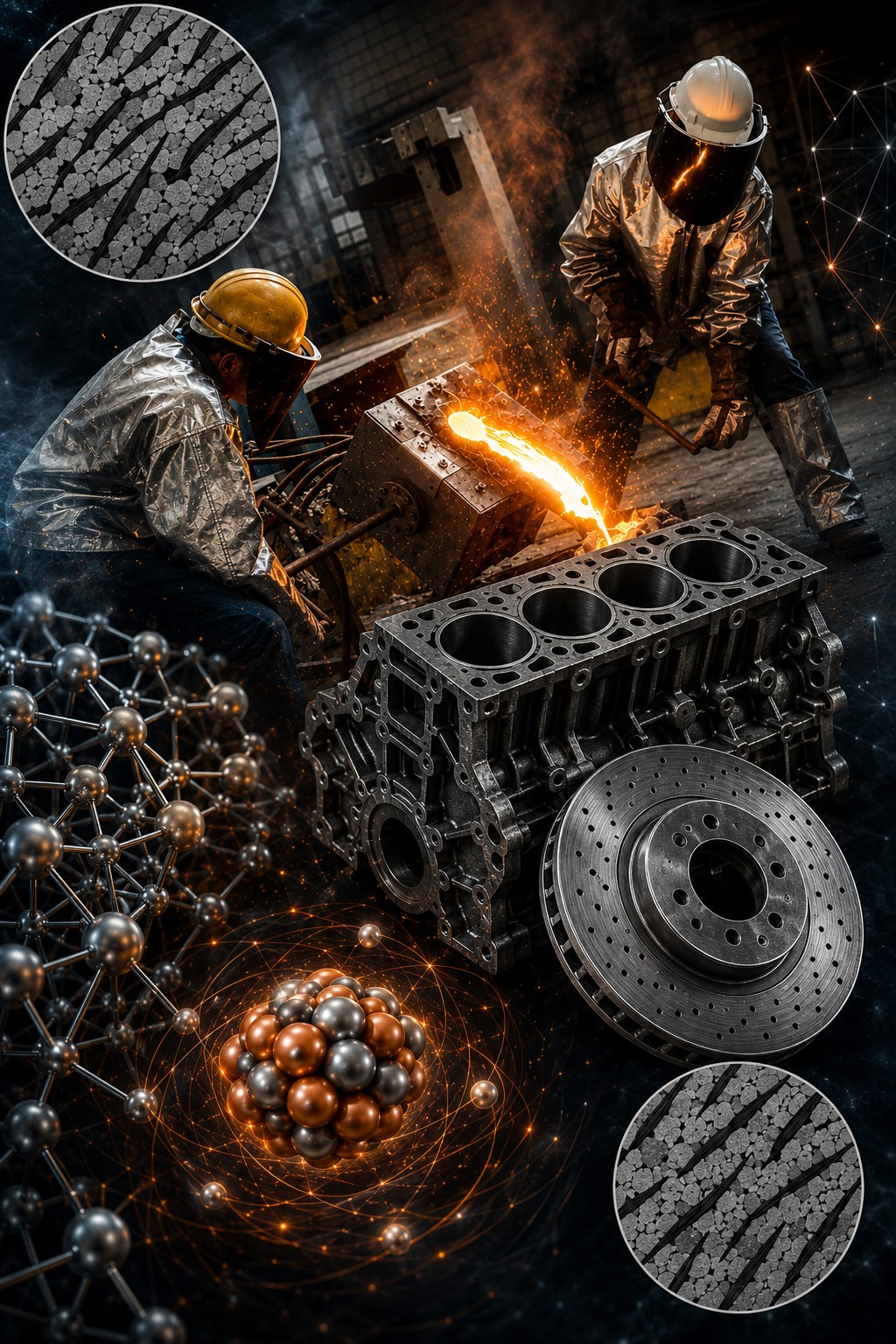
La corrosión de los discos de freno de hierro gris en ambientes agresivos representa un desafío creciente para la industria automotriz, particularmente en los vehículos híbridos y eléctricos, donde la menor frecuencia de frenado favorece los procesos de degradación por corrosión. Este fenómeno no solo afecta el desempeño y la vida útil de los componentes, sino que también contribuye a la emisión de material particulado con potencial impacto sobre la salud humana y el medio ambiente. El presente estudio evaluó la influencia de tres materiales preacondicionadores (grafito metalúrgico, grafito de electrodo y coque metalúrgico) sobre la microestructura y la resistencia a la corrosión del hierro gris. Se realizaron tres coladas independientes bajo condiciones idénticas de fusión a 1450 °C, empleando cada material preacondicionador por separado. De cada colada se obtuvieron tres probetas para la caracterización microestructural y electroquímica. La cuantificación microestructural se realizó mediante análisis de imágenes utilizando diez mediciones por condición experimental para determinar la fracción de perlita fina, la densidad de inclusiones de MnS y el espaciamiento interlaminar de la perlita. La resistencia a la corrosión se evaluó mediante ensayos de polarización potenciodinámica en una solución de NaCl al 3.5% en peso, utilizando una velocidad de barrido de 0.1667 mV/s y un intervalo de potencial de ±0.5 V respecto al potencial de corrosión. Se realizaron cinco mediciones por probeta y los resultados reportados corresponden al valor promedio. Las diferencias entre las condiciones experimentales se evaluaron mediante un análisis de varianza de una vía (ANOVA), encontrándose diferencias estadísticamente significativas (p < 0.05).
El hierro gris preacondicionado con coque metalúrgico presentó la mayor densidad de inclusiones de MnS (226 ± 5 MnS/mm²), la mayor fracción de perlita fina (55.35 ± 0.84%) y el menor espaciamiento interlaminar de la perlita (170 ± 3.50 nm). En correspondencia, esta aleación exhibió la menor densidad de corriente de corrosión y la menor velocidad de corrosión (0.016 ± 0.002 mm/año), lo que representa una reducción aproximada del 65% con respecto a la aleación preacondicionada con grafito de electrodo. Los resultados indican que la mejora en la resistencia a la corrosión está asociada con la influencia combinada del material preacondicionador seleccionado y de las condiciones metalúrgicas resultantes, incluidas las diferencias en el contenido de azufre, la relación Mn/S, el equivalente de carbono, la densidad de inclusiones de MnS y el refinamiento de la perlita. Estos hallazgos demuestran que una adecuada selección del material preacondicionador puede modificar el comportamiento de solidificación y la evolución microestructural del hierro gris, mejorando su desempeño frente a la corrosión en ambientes agresivos.
Referencias
1. ACEA (2025) Economic and Market Report Global and EU auto industry: Full year 2024. Acea.
2. de Souza, A., de Oliveira-Júnior, J.F., Cardoso, K.R.A. and Gautam, S. (2025) Impact of vehicular emissions on ozone levels: A comprehensive study of nitric oxide and ozone interactions in urban areas. Geosystems and Geoenvironment, 4, 100348. https://doi.org/10.1016/j.geogeo.2024.100348
3. Al-Sabbagh, T.A. and Shreaz, S. (2025) Impact of Lead Pollution from Vehicular Traffic on Highway-Side Grazing Areas: Challenges and Mitigation Policies. Int. J. Environ. Res. Public Health, 22, 1–30. https://doi.org/10.3390/ijerph22020311 http://www.ncbi.nlm.nih.gov/pubmed/40003536
4. Selvi, M.S. and Önem, Ş. (2025) Impact of Variables in the UTAUT 2 Model on the Intention to Use a Fully Electric Car. Sustainability (Switzerland), 17, 1–24. https://doi.org/10.3390/su17073214
5. Alvarez-Diazcomas, A., Estévez-Bén, A.A., Rodríguez-Reséndiz,J., Carrillo-Serrano,R. V. and Álvarez-Alvarado,J.M. (2023) A High-Efficiency Capacitor-Based Battery Equalizer for Electric Vehicles. Sensors, 23, 1–16. https://doi.org/10.3390/s23115009 http://www.ncbi.nlm.nih.gov/pubmed/37299739
6. Szumska, E.M. (2025) Regenerative Braking Systems in Electric Vehicles: A Comprehensive Review of Design, Control Strategies, and Efficiency Challenges. Energies (Basel)., 18. https://doi.org/10.3390/en18102422
7. Jamadar, N.M. and Jadhav, H.T. (2021) Rule-based assistive hybrid electric brake system with energy generation for electric vehicle. Energy Sources, Part A: Recovery, Utilization and Environmental Effects, 43, 1–19. https://doi.org/10.1080/15567036.2021.2015485
8. Gweon, J., Shin, S., Jang, H., Lee, W., Kim, D. and Lee, K. (2018) The Factors Governing Corrosion Stiction of Brake Friction Materials to a Gray Cast Iron Disc. SAE Technical Papers, 2018-Octob, 5–12. https://doi.org/10.4271/2018-01-1899
9. Gweon, J., Park, J., Kyu, W., Yeon, D. and Jang, H. (2021) Root cause study of corrosion stiction by brake pads on the grey iron disc. Eng. Fail. Anal., 128, 1–13. https://doi.org/10.1016/j.engfailanal.2021.105583
10. Motta, M., Fedrizzi, L. and Andreatta, F. (2023) Corrosion Stiction in Automotive Braking Systems. Materials, 16. https://doi.org/10.3390/ma16103710
11. Mao, F., He, Y., Guo, A., Wang, X., Zhong, Y., Huang, Z., Chen, C. and Wei, S. (2025) Effect of vanadium and temperature on the tribological properties of gray cast iron. Journal of Materials Research and Technology, 38, 3578–3590. https://doi.org/10.1016/j.jmrt.2025.08.211
12. Kumar, A., Pandey, R., Kumar, R., Kumar, N. and Kiran, T.R. (2021) Materials Today: Proceedings Thermal analysis on car brake rotor using cast iron material with different geometries. Mater. Today Proc., 10.1016/j.matpr.2021.05.299. https://doi.org/10.1016/j.matpr.2021.05.299
13. Liu, Y., Lee, H., Hess, D. and Coryell, J. (2025) Thermomechanical Fatigue Behavior of Gray Cast Iron in Brake Rotors. In SAE Technical Papers. https://doi.org/10.4271/2025-01-8319
14. Wang, Y., Shuai, S. and Ge, Y. (2025) Controlling brake particle emissions: New brake disc needs more attention. Results in Engineering, 27, 107120. https://doi.org/10.1016/j.rineng.2025.107120
15. Catapano, F., Iorio, S. Di, Magno, A., Sequino, L. and Vaglieco, B.M. (2025) Brake particle emissions: Effect of temperature and modeling of temperature behavior. Results in Engineering, 26, 104872. https://doi.org/10.1016/j.rineng.2025.104872
16. Gonet, T. and Maher, B.A. (2019) Airborne, Vehicle-Derived Fe-Bearing Nanoparticles in the Urban Environment: A Review. Environ. Sci. Technol., 53, 9970–9991. https://doi.org/10.1021/acs.est.9b01505 http://www.ncbi.nlm.nih.gov/pubmed/31381310
17. Bruna, H., Allende-Seco, R., Artigas, A., Monsalve, A. and Sánchez, C. (2024) Effect of Copper and Nickel Content on the Corrosion Mechanisms in Ferritic Matrix Gray Cast Irons under Simulated Marine Environments. Metals (Basel)., 14. https://doi.org/10.3390/met14060696
18. Seikh, A.H., Sarkar, A., Singh, J.K., Mohammed, S.M.A.K., Alharthi, N. and Ghosh, M. (2019) Corrosion characteristics of copper-added austempered gray cast iron (AGCI). Materials, 12, 1–17. https://doi.org/10.3390/ma12030503
19. Godwin, I., Sunday, O., Fayomi, I. and Nwankwo, P. (2023) Investigation of the microstructure, corrosion resistance and hardness of bone particle reinforced cast iron for engine blocks application in automotive and marine industries. 2.
20. Dwulat, R., Janerka, K., Grzesiak, K. and Gałuszka, M. (2023) Influence of Charge Materials on the Metallurgical Quality of Gray Cast Iron. Archives of Foundry Engineering, 23, 66–71. https://doi.org/10.24425/afe.2023.144297
21. Futas, P., Pribulova, A., Petrik, J., Blasko, P., Junakova, A. and Sabik, V. (2023) Metallurgical Quality of Cast Iron Made from Steel Scrap and Possibilities of Its Improvement. Metals (Basel)., 13, 1–10. https://doi.org/10.3390/met13010027
22. Scherbring, S., Adams, B. and Mola, J. (2024) Impact of interlamellar spacing and non-pearlitic features on mechanical properties and cyclic damage initiation in near-eutectoid pearlitic steels. Materials Science and Engineering: A, 889. https://doi.org/10.1016/j.msea.2023.145846
23. Genculu, S. (2024) Cast Irons -Properties and Applications. CAB worldwide.
24. Srivastava, R., Singh, B. and Saxena, K.K. (2019) Influence of S and Mn on mechanical properties and microstructure of grey cast iron: An overview. Mater. Today Proc., 26, 2770–2775. https://doi.org/10.1016/j.matpr.2020.02.577
25. De Santiago-Méndez, L.F., Castro-Román, M. de J., Herrera-Trejo, M., Mancha-Molinar, H. and Bravo, B. (2025) Influence of S and Mn Initial Concentrations on the Graphite Branching in Gray Cast Iron as Quantified by 2D Image Analysis. Materials, 18. https://doi.org/10.3390/ma18214837
26. Stefan, E., Chisamera, M., Riposan, I. and Stan, S. (2021) Graphite nucleation sites in commercial gray cast irons. Materials Today: Proceedings, 45, 4091-4095. https://doi.org/10.1016/j.matpr.2020.11.009
27. Lima, M.L., Albertin, E., Correa, E.R., Rabello, R.B. and Uehara, S. (2020) Pearlite Refining Strategies for Hypoeutectic Gray Cast Iron. International Journal of Metalcasting, 14, 766–773. https://doi.org/10.1007/s40962-020-00413-6
28. Roučka, J., Prochazka, J., Kana, V., Krutis, V. and Nedelova, K. (2019) The influence of lamellar graphite cast iron annealing on hardness and structure. Archives of Foundry Engineering, 19, 105–112. https://doi.org/10.24425/afe.2019.129639
29. Stefanescu, D.M., Alonso, G., Larrañaga, P. and Suarez, R. (2016) On the stable eutectic solidification of iron-carbon-silicon alloys. Acta Mater., 103, 103–114. https://doi.org/10.1016/j.actamat.2015.09.043
30. Alloys, I. (2020) Recent Developments in Understanding Nucleation and Crystallization of Spheroidal Graphite in.
31. Eiken, J. (2020) Calphad-based phase-field study of the interplay between spheroidal graphite growth and chemical segregation in ductile cast iron Calphad-based phase-field study of the interplay between spheroidal graphite growth and chemical segregation in ductile cast. Materials Science and Engineering, 861, 1–8. https://doi.org/10.1088/1757-899X/861/1/012055
32. Yin, R. yu (2021) Review on the study of metallurgical process engineering. International Journal of Minerals, Metallurgy and Materials, 28. https://doi.org/10.1007/s12613-020-2220-z
33. Ştefănescu, D.M., Alonso, G., Larrañaga, P., De La Fuente, E. and Suarez, R. (2018) Reassessment of crystal growth theory of graphite in cast iron. Materials Science Forum, 925 MSF, 36–44. https://doi.org/10.4028/www.scientific.net/MSF.925.36
34. Dwulat, R. and Janerka, K. (2023) Evaluation of the Metallurgical Quality of Nodular Cast Iron in the Production Conditions of a Foundry. Journal of Manufacturing and Materials Processing, 7. https://doi.org/10.3390/jmmp7010018
35. Wang, Z., Zhang, X., Yu, H., Liu, J., Cheng, L., Hu, S.E. and Wu, K. (2022) Effects of pearlite on corrosion initiation and propagation in weathering steels in marine environments. J. Mater. Sci., 57, 6039–6055. https://doi.org/10.1007/s10853-022-07001-5
36. Siswanto, A., Widodo, R. and Ardiansyah, E. (2020) Effect of interlamellar spacing on tensile strength gray cast iron with copper variations. J. Phys. Conf. Ser., 1450. https://doi.org/10.1088/1742-6596/1450/1/012127
37. Zhang, Y., Feng, X., Huang, Q., Li, Y., Hao, X. and Wang, C. (2023) The corrosion characteristics and mechanism of directionally solidified Mg-3Zn-xCa alloys. Journal of Magnesium and Alloys, 11, 3673–3687. https://doi.org/10.1016/j.jma.2022.02.010